Trade
Trade

Arbikie The Signature is here. Or, to give the whisky its full title (at least on this site), Arbikie Single Malt Whisky – The Signature (First Release).
We’ve had plenty of Scotch whisky category-shaking rye from Arbikie, but this is its first single malt. And Arbikie 10 Year Old The Signature boasts the lot.
Provenance. Terroir. Heritage. We are playing whisky nerd bingo and Arbikie is one numbered ball away from a full house. Naturally, that creates expectations. So does the £250 RRP (although we have it for £246.95, see below).
From field to bottle
The Stirling family has farmed for centuries, initially on Scotland’s west coast and, since the early 20th century, at Lunan Bay in Angus. The 2,000-acre Arbikie Highland Estate has now been home to four generations of the family.
Brothers John, Iain and David Stirling grew up working on the farm before pursuing careers elsewhere. All three eventually returned to establish Arbikie Distillery, converting part of the estate from dairy farming to distilling. It opened in 2014 with a very literal interpretation of field-to-bottle production. The principal ingredients for its spirits are grown here: water comes from the estate, distilling takes place on the farm, and spent grains return to the land as cattle feed or fertiliser
The distillery also operates a stainless steel semi-lauter mash tun with a 0.75-tonne charge, four washbacks and a pair of copper pot stills. Its 4,000-litre wash still feeds a 2,400-litre spirit still, while a separate rectification column is used for vodka and gin production.

When Arbikie Distillery says field to bottle, it means field to bottle
The making of Arbikie The Signature
Whisky drinkers may know Arbikie best for its rye whisky. The distillery helped revive a style absent from Scottish whisky for roughly two centuries, producing both peated and unpeated rye releases from grain grown on the estate. They are very good. Do try them.
The Signature, however, is single malt. Which all begins with barley, specifically Odyssey barley sown in the estate’s MB01 Blue Bear field back in 2015. Arbikie says the crop ripened slowly through the cool, damp conditions of the Angus coast, contributing greater depth of character.
That is an interesting way to discuss barley. I’ve noticed Tequila and mezcal producers frame their products as maturing for years in the field, rather than in a cask, as agave takes years to reach maturity (unless you’re being cheap/slack). Whisky rarely talks about the material conditions of its grain, and tends to treat grain as a commodity once its variety and yield have been recorded. It’s a revelation to even know the variety half the time, never mind getting this much detail.
Of course, barley does not acquire age and prestige in the same way as agave. Still, its variety, growing conditions and nitrogen levels can influence its performance in the maltings, distillery and eventually the glass. If whisky wants to talk seriously about terroir, then these are conversations to explore.
Malting, fermentation, distillation, maturation
The Odyssey barley was harvested from a single field and sent to Glen Esk Maltings, around eight miles from the estate. This does put a small asterisk beside the claim that every stage happened on site, but it hardly turns the whisky into an international logistics operation.
Back at Arbikie, the malt underwent a 96-hour fermentation before distillation in May 2016. Four days gives yeast and bacteria more time to contribute to flavour development before the wash reaches the still.
The resulting spirit was filled into six bourbon casks at 63.6% ABV. It then spent ten years in a traditional south-facing dunnage warehouse on the estate. The whisky was bottled at 48% ABV, without chill-filtration and at its natural colour. Just 1,000 bottles make up the inaugural release.
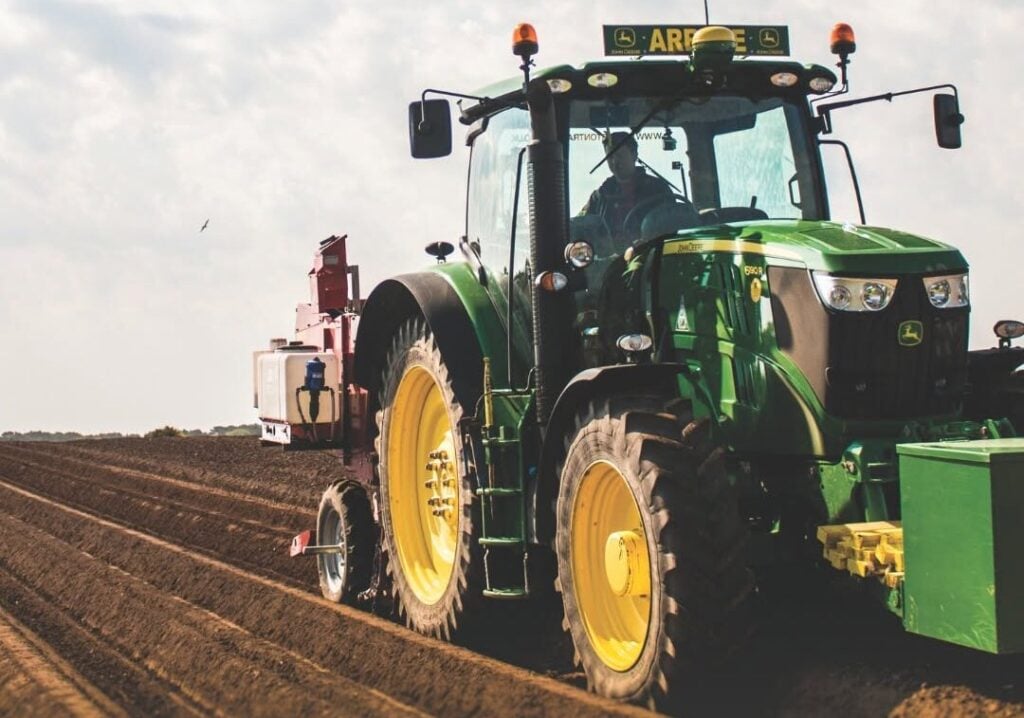
The family are farmers going back generations
Does single-estate whisky taste different?
Single estate is not a protected Scotch whisky category with its own legally prescribed definition. The team at Arbikie uses it to describe control over the agricultural and production processes, from growing grain and drawing water to distilling, maturing and bottling the whisky.
The family can identify the barley variety, field, harvest and distillation date behind this release. They do not need to buy grain from the wider commodity market. There’s a distinction between making whisky this way and scattering some locally grown barley into a mash bill and calling it a sense of place. Even if there is no legal framework (yet?) that enforces it. While the term might not be protected, it’s easily marketed. Their press releases almost write themselves.
Whether a drinker can taste one Angus field rather than another is a more difficult question. Whisky production transforms its raw materials repeatedly through malting, fermentation, distillation and maturation. Ten years in active bourbon casks leaves plenty of fingerprints of its own.
A drinker need not be able to name the field in a blind tasting for growing conditions to matter. Traceability alone may not demonstrate a flavour difference. But what Arbikie gives us is a clear account of where this whisky came from; establishing what that origin contributes to the glass is a further question.
Arbikie and sustainability
The farming model also gives Arbikie greater control over its environmental impact. Sustainability is an infrastructure issue, after all. It’s amazing how ticking one box makes the subsequent ones easier to check, isn’t it?
The distillery uses on-site renewable energy. Spent grain returns to the farm as cattle feed or fertiliser, keeping nutrients within the estate. That’s pretty typical in whisky, although most distilleries aren’t sending spent grain to their own farms. The most ambitious project is a green hydrogen system incorporating a wind turbine, electrolyser, hydrogen storage and boiler. The aim is to generate the steam required for distillation without burning fossil fuels.
The extent to which that system is now supplying the distillery’s energy needs needs confirming. Even so, Arbikie’s underlying advantage is already clear. Farming, distilling and waste management take place within the same operation. A decision in one part of the estate can support another.
Arbikie became a certified B Corp in 2025. It was also named global Sustainable Distillery of the Year at the Icons of Whisky 2026.

Arbikie The Signature Whisky is the distillery’s first single malt
The price of good policy
Arbikie calls this inaugural release a showcase of patience, provenance and precision. It also has that price tag.
With a small outturn, it will likely sell. Our first allocation sold out on Master of Malt quickly. Yet that RRP cannot be treated as a minor detail. It is an enormous amount for a 10-year-old whisky matured entirely in bourbon casks, particularly at a time when plenty of excellent Scotch is struggling to sell for considerably less.
Provenance, small batches, sustainable processes and patient maturation cost more. We do not know how much of this £250 reflects those costs and how much reflects the positioning of a scarce first release. Many of us are all too aware of the far-reaching tentacles of tension, scarcity, and greed that seem to choke every part of society and industry in the modern day. Perhaps Arbikie is just another victim of this reality, where doing things the right way costs a lot of money.
The distillery does not have a model that lends itself to mass production. There are only 1,000 bottles. And a decade-plus of waiting before selling the first single malt is hardly a friendly business model for cash flow. But explaining a price is not the same as justifying it to the person paying, and admiring the way a whisky is made does not oblige us to accept whatever price is attached to it. Wages are not maturing as blissfully as Arbikie whisky. As usual, the consumer, which is all a market like this is capable of seeing us as, foots the bill.
Arbikie The Signature review
Only a certain class of people, or those with my kind of access because of their work, will get to interact with it, and that is a shame. Tasting the whisky, it is one that deserves sharing, drinking, even if the price tag encourages collecting. Arbikie The Signature is an assured first single malt. It is bright, elegant and well structured, with enough cereal and fruit character to remain recognisably spirit-led after a decade in bourbon wood.
It does not perform a £250 magic trick; no whisky can do that. Was it worth the wait? As a first single malt, yes. Arbikie has made a whisky I would happily return to. Though admiration is easier than a purchase.
Arbikie The Signature tasting notes:
Nose: The nose is beautiful. Ripe nectarine and warm banana bread, with toffee, apricot jam, and pineapple chunks in support. It has a distinctly malty quality, perhaps almost a honeyed granola note, and a citrus sweetness like marmalade, lime and orange.
Palate: All that stone-fruit sweetness comes to the fore again, with more marmalade and dessert notes of lemon posset and vanilla custard. A gentle coastal saltiness adds definition, followed by white pepper and sweet oak.
Finish: Creamy vanilla and coconut linger alongside orange blossom, lively spice and drying malt. The finish is clean and pleasantly mineral.