Trade


At Kythe Distillery in Highland Perthshire, someone has to feed a wood fire every ten minutes to keep the wash still running. The three whisky lovers who built the place reckon it’s worth the bother.
Johnny McMillan was reserve whisky manager at Berry Bros. & Rudd. Angus MacRaild is the independent bottler behind Decadent Drinks and the man responsible for the Whisky Sponge. Completing the trio is Aaron Chan of Club Qing, the Hong Kong whisky bar.
Together, they founded Kythe, a small, independent Highland distillery with a simple mantra. Efficiency is the enemy of character. They want to recreate the lost style of 1960s whiskies.
A Highland distillery with a taste for old Scotch
MacRaild says to consider Glenmorangie’s standard bottling, the one somebody would have picked up for an evening drink in the early 1970s. Taste it alongside its modern counterpart and, for him, there is a big difference. And it starts with how the whisky sits on your tongue.
“They all have more texture. They’ve all got more fruit. They’ve all got more of this kind of mineral, waxy, oily characteristic.” When he talks about wax and oil, he’s describing a sensation as much as a flavour. You can feel the weight of the spirit in your mouth and the coating it leaves after you swallow. Reading Serge Valentin’s reviews on Whiskyfun helped him put words to something he’d already felt in the glass.
MacRaild recalls the samples he would taste working at Ardbeg at the age of 19. He says European whisky geeks would turn up at the distillery with the goods in the boots of their cars and gladly share them. “What is this? This is so different. This is incredible.” Those are the thoughts MacRaild remembers having as a teenager. Later he started pressing old bottles on McMillan, “and then I ruined whisky for him”.
McMillan can attest to this, particularly where Longmorn 1969 is concerned. His taste in Scotch whisky, he admits, exceeds his budget. Building a distillery isn’t exactly a cheap solution, but we’re nothing if not slaves to a good idea once we’ve had one, are we? Evidently their passion to see a revival of this style of whisky was compelling enough to risk it all on a pair of Perthshire farm sheds and the distillery they contain.

We spoke to Johnny McMillan and Angus MacRaild about Kythe
’Twas better back when…
Full disclosure. I’m a bona fide romantic. I love a good dose of nostalgia. I spread it heartily on my toast as if it were the apricot jam from that one holiday in Spain when I was five. But I’m not a slave to it. I’m wary of arguments that begin with how much better everything used to be. You could leave your doors open in the ’70s. Serial killers had a field day.
Not all whisky was better back then. The average standard may even be higher today. You can admire a floor maltster’s work and still understand why somebody wouldn’t want a monkey shoulder. Likewise, anyone who’s had to keep a fire going for an entire shift could make a decent case for steam. Cost, energy use and getting people home safely all deserve a hearing.
But give me certain whiskies (Bowmore, Longmorn, or Clynelish, to name a few) distilled in the 1960s and I too find textures and flavours I rarely come across today. Direct-fired stills, older barley varieties, floor malting and worm tubs were more common back then. Fermentation times could vary with the working week, too. These are production processes that create a definable difference.
Leave a wash fermenting after the yeast has done most of its work and lactic acid bacteria have time to produce acids that can go on to form fruity esters. Researchers who added one such bacterium to whisky wort measured more ethyl acetate in the resulting new make. Better still, a tasting panel could tell the spirits apart. Glenfarclas tried fitting steam coils to one of its stills. John Grant’s verdict was that it took “the body and guts” out of the spirit.
Follow the vapour out of the still and there’s another choice to make. In a worm tub it condenses inside a copper coil sitting in cold water. In a shell-and-tube condenser it meets a bundle of water-cooled tubes. That usually gives it more contact with copper, which helps remove sulphur compounds. A worm can leave a little more of that meaty character in the new make.
The ironically slow descent into “efficiency”
These once-common practices gradually fell out of favour. The spirit they produced could be terrific, but there were more efficient ways to make it. Higher yields, less waste and lower costs took precedence, particularly as whisky became bigger and bigger business. What made for the most painless reading on a balance sheet mattered more. And if a few small tweaks were made, just how much difference would we taste anyway?
You swap a worm tub for a shell-and-tube condenser. There’s a change, but one that most consumers at least tolerate. Further down the line, you knock a few hours off a ferment. A grower plants barley that delivers more fermentable sugar. A distiller buys yeast that keeps for months and gets more alcohol out of the wash. Fine margin follows fine margin until, decades later, you do taste the difference. It’s the Quality Street tin getting a little smaller and a little lighter every Christmas. It’s not a conspiracy, it’s just business.
An old bottle gives you a rare chance to taste across those decades. MacRaild has been opening a few with the team. He remembers watching their faces as they tasted the whiskies he and McMillan had spent years talking about. Their “minds were properly shattered”, he says.
Heat exchangers, insulation and the electric boiler that meets Kythe’s modest steam needs all have their place. They’re not Luddites, it’s about prioritising quality over quantity or cost.
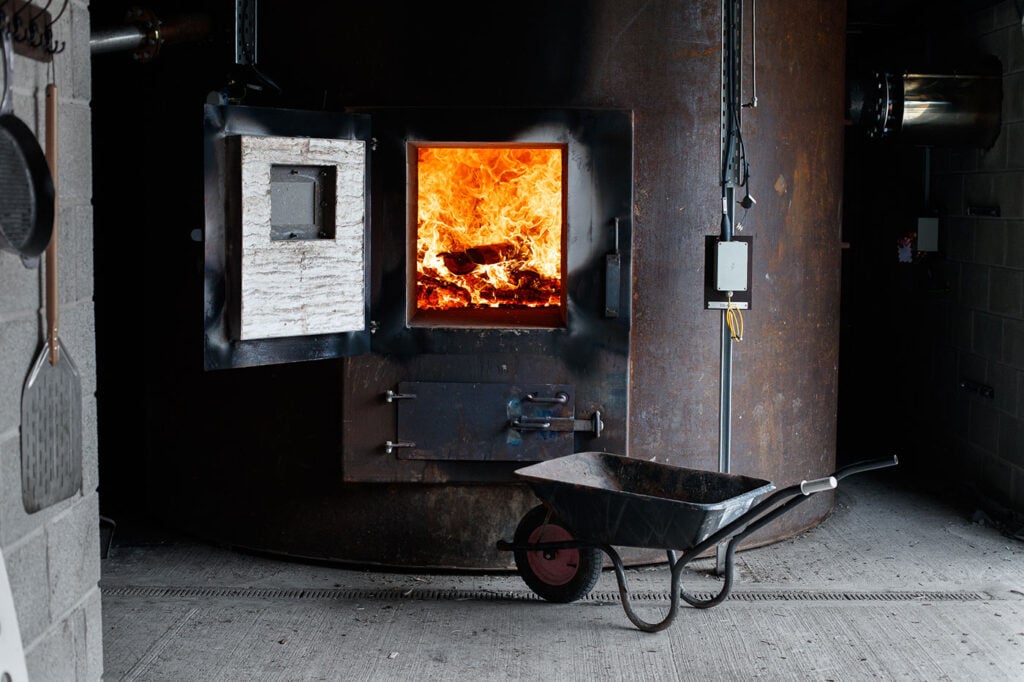
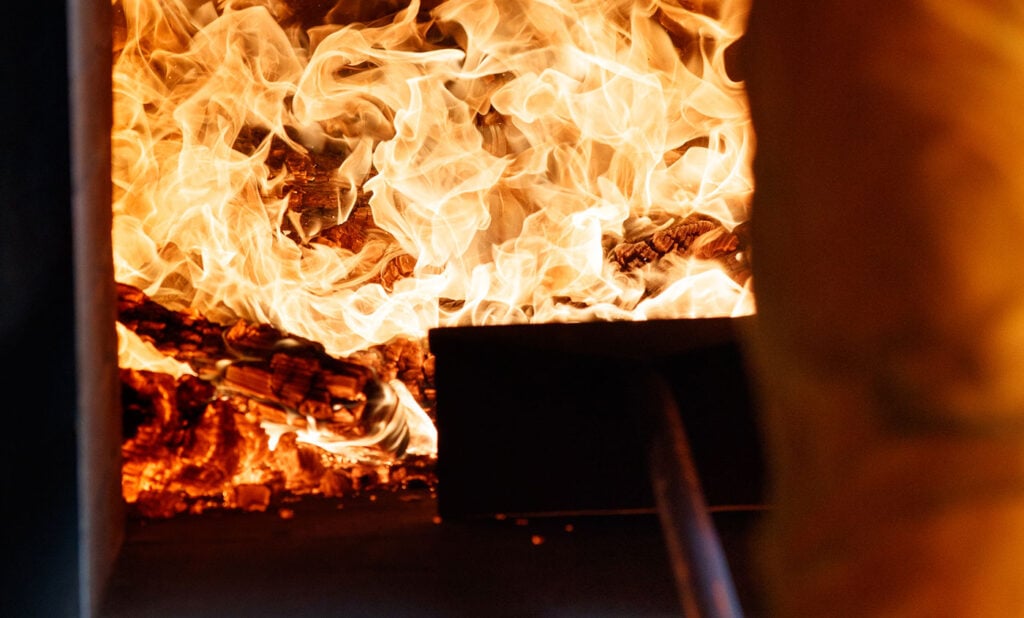
This baby needs feeding every ten minutes to run the wash still
From a car journey to a Perthshire farm
We’re probably about five minutes in when McMillan offers me a couple of shifts at Kythe. One on mashing and one on distilling. He’s also told me what time he starts on a Monday, how many flights of stairs he does and precisely who shovels out the mash tun. I do appreciate an invitation that leaves no detail out. He’s the distillery manager, so I take him at his word.
The offer, should I choose to accept it, would see me travel to two sheds at Hills of Bendochy Farm near Blairgowrie. The Cairngorms lie to the north. From his window, McMillan can pick out a lavender field beyond the grain fields. MacRaild remembers the car journey up from London in 2014 when the idea of making the stuff themselves took shape.
“We have no land and no money,” he says of their position at the time. They did manage to spend several years on plans for a site in Perthshire. It was going to have floor maltings. It was going to have beautiful stone walls. Anyone who remembers the mood around new Scotch distilleries at the time will recognise the building. It never went up.
The expensive bits went inside the shed
Chan, whose background is in finance, asked the questions that got them going again. MacRaild remembers the conversation. “If you really want to do this and hold on to what really matters at the core of the project, what do you need? Where do you need to be? How much money do you really need to raise?”
A gleaming temple of whisky was eschewed in favour of two agricultural sheds. One building houses the distillery, the other the casks. Fellow whisky enthusiasts put up the money. There’s no visitor centre or gin operation and the business was pitched on the understanding that the people making the spirit would get to decide how much alcohol was worth leaving behind in pursuit of flavour. Production began earlier this year.
“We’ve probably spent more on plant and process than the average one-ton distillery,” McMillan reckons. You can buy a good deal of handsome stonework for the trouble involved in fitting a wood-fired wash still into a farm building. The intended annual output is around 60,000 litres of pure alcohol, but nobody on shift has to hit a yield figure that obliges them to give up on an interesting batch of barley.
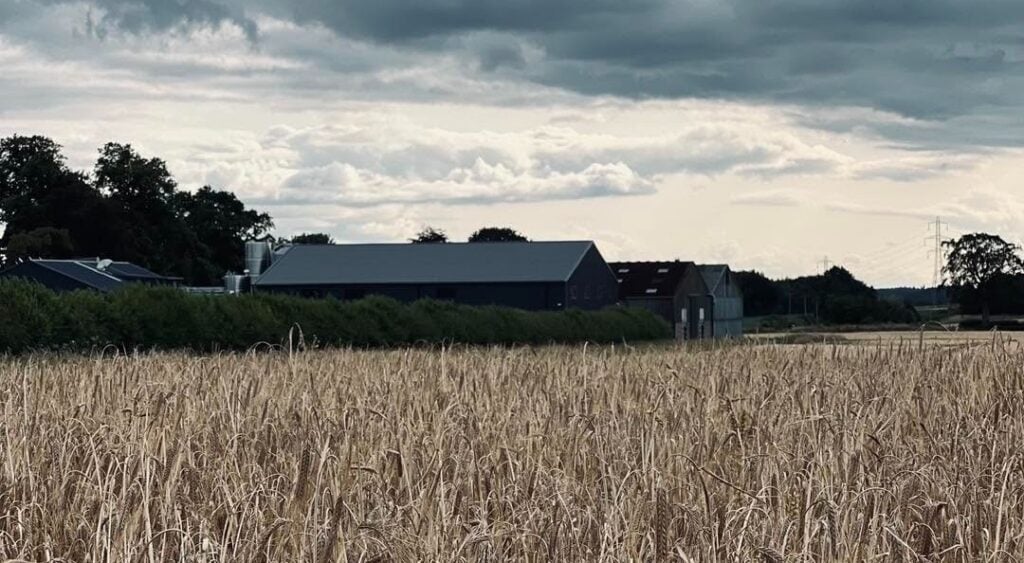
Another batch of local barley getting ready for harvest, within sight of Kythe Distillery
A Monday at Kythe
I asked McMillan to take me through a working day and to please leave the numbers in. I need to know what I’m up against. He picked Monday, “since it’s the most gruelling”. They start at six in the morning (darlings, I’m an artiste, who are we kidding here?), when the refractory chamber beneath the 6,000-litre wash still is cold. The fire needs lighting. In the early runs, somebody had to put in 15 to 20 logs every 15 to 20 minutes. I checked back with the team afterwards and both the fuel and the routine have changed.
They now burn old cask staves from a cooperage, about 30 at a time, every ten minutes throughout the run. The temperature in the chamber directly beneath the copper reaches 700 to 800°C. Feeding it and watching the stills can occupy someone from six in the morning until half seven in the evening.
The fire is downstairs behind a big roller shutter, handy for bringing the fuel in, with a concrete floor separating it from the stillhouse above. MacRaild took inspiration from Cognac distilleries for the layout. Up here on an exposed rise in Perthshire, McMillan can tell when the wind’s up by the way the fire burns. Heat gets drawn out of the chamber faster and the distillation slows down.
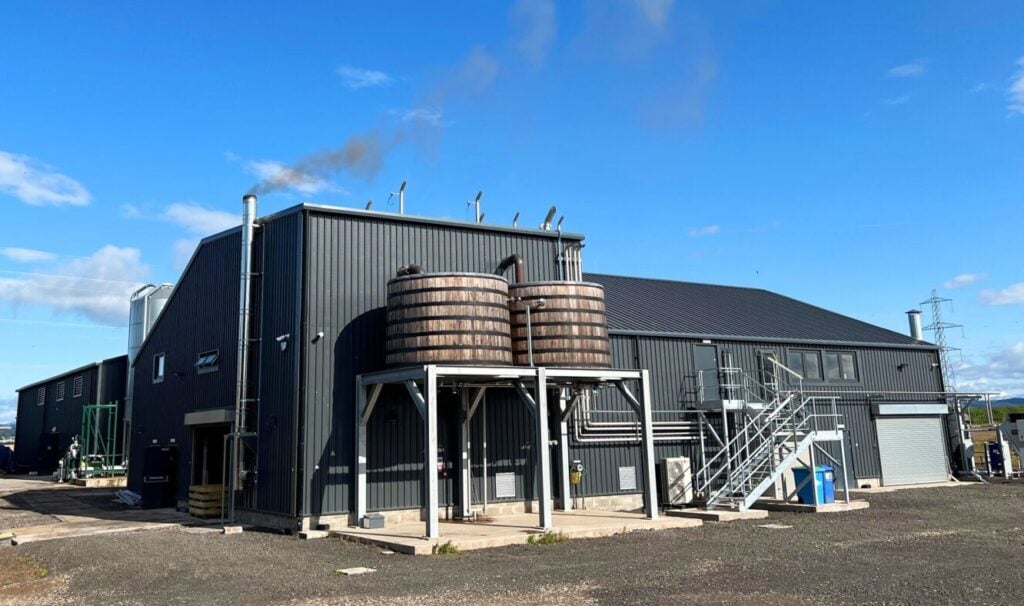
This is Kythe Distillery
The Maris Otter next door
Meanwhile, at about seven, somebody has a tonne of malt to mash. It’s Maris Otter, a variety dating to the 1960s, with roughly half coming from the neighbouring farmer. His barley goes down to Warminster for floor malting and comes back up again. Warminster supplies the balance. Next year’s crop, says McMillan, will be close enough that “you could have your hand on the warehouse wall and your hand in the field”.
Here’s where Kythe’s line about efficiency being the enemy of character acquires a price per tonne. McMillan reckons on about 350 litres of pure alcohol per tonne of Maris Otter on a good day. His comparison for a modern distilling variety is 410 to 415. The protein-rich malt interests them for what it can contribute to fermentation, and they’ve tasted whisky from other distillers’ Maris Otter runs that convinced them to take the hit.
They’d like to try Bere and Plumage Archer, and McMillan is curious about Chevalier, though they haven’t begun to source anything yet. There’s enough to learn here without throwing in new variables. Plenty of time for that later…
The mash tun is an infusion tun, an empty vessel with no knives, gears or mechanical stirrer. Fifty minutes or so into mashing in, someone gets to work with what McMillan describes as a massive potato masher. “It’s incredibly relaxing,” he says. “It’s a bit like rowing through a ton of porridge, I guess.”
The wort runs off at about 40 litres a minute. The second water has to wait until the first has drained, then it too is left to stand before it’s drawn off. A mash takes them around seven hours. To get the draff out, two people climb in with shovels. I’d love to tell you they unearthed that particular technique in a distiller’s notebook from 1958, but McMillan puts it down to poor design. You learn as you go.
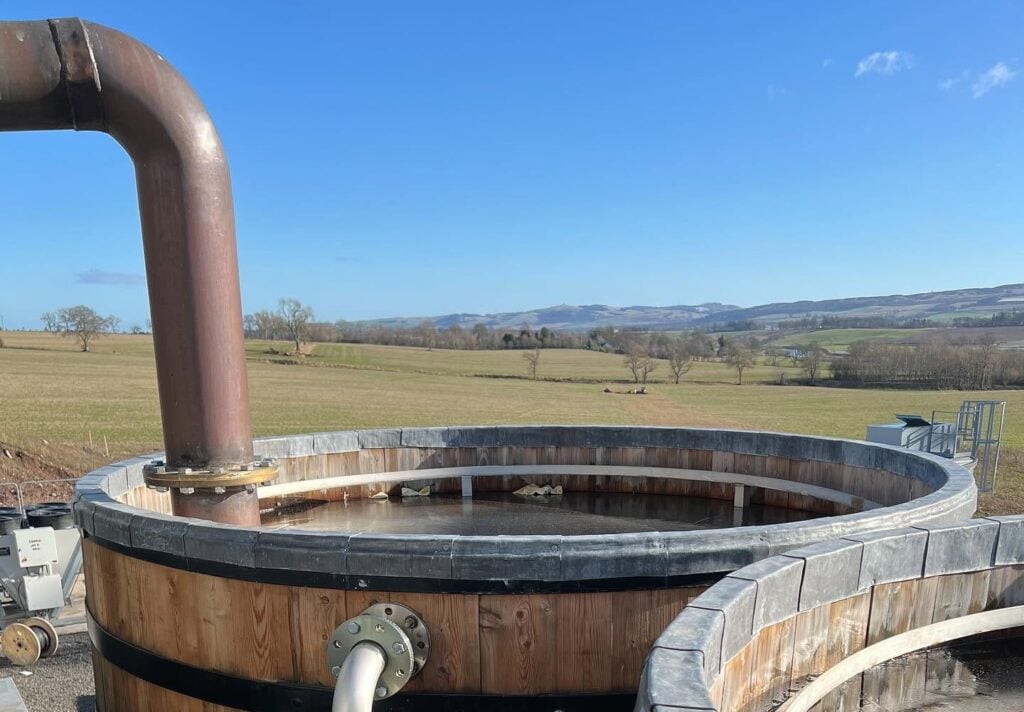
A traditional-style worm tub at Kythe
The people making Kythe
McMillan’s phone has clocked 15,000 to 20,000 steps and 42 flights of stairs in a working day. Sharing the exercise are head of production Colas Malaise, previously at Blair Athol and The Lakes, and operators Ngiam Chee Wang and Saumit Vartak. The latter two are Heriot-Watt graduates. Vartak came from Copper Rivet in Kent, practically down the road from me. I met him once. Smashing fella. McMillan is even more effusive.
“He is absolutely impossible to have a bad day around,” he says. Wang worked at a Singapore brewstillery and likes to know how things work. “We caught him the other day trying to take apart the flow meter. He loves taking stuff apart.” Malaise, meanwhile, is “the most diligent person I’ve ever worked with”, according to McMillan. He wants to understand everything that happens in the place, and his manager gives him a good deal of the credit for the way the spirit is shaping up.
Their favourite gathering point is the spirit safe. When the run comes on in the morning, everybody finds a reason to be there, then comes back twenty minutes later to see how it’s changed. “It still has a feeling of Christmas morning,” says McMillan. MacRaild says they leave room for a little inefficiency here. If an operator can smell the spirit coming off, make a judgement and change where the cut ends, you’ve left them a say in what eventually goes in the bottle.
He also credits McMillan with bringing that team together. He gets as far as saying his friend would never sing his own praises before McMillan cuts in. “I’m really good at it.” In another part of the interview, he describes himself as the least qualified of the four. His job, as he sees it, is getting the best out of the other three and “avoiding the rocks of bankruptcy”.
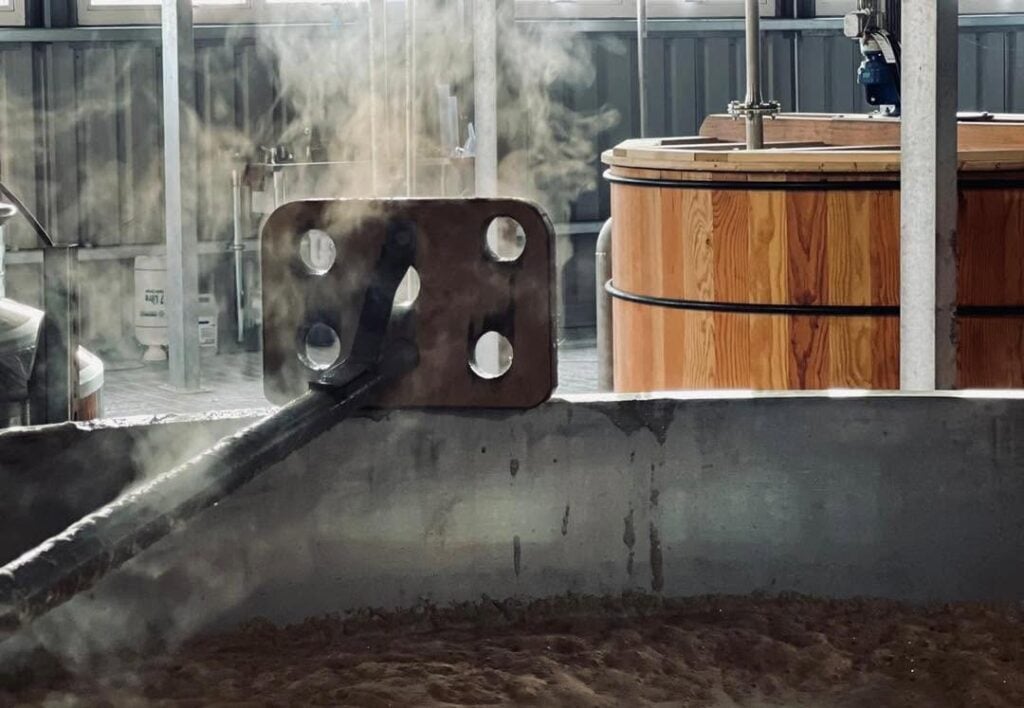
The long lost craft practice of ‘hot paddling’ gives Kythe the “most agitated mash in the Highlands”
What the brewers sent over
Of all the historical details Kythe has turned up, my favourite involves a wooden bucket. At Longmorn in the late 1960s, brewer’s yeast and pressed distiller’s yeast went into a bucket together. At the beginning of the week at Kythe, the team sets out four or five wooden buckets, one for each day’s mash, and puts 20 litres of spent Belhaven brewer’s yeast and a measure of pressed M-strain distiller’s yeast into each.
The less picturesque bit of reviving this practice is organising a fresh delivery of yeast slurry every fortnight, cleaning the container and sending it back to the brewery. Dried yeast, McMillan points out, could come in on a pallet once a year. The Belhaven yeast has already done a job before it gets to Perthshire and its condition varies, particularly when it’s warm.
Wang’s lab experience comes in handy for checking how much of it is alive and how well it’s likely to perform. McMillan says the mixed yeast also gives them slightly lower attenuation than dried distiller’s yeast alone. A little more of the available sugar goes unfermented, another small surrender on the yield sheet.
Why Kythe shortened its fermentations
Kythe built in enough capacity in its wooden washbacks to let a fermentation run for a fortnight. The team later went back to the records. “We’ve made noise for the last few years about very long ferments, but actually there’s no evidence this was ever done in the era we’re looking at, so we’ve had to honestly reappraise our approach and stick with the facts, which means shorter ferments,” the team wrote when I followed up.
“We hope this will mimic old style production where ferments were generally short, 2 or 3 days, but with a longer run over the weekend.” I like that little detail about the weekend. A Friday mash might get a couple of extra days because the next shift started on Monday. A fortnight in a wooden washback would have earned Kythe a handsome tick on the Fine Ol’ Distillery Checklist. It took real nerve to build the place, check the records and then admit that wasn’t right for them.
Kythe now runs three-, four-, five- and six-day fermentations. The team pitches the yeast at around 20 to 22°C and sees temperatures reach 31.5°C. After distillation, they vat together new make from the different runs. A single cask can therefore hold spirit from several different ferments. Should somebody open one a few years hence and be blown away, the production software will tell them what went into it.
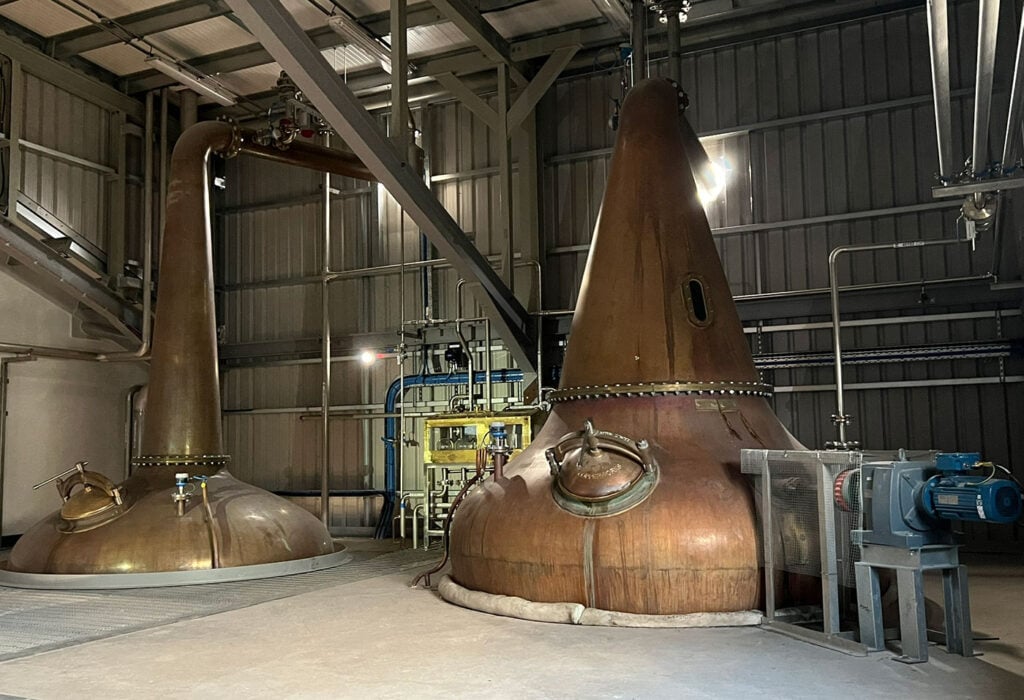
The stills were inspired by Bowmore
How old Bowmore shaped Kythe’s stills
Old Bowmore gave the founders a starting point when the engineers needed to know what shape to make the copper. They particularly admire the whiskies distilled there in the 1950s and 1960s. Take scale out of the picture, McMillan says, and you’d recognise the family.
The wash still is squat and wide with a chunky onion shape. The 4,000-litre, steam-heated spirit still is taller and slimmer. Both have gently rising lyne arms leading into big worm tubs. MacRaild wanted weight from the first distillation and a little refinement in the second to bring out the fruit. Also, “I love our stills, I think they’re magnificent little creatures.”
So what came off the end of these magnificent little creatures after twelve years of planning? “When the spirit emerged off the still, I almost wasn’t sure what to think. The first couple of runs were probably slightly blander than I was hoping for,” MacRaild says. He’d had more to go on than most, having tasted samples of new make dating back to the 1950s. Even so, he’d spent years trying to imagine what his own would taste like. There was a bit of industrial heft there from early on, which he liked.
The fruit took longer. “We want something that is a bit sweaty, a bit funky, a bit heavy, something that gives off an immediate sense of texture,” he says. He’d been away for about ten days before our conversation and had just nosed the spirit again. “I think now we’re starting to get something which is close to or suggesting fruit character, which is really interesting. We hadn’t had that before.”
Alan Winchester takes a shift
They’ve been keeping samples as they go. MacRaild mentions the old distillers’ reckoning that it takes a hundred mashes for a place to bed in. He expected to reach that point around December, when he’d be able to put six months’ worth of samples on the table and nose the changes in sequence.
Tropical fruit is one of the things they most want to find. One man who had a few ideas about getting more character out of the place was Alan Winchester, The Glenlivet’s former master distiller. He came in for a shift, turned up at half six, helped clear the washbacks and stayed to shovel out the draff.
His comments on the spotless new copper prompted the team to drive the stills harder and reconsider one fairly small piece of plumbing. They blanked off the spray ball that put caustic cleaner into the neck of the wash still. “We believe this will help cut down reflux, decreasing copper contact, and hopefully allow more character from our wash through the pot,” the team explained afterwards.
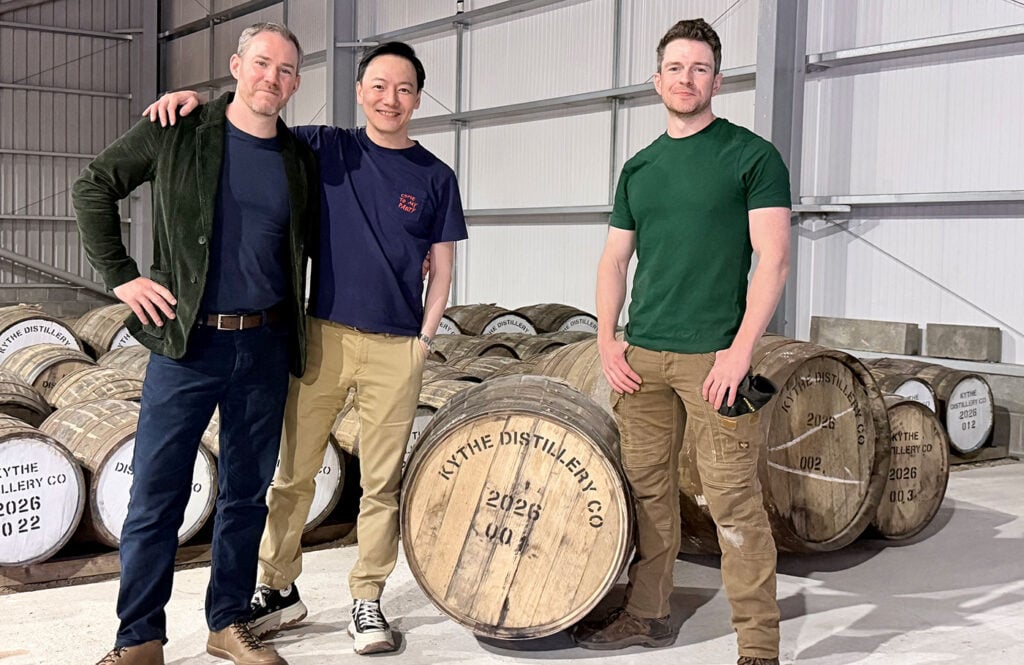
The founders with casks of Kythe
Jamaican rum in the feints tank?
The bit of plumbing I’d make a point of asking to see is the outlet on the feints tank. Feints are the later-running part of the distillation, collected to go back through the spirit still. In a balanced operation you can use the lot each time you charge the still. Kythe put its outlet high enough up the tank to leave about 800 litres behind. Fresh returns mix with what’s already there.
The next charge draws on that mixture and leaves another 800 litres for the run after that. Older distilleries could carry a stock of feints across runs. Kythe can do it thanks to the height of a pipe. That pool was changing appreciably every couple of weeks when we spoke. McMillan says it smells like Hampden, “which is a really good thing.”
They’ve also fitted a split receiver. The operator can collect the upper part of the spirit cut on its own, switch receivers for the lower part, then taste what happens when the two are put back together. They tried ending the cut at 63% ABV against 61%, then 61% against 59%.
When they tasted the samples blind, Malaise kept picking one and the others kept picking the other. MacRaild went home with samples. The team sent me the result afterwards. “We have now settled on a 61% bottom cut, at least for now.”
What Kythe wants from a cask
When I started writing about whisky, I lost count of the distillery tours on which somebody told me 70% of the flavour came from the cask. I put that to MacRaild. For anyone who’s heard the same line, he recommends a five-year-old Clynelish bottled in the 1960s, or one of the old high-strength Glen Grants.
He’s a fan of young, pale whisky with bags of character and is fairly economical about the job he wants oak to do. “Wood just needs to be there to kind of unpack the distillate a bit, open it up, draw out a few impurities, and just balance it out.”
It helps to know what he wants going into those casks. MacRaild likes new makes that are “thuggish, brutal, chunky, oily beasts”. He’ll quite happily take a spirit that’s awkward to drink straight off the still if it has enough weight and character for something beautiful to emerge in maturation. You can see why those slightly bland first runs gave him pause.
Just because they care about what happens before the spirit goes into casks doesn’t mean they skimp on quality here. MacRaild has gone to some trouble to buy it. Take the sherry hogsheads. The wood comes from butts used to mature oloroso at Fundador for around fifty years. A cooperage in Spain rebuilds them as hogsheads and seasons them again with aged cream sherry of a quality intended for drinking.
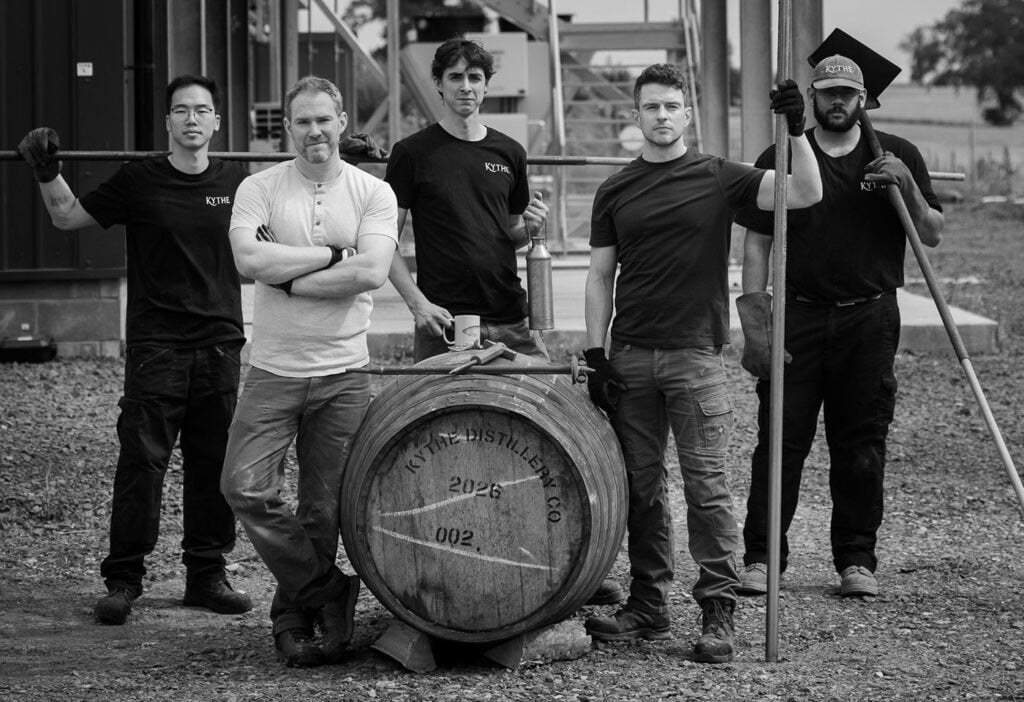
The team at Kythe
Trust independent bottlers to see the wood for the trees
MacRaild tried similar casks through Decadent Drinks and liked them enough to commission them for Kythe. The question now is how that old wood and a fresh application of good sherry will suit this particular spirit.
Then there are the ex-solera butts, some 80 to 100 years old, tightened up and brought over from Spain so Kythe can fill them while they’re still fresh. Smaller parcels from different cooperages should give him something different to work with each year. Some old butts are being broken down into quarter casks so he can see how a smaller vessel gets on without having to introduce much fresh oak.
On the bourbon side, there are American barrels that previously held pot-distilled bourbon. They’re made with air-seasoned staves and sit alongside first-fill barrels sourced in Scotland and remade refill hogsheads.
Why so many variations for a man who doesn’t want oak that twists and shouts? He’ll eventually have to blend this lot. The more active casks give him an early look at what the spirit can do as it matures. He expects to lean increasingly on refill wood as he gets to know it. What he wants to bottle are small batches with a discernible Kythe character and, in time, a range of age statements.
MacRaild has had plenty of practice finding interesting casks. Both he and Chan have independent bottling businesses. Between them, they know where to look for good refill wood and can bring suitable casks into the warehouse as they come across them.
What a Perthshire winter might change
The warehouse is a high-roofed farm building with plenty of air moving around the casks. After a summer there, MacRaild suspects evaporation may run a little higher than he’d ideally like. There could be something in it for the drinker. He thinks the whisky might concentrate more quickly in those early years, which could suit the younger releases. He expects that to ease as the warehouse fills and there’s less space around each cask.
McMillan is looking forward to finding out what winter does to the groundwater that cools the worms. He already finds the summer spirit thick and suspects winter’s colder water could give him something thicker still.
MacRaild reckons this is one of the more interesting ways a place can leave its mark on whisky. The temperature of the water changes how the vapour condenses in the worm. Here, on this particular rise in Perthshire, the team will have winter runs to taste alongside the summer samples.
Will the distillery live up to its promise?
When can we drink it?
The press release celebrating Kythe kicking off production says we can expect a whisky in eight years. In our conversation, MacRaild was frank about the business of getting there. “I think commercial reality means that we will probably need to bottle something relatively young, between three and five.” He leaves himself some room on that one. “We’ve got the ability to defer that and wait if we feel we have to, which we will.”
When I followed up, the team said the tropical fruit, waxiness and weight they’re after were starting to show in the new make. How early they can get those qualities into a bottle remains open. I asked what they’d like people to recognise in a glass of Kythe once it’s had a decade or two to find its feet. MacRaild pictures somebody pouring a dram for a pal who noses it and knows the distillery blind. He’d like a thriving business that gives the people working here a good quality of life.
That means getting beyond the years of selling casks to keep the place running. Eventually, they’ll need to make their living from people who open a bottle, share it and come back for another. “We need people to destroy what we’re creating in order for us to make a success of it,” he says.
The ambition alone is attractive at Kythe. Laid out in full, this is not a collective memory hunt. You can see what those old whiskies meant to them in the buckets of brewer’s yeast and the pile of cask staves beside the fire. Maybe one day I’ll be there when someone opens a bottle of Kythe for a pal and sees the look MacRaild remembers from those tastings at Ardbeg.
The word ‘kythe’ comes from Scots and means to show, demonstrate or prove. They’ve given themselves something to live up to. No pressure, lads. Just don’t judge them based on anything made on my shifts…