Trade
Trade

The first-ever official permanent line-up from Tormore is here! Limited editions Blueprint and Legacy in 2025 gave us a hint of what was to come. Now the Speyside distillery is placing itself firmly in the spotlight with three core whiskies: Tormore Timeless, Tormore 12 Year OId, and Tormore 16 Year Old.
This is relatively new territory for a distillery whose whisky has long been destined for fillings and blends. When the stills first ran in 1960, it was to supply Long John Distillers. Since then, most people’s only interaction with Tormore will have been through the odd independent bottling. Exciting times.
We attended the launch event and then caught up with distillery manager Polly Logan along with head blender Oliver Chilton to get the skinny on the launch. Let’s meet the whiskies, then get stuck into the story of Tormore.
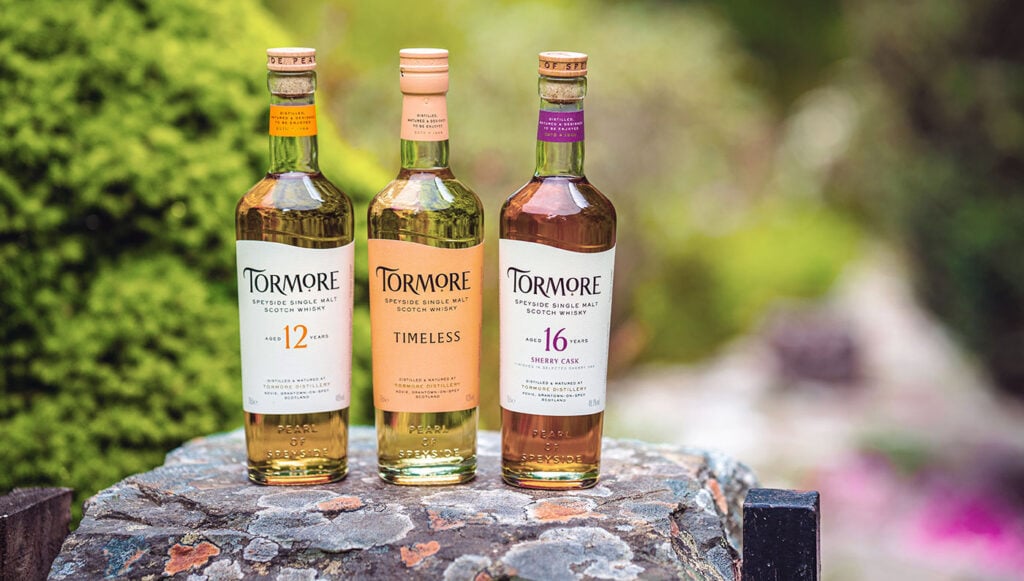
This is Tormore stepping out into the world as a fully fledged single malt brand
Tormore whiskies
Logan takes us through the range, and begins by saying that if you have the opportunity to taste through them all, to consider that distillery character of fruit-forward elegance, peaches and pears, notes of vanilla, running throughout.
“Each expression is very distinctly Tormore. That will almost certainly live on in everything we create in the future”.
Tormore Timeless
A non-age-statement whisky (though there’s a mix of older and younger vintages) predominantly matured in bourbon casks that allow the spirit to shine, with a touch of sherry cask ageing for additional structure. It’s bourbon-cask-led, bright, creamy. Think peaches, pears, vanilla… Think Tormore. The Strawberry Collins cocktail at the launch event made with this was fantastic. More whisky drinks like this please.
“Tormore Timeless is our no-age statement, and it’s been designed with mixing in mind. We’ve been enjoying some ‘summer smash’ style long drinks. We’d love this to become first choice for a long refreshing drink, which is exactly how whisky was enjoyed back when the distillery first opened,” Logan explains. “Tormore’s liquid has historically been used in blended whiskies that were mostly enjoyed mixed, hence its fruity elegance. Now that same Tormore character is in single malt form and still ideal for mixing”.
Tormore 12 Year Old
Aged in bourbon, cream sherry, and toasted American white oak casks, this has a slightly creamier mouthfeel. Its beautiful texture builds on the palate and the flavour develops without losing the DNA of the distillery, and for my money is the highlight of the range. Like drinking pear custard. Is that a thing?
“Tormore 12 Year Old is a truly elegant dram, and we’re seeing it become a bit of a crowd-pleaser,” Logan says. “Ideal for sipping at any time of the afternoon with lots of those peaches and pears with vanilla notes, akin to peach crumble with custard. It works well with food too. Try it with a grilled peach and Parma ham salad”.
Tormore 16 Year Old
Sherry gets introduced in the form of cream sherry and oloroso from refill American and European oak casks. Deeper, darker, richer, older, but also the whisky that feels a bit at odds with the rest of the range and the wider purpose.
“Our 16 Year Old brings more sherry cask influence and so the fruit is slightly jammier and mingles with soft spice,” Logan reveals. “This is definitely the after dinner dram but it’s not too overpowering or heavy so could be enjoyed all evening, or even alongside dessert”.

The OG Tormore Distillery. You can tell it’s old ‘cos black and white.
A bit of history
Technically there has been the odd Tormore bottling before. A quick bit of history reveals all. Provided, seemingly as always, by the Malt Whisky Yearbook. Tormore was founded in 1959 by Schenley Distillers, who were owners of Long John whisky. They sold it and all distilleries to Whitbread in 1975. In 1989, Allied Lyons (to become Allied Domecq) bought the spirits division of Whitbread and by 1991, Allied Distillers launched the Caledonian Malts range where Tormore is given a short lived representation before Scapa replaces it.
By 2004 a 12-year-old Tormore was launched as an official bottling, a year before Pernod Ricard (with its Scotch whisky arm Chivas Brothers) took over the distillery after acquiring Allied Domecq. In 2012, they increased production by 20% and two years later replaced the 12 Year Old with a 14 and 16 Year Old. In 2021, Pernod Ricard bought The Whisky Exchange, who apparently trade in whisky and the like, and by a miracle of coincidence Tormore became available soon after.
Just a year later, the founders of TWE, brothers Sukhinder and Rajbir Singh, took the distillery off Pernod Ricard’s hands and brought it into the Elixir Distillers fold. No sum was ever disclosed for the sale, but the agreement did include Tormore’s inventory of aged stock. You probably already know Elixir Distillers as a creator, blender and bottler with a portfolio of primarily Scotch whisky, together with Irish, Japanese, and American whiskies as well as rum and Tequila. Core brands include Port Askaig, Elements of Islay, Single Malts of Scotland, and Black Tot.
But Tormore is the brand that has caught our eye today. In fact, it’s rather good at that.
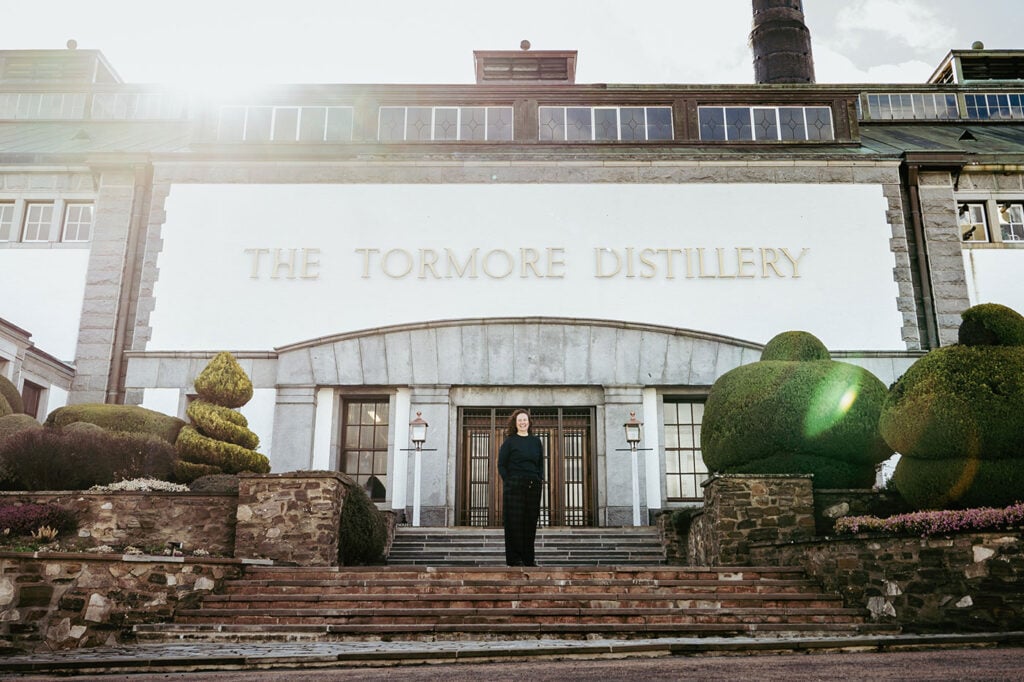
Welcome to Tormore, with bonus Polly Logan!
“Is this a distillery? It doesn’t look like a distillery…”
Dave Broom in the third edition of the World Atlas of Whisky (2024), says that Tormore “Doesn’t look like a distillery.” He adds: “It’s a strange modernist/neoclassical mashup in the middle of moorland built – as Chilton puts it – ‘by four eccentrics’.”
One was Lewis Rosenstiel, the former bootlegger who owned Schenley Distillers. In 1959, he and press baron Brendan Bracken hired the 79-year-old architect Sir Albert Richardson to build the distillery. “Somehow Tory MP Bracken got author Neil M Gunn (a lifelong Scottish nationalist) to find the site,” Broom explains. “If none of that seems to make sense, then neither does the distillery, one of whose three tun rooms is inside a clock tower. At a time when distilleries were building functional boxes, it’s a chaotic mess”.
R.J.S. McDowall in The Whiskies of Scotland (1967) says the success of Long John Distillers led to the building of Tormore, and calls it “One of the show distilleries in Scotland and such a change from the many drab places which exist, a breakaway indeed from the almost studied careless shabbiness of the Speyside distilleries”. He credits Sir Richardson, who he notes as a past President of the Royal Academy for the look, and adds that “The trade is proud of new Tormore although it is interesting to note that it makes whisky in the old traditional way”.
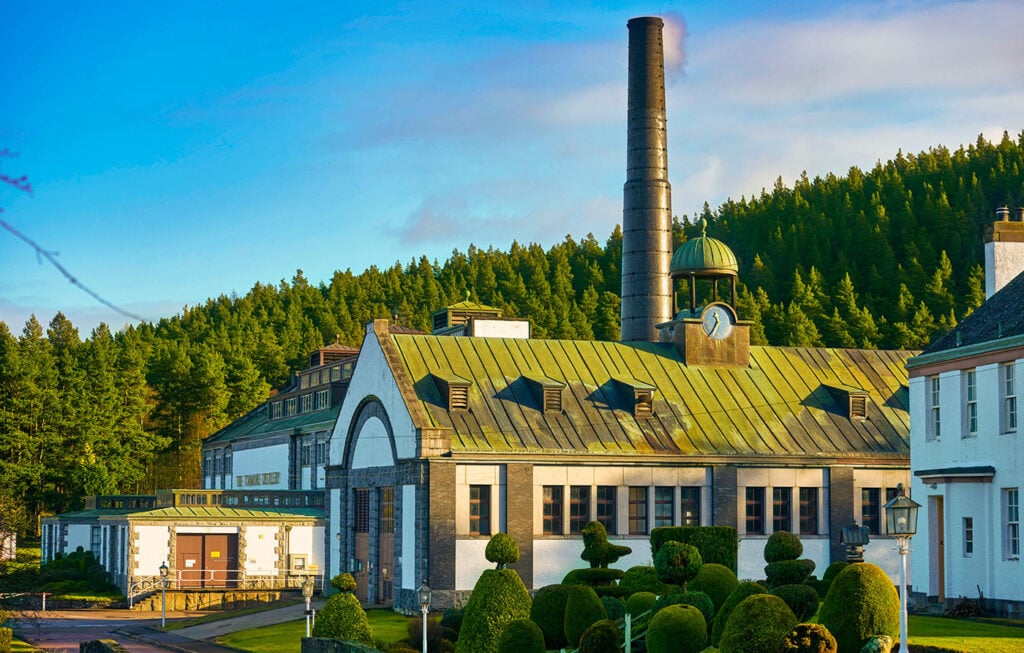
No other distillery looks like this
“The most elegant of all malt distilleries”
Michael Jackson, in his formative Malt Whisky Companion (1989), has perhaps the most definitive statement on Tormore, calling it:
“Architecturally the most elegant of all malt distilleries and with a whisky of equal urbanity”.
He continues: “As the hills around the Livet and Avon recede, Tormore presents a sight that is hard to believe. With its ornamental curling lake and fountains, its pristine white buildings, decorative dormer windows, belfry and musical clock, the topiary, and the huge hill of dense firs forming a backdrop, Tormore might be a spa, offering a mountain water cure. Instead, it brings forth the water of life, uisge beatha. In its high, cold location, shaded from the sun, it produces a beautifully clean malt. Tormore was erected in 1958, during the boom years for the Scotch whisky industry. It was the first completely new malt distillery to be built in the Highlands in the 20th century and was evidently intended as a showpiece”.
He defines the house style as “nutty, soft, versatile”. Others talk of the bouquet of pear, peach, and stone fruits. The aesthetic and distillery character meant Tormore gained the name ‘The Pearl of Speyside’. Some coincidence, it was mine too at Spirit of Speyside ‘22.
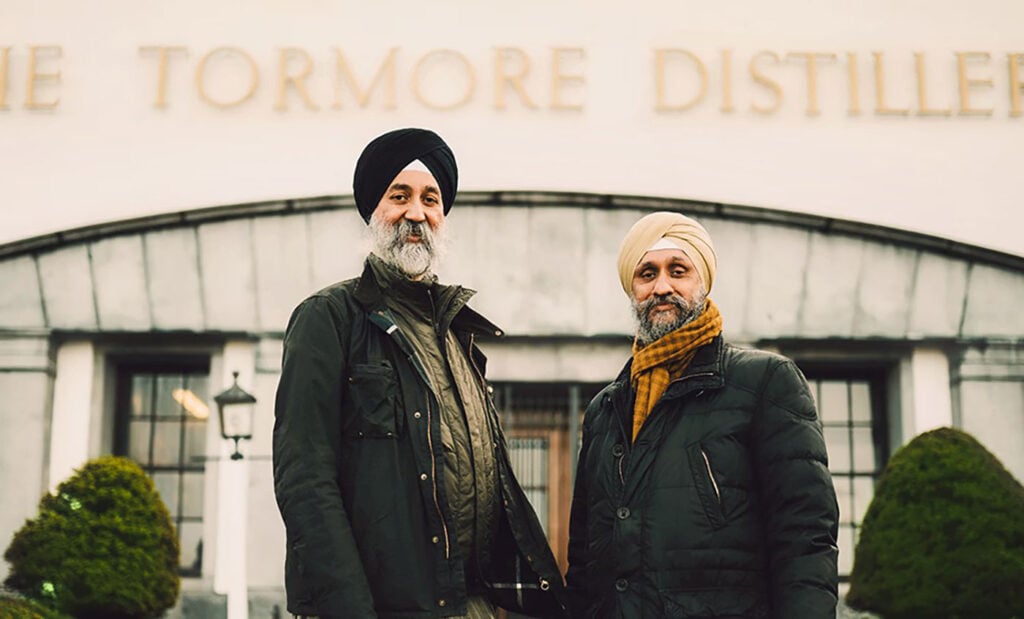
Rajbir and Sukhinder Singh are leading Tormore into a new era
“The Pearl of Speyside”
According to Logan, Sir Albert Richardson came to Tormore with a complete vision of the distillery and the community and all the recreation areas, the village hall, the cottages, and the beautiful gardens as a whole. His idea was of one complete place to be, to work, and to live. “That gave way to the visual design which is broadly based on older architecture of the late 1800s, a time when distilleries were indeed at the heart of their communities”.
Logan credits the creation of this community to the optimism of the time. “In the late ‘50s we’d passed prohibition, everything was starting to move and become more optimistic and more forward-thinking. That’s reflected in the final result.”
She adds that, “Tormore is without doubt the most beautiful distillery in Speyside. I daresay it might even be Scotland. When you drive around that corner, coming from Grantown-on-Spey, and you see this phenomenal white facade just appearing out of the middle of nowhere, you can see why the locals call it ‘The Pearl of Speyside’.”
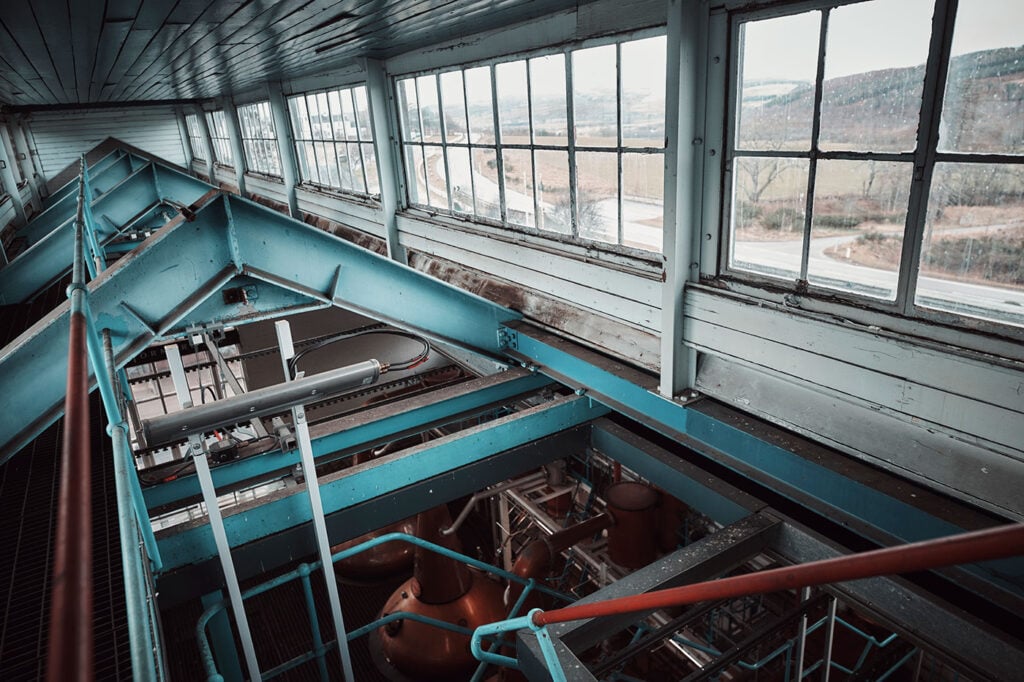
There’s a lot to explore at Tormore, and Elixir is having plenty of fun doing so
Figuring out Tormore
Broom is writing in 2024, before this launch and it’s interesting to see him record the process of Logan and Chilton figuring Tormore out. “The more they uncover, the more bizarre it becomes”, he says. “The short ferments are 50 hours, the longs are 100. Each of the eight stills has a purifier, but they’ve discovered a rectifying plate in the wash stills and possibly the same in the neck of the spirit stills”. Chilton also reports to Broom that there were copper chains inside the stills at one point and at another there were water-cooled copper pipes inside the neck.
Chilton tells Broom the future is about harnessing the word eccentricity of Tormore, and bringing back the culture. He, like Logan, talks of Richardson building an arc of houses on both sides, some of which are being bought back by Elixir. The investment is in the plant, and the community, the workforce has already tripled. Production is being kept roughly at the level, but the short and long fermentation is being extended, plus there’s a change in yeast.
“We’ve worked really hard with our yeast suppliers, and gone back to slightly older strains of yeast, as well as a mixture of distillers and ale yeast, to give us all the lovely congeners we’re looking for,” Logan explains. “It’s during this fermentation stage that all the best flavour compounds develop so it’s not a process we want to rush. We run both long and short fermentation times, with the longs being 110 hours and the shortest 60 hours – this brings complexity to the flavour of our wash”.
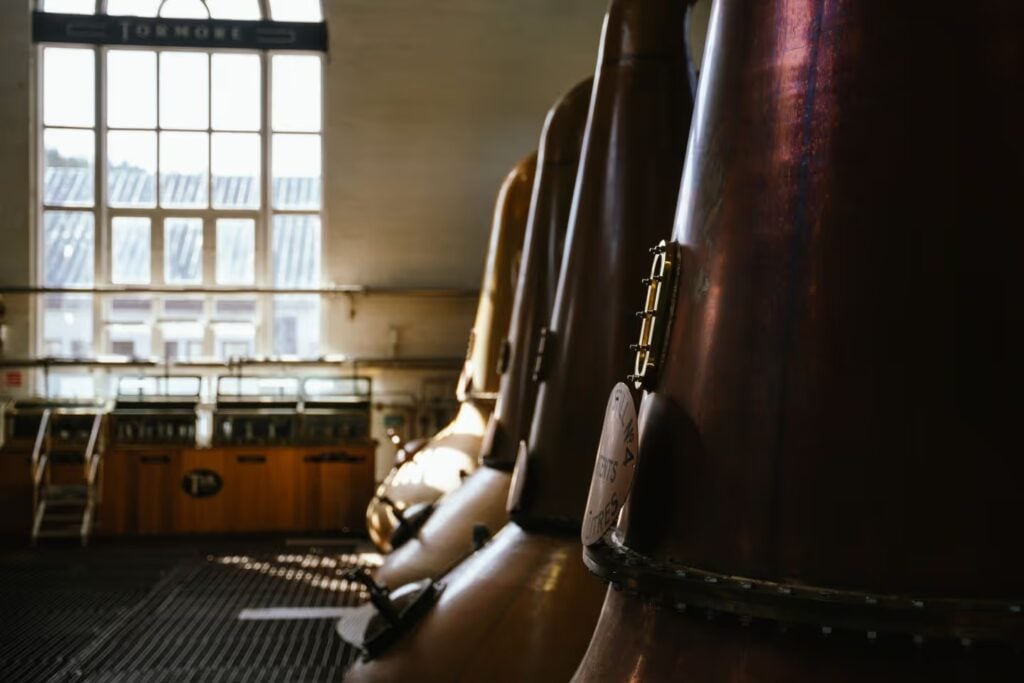
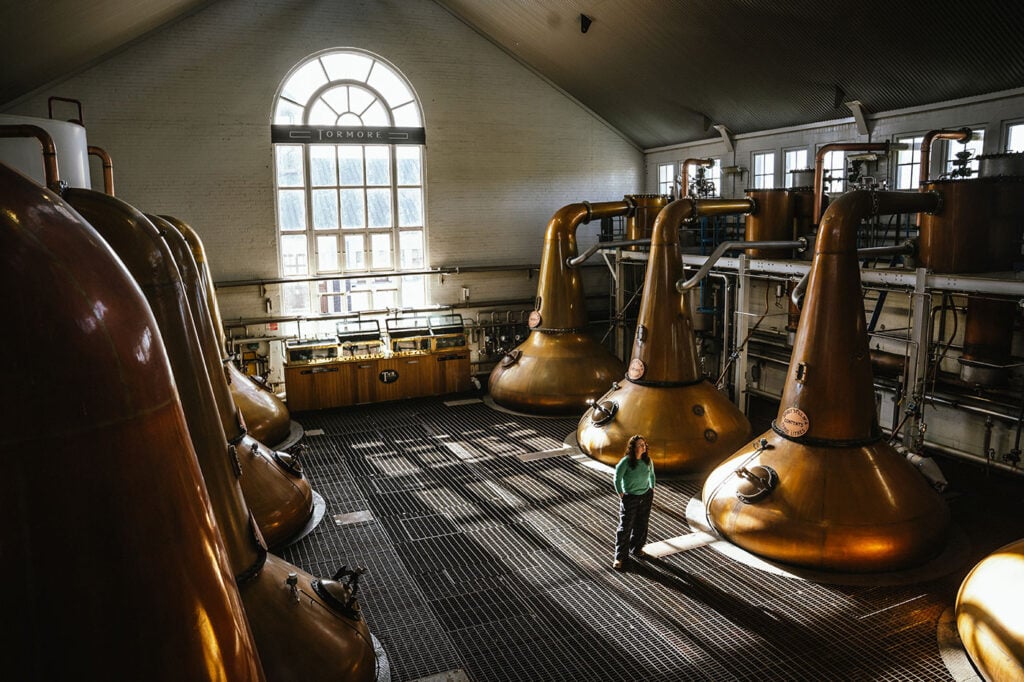
The stills, like everything else at Tormore, are unconventional
Production details
The distillery is capable of producing up to 4.8m litres of alcohol per year and is equipped with a 10.4 tonne stainless steel full lauter mash tun, eleven stainless steel washbacks, four 18,500 litre wash stills, and four 13,900 litre spirit stills. Each of them are equipped with purifiers which together with a clear wort, long foreshots (25-30 minutes) and slow distillation, contribute to the style of the new make. “Every little step of the Tormore process is focused on developing and then maintaining that truly elegant spirit with peaches and pears, vanilla and coconut,” says Logan. “There is a beautiful biscuity edge that builds body and makes the whisky so moreish”.
The purifiers are a standout feature. “Each one is essentially a big copper pot with a single copper baffle that the vapour has to navigate. Any vapour that condenses in the purifier runs back into the main body of the still to be re-distilled,” Logan reveals.
“The copper contact increases our fruity flavours that have been carefully nurtured during longer fermentation and removes any impurities. It’s a big step in ensuring we get the clean, elegant and light spirit we’re looking for and we’re incredibly thankful to the clever minds who thought to install purifiers from the beginning!”
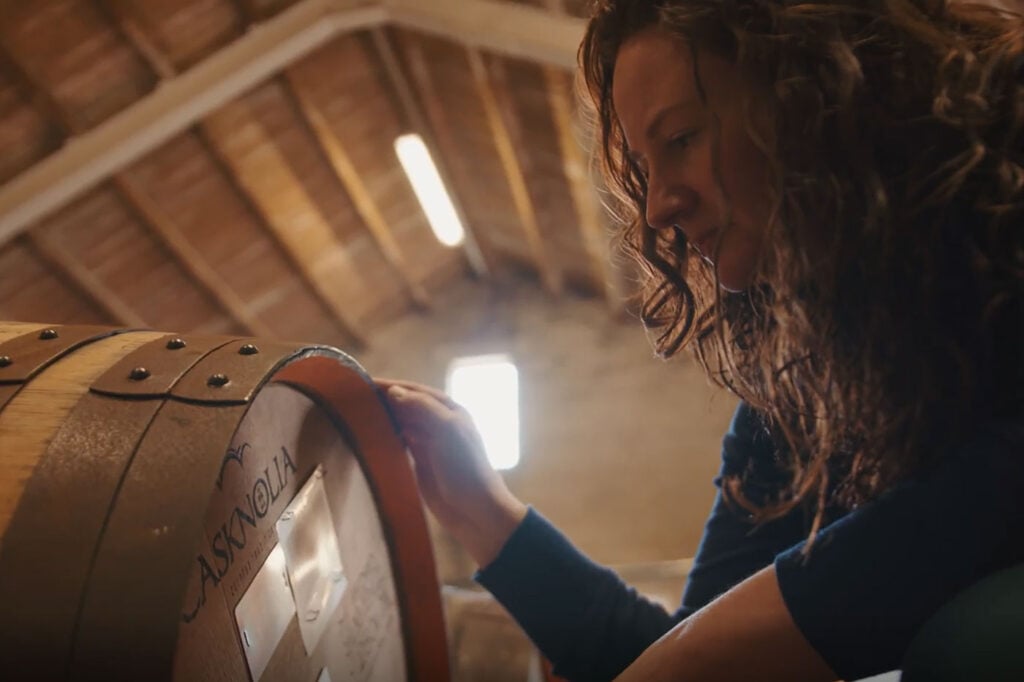
There’s a considerable inventory of casks that Elixir is adding to. Hey, isn’t that Polly again?
Peaches and pears bruise easily
The key question then becomes one of how to maintain a cask regime that doesn’t mask the distillery character. “With the stone fruit flavours being at the centre of Tormore’s elegant liquid, we knew we had to look at wood styles that would complement the spirit and allow it to shine. As Polly says, peaches and pears bruise easily, so you need to have a light touch,” Chilton explains.
“When we wrote down that core flavour camp all I could think was how lovely those fruits would be with a dollop of custard,” he continues. “With that in mind we have focused a lot on American Oak, looking at ways we can draw out and complement vanillas and soft sweet spices. We work closely with coopers across Europe, the UK and the USA in terms of the process and then look at what brilliant liquid, in terms of bourbon, sherry, Montilla-Moriles and other wines, we can find to help mellow those casks before putting our Tormore in”.
There’s been a little experimentation too with the new make spirit and Chilton tells me they’re seeing some exciting things happen with the spirit that is less than threeyears old, where the team has control on filling strength and very specific styles of wood. A positive challenge has been assessing the inventory of stock they inherited and figuring out what and how to re-rack, while staying true to that Tormore DNA. “We’re incredibly proud of what we’ve achieved but it’s not been a quick or easy process”.
Working with what you’ve got
Chilton feels the team were incredibly lucky with what they inherited. There’s a consistency in the liquid across the existing stocks, despite all the change of hands over the last 60 years or so. “A lot of the casks we inherited were refill bourbon barrels, and thanks to the previous owners, we had great records in terms of the filling and quality. These casks really let the spirit shine. Alongside this there was a small quantity of top-quality first-fill bourbon barrels, that, for me, truly expresses the heart of Tormore”.
He continues: “We immediately recognised the flavours of peaches and pears and that stone fruits were the centre of everything for Tormore. It’s always been an elegant, very fruit-forward spirit and we knew straight away we didn’t want to hide that”.
Having inherited such an inventory of stock, Chilton thinks it would be foolish not to consider some older age statements in the future, with an 18 and 21-year-old likely. “The maturing stock at Tormore is really quite exceptional,” he says. “But we’re dedicated to flavour first. We’ll only release it if it’s great quality, has finished its time in cask well, and still reflects that fruit-forward elegance that has become Tormore’s character”.
Tormore’s style is not going to change. What will be different is the platform it gets. Hang on, that’s Polly again, isn’t it?
Among the smoke and sherry
At the launch event, Sukhinder spoke about introducing a new whisky brand into a market shaped by both success and saturation. Much of it driven by demand for big flavour: smoke, sherry, and high strength. He sees Tormore as something of an antidote, a fruit-forward, elegant Speyside single malt that moves in the opposite direction. Going against the market can be exciting, but it also carries an obvious risk. So how do you persuade drinkers to follow?
“I would say that the market is always changing and evolving, and it feels like there has been a shift away from those extremes and towards flavour first, which suits Elixir Distillers and Tormore,” Chilton says.
“Single malt whisky is a drink first and we wanted to put whisky from Tormore in a bottle that people will pop open and enjoy. We are lucky that, from day one, Tormore was designed to make an approachable, brilliant spirit,” he continues. “We are not looking to make the darkest, strongest or most wacky whisky, but instead just the best drinking experience that people will return to again and again. All of ushave limited budgets and we believe that flavour will be the most important thing that dictates why you return to a bottle”.

Tormore has always stood out, but not enough for its spirit. Will that change now?
The singular Speysider
Not that there’s a shortage of elegant, fruity Speyside single malt. So what makes Tormore different from them?
“For me, Tormore is special due to intentionality of it,” Chilton says. “It was designed to make a light, fruit forward spirit, specifically to be easy drinking and approachable. We don’t cut corners, whether that is in the still house, where Polly and the team work hard to refine the peach and pear characters that define our elegant flavours, or in the filling store, where we fill at lower strength to make sure we get the best extracts from the wood to complement our spirit”.
Tormore is one of a number of Scotch whisky distilleries that shunned the single malt limelight for blend padding. It isn’t glamorous, but it is vital. It’s also not the full story.
“There’s a misconception that Tormore was never intended to be a single malt,” Chilton reveals. “In fact, we have references to Tormore’s liquid being praised for its potential to age and to be enjoyed as an eight to 10-year-old single malt. And that certainly happened on occasion so if you’re lucky you may find some old bottlings of 10-year-old Tormore out there in the wild”.
Taking Tormore into the Spotlight
This is the difficulty with a distillery that has so many stories built into it: telling them all to the right audience in a way that does them justice.
“We unearthed a lot of history, not only about the place, but also about the liquid, and there’s just so much to share and to bring back to life,” says Logan. “It’s impossible to tell the whole brand story in a few short sentences…we need more of everyone’s time to do it all justice! But that’s a positive challenge to face”.
Tormore has spent most of its life hiding in plain sight. It is one of Speyside’s most distinctive buildings, producing a whisky that reflects its home, yet one that relatively few drinkers know. Plenty have stopped along the A95 to take its picture. Fewer have tasted the intricacies its purifiers, and long fermentations create.
But all roads lead back to the same point: a peachy whisky that wants to win the day with restraint. Elixir’s task is not to invent an identity for Tormore. The trick is to polish the pearl without dulling it into something generic.