Trade
Trade

Midleton Very Rare Irish Chestnut Edition is here. The distillery describes it as the first whiskey to be released that was matured in casks made from Irish-grown sweet chestnut.
It’s the culmination of a project nearly a decade in the making from Irish Distillers, Midleton Distillery’s owners, which began with six trees from Cappoquin Estate in County Waterford. Those trees yielded 41 casks, in which the single pot still Irish whiskey selected for this release spent a further five years. It was then bottled at a cask strength of 56.1% ABV, without chill filtration, with approximately 800 case equivalents available worldwide.
We got to travel to Midleton*, taste the whiskey, and learn the story. There is plenty there for a whiskey nerd to get into. As one, I should know.
The whiskey before the chestnut
There are three kinds of single pot still whiskey made at Midleton Distillery, categorised as light, medium and heavy (or Trad, as in traditional) pot. You can read more about the how and the why of all that, in How Redbreast Irish Whiskey is Made, featuring master blender Dave McCabe.
For the Midleton Very Rare Chestnut Edition, whiskeys from each of those three styles were selected, following an initial maturation in first-fill and refill bourbon barrels. Master distiller Kevin O’Gorman tells us that whiskeys aged 12 to 19 years were transferred to the Irish sweet chestnut casks, bringing the finished whiskey’s age range to 17 to 24 years.
The practical business of finding suitable trees, turning them into casks and understanding what happens inside them was enlightening. But before the forest came the distillery, specifically the microdistillery at Old Midleton.
Built in 2015, it’s the new distillery at the old distillery, a place the size of many start-ups where Method and Madness embraces both elements of its name. The genesis of this release belongs to that same culture of experimentation, and it’s here that we fortunate few got samples of each of the pot still styles first as new make, then as bourbon-cask-aged whiskey.
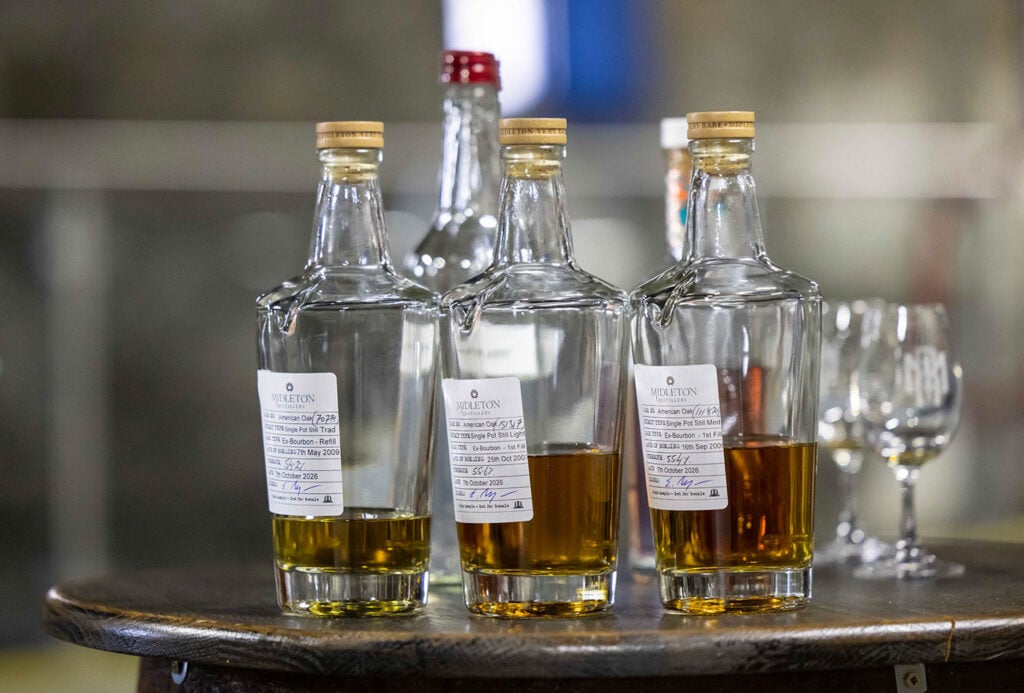
We got to taste the three kinds of pot still whiskey made at Midleton Distillery
Three kinds of pot still whiskey
We start with the light pot still new make, which was all apricot and pineapple jams, with soft pear flesh and sweet grassy barley notes. Age made it slick with fudgy vanilla, coconut, acacia honey, and apple pie dusted with cinnamon. The matured sample was 55.6% ABV, so I added water, which made it more floral and fruity.
The medium pot still brought nectarine, passion fruit, huskier barley, and allspice. The spirit was silkier and more viscous, and after maturation, we got toasted brown sugar, sweeter spices, and a more tropical style of fruit. This one was 55.4% ABV, so a little water revealed something extremely elegant, honeyed and lush. They should bottle it.
The heavy or Trad pot still marked a departure. It was funkier, dirtier, oilier, with spearmint and new leather and petrichor, plus a little vegetal bell pepper character. The pot still spices were more aromatic, with ginger and nutmeg; there was also a lovely bright apple sweetness. They call it Midleton’s special sauce. Indeed.
We then tried a 17-year-old single cask sample at 54.2% ABV. I can feel your envy through the page. And you’re right, it was sublime, maybe one of the best whiskies I’ve had this year. The funk and force carried through with an almost rancio quality, and the fruits were beautifully concentrated into tropical juice, banoffee pie, pear drops, and dried mango. Then golden syrup, gingerbread, cloves, almonds… A pastry shop.
And a useful reference point for the main event. There was already a great deal going on here before the new wood got involved. We made a crude blend of the three from what was in our tasting glasses to get a rough idea of the kind of whiskey that went into the chestnut casks. A very good one, even with my untrained hand. Promising stuff.
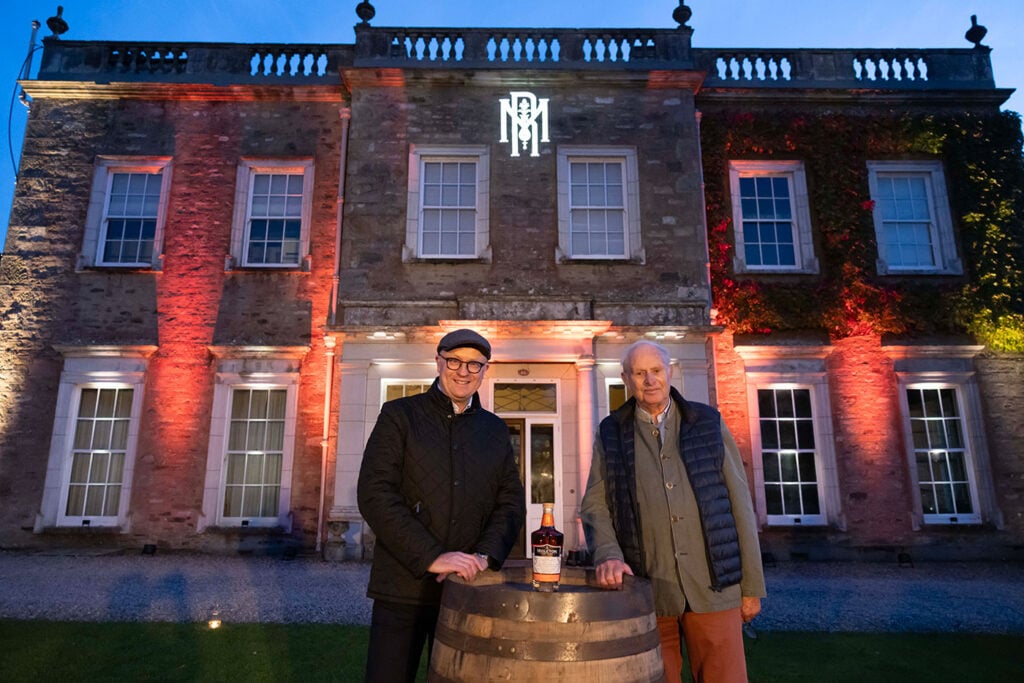
Kevin O’Gorman and Sir Charles Keane at Cappoquin Estate
Finding the trees
After the distillery came the forest. Finding Irish sweet chestnut suitable for cask-making takes some doing. The search reached Cappoquin Estate, which has been associated with the Keane family since 1735. Its Georgian house stands on the site of an old FitzGerald castle, overlooking the Blackwater valley.
Today, Sir Charles Keane maintains its long legacy, equipped with no shortage of dry wit, and the back label specifically thanks him. Fun fact: Tourin House, on an estate on the River Blackwater near Cappoquin, belongs to three Jameson sisters, descendants of John Jameson.
“For generations, our family has cared for these woodlands with the responsibility of passing them on in good health to those who follow,” says Sir Charles Keane. “Seeing a small number of these rare, sweet chestnut trees become part of the story of Midleton Very Rare reflects that same long-term thinking, respecting nature, valuing craftsmanship and allowing time to create something that will endure.”
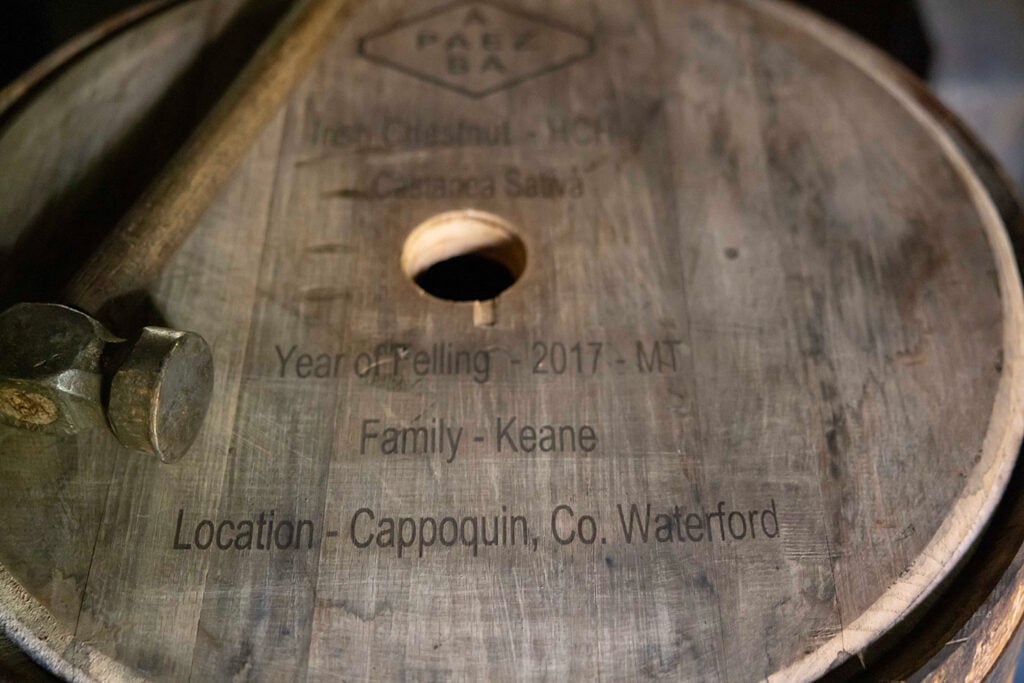
Irish sweet chestnut is new ground
Being a bit nutty about chestnut
Irish-grown sweet chestnut needs a little unpacking. Sweet chestnut, Castanea sativa, is not native to Ireland. A 2019 genetic study discusses a presumed medieval introduction, and Cappoquin is actually among the sites acknowledged for providing access to that research.
Then comes Ireland’s loss of woodland. It began long before the seventeenth century, but conquest, settlement, agricultural expansion and timber exploitation intensified the clearance. Teagasc’s account includes the export of Irish oak for ships, buildings and barrel staves, and ironworks consuming woodland for charcoal. Casks are already part of its history.
The present opportunity depends on what survived and what was subsequently planted and managed. An estate like Cappoquin can hold timber that is difficult to source through a routine cooperage order. That does not make every tree suitable, or every suitable tree available. A continuing supply of good timber depends on the health of the trees (chestnut blight an example of a potential problem) as well as the willingness of someone to grow them.
The woodland discussion also introduced a complication that whiskey drinkers, usually quite keen on age, ought to appreciate. The age of a standing stem and the age of the living tree beneath it can be different. Sweet chestnut responds well to coppicing: cutting stems back and allowing new growth from the established stool. Successive generations of timber can therefore come from the same living base.
Wood potential
The discussion at Cappoquin put the age of the harvested timber at about 140 years, with an older stool potentially reaching back 250 to 300 years. Whether a particular harvest is responsible depends on the condition of the woodland, what is retained and how it regenerates.
Research on chestnut heartwood reveals how tannic it is, containing both gallotannins and ellagitannins, two groups of hydrolysable tannins. Toasting changes that balance again, breaking down tannins and generating smaller phenolic compounds from lignin, one of wood’s structural components. Separate research into chestnut’s aromatic potential found substantial levels of compounds including vanillin (which brings us those classic woody vanilla notes associated so strongly with whiskey) and its derivatives.
That does not give us a recipe for the taste of every chestnut cask, but an indication of the potential in the wood. This whiskey is the result of a particular wood, prepared in a particular way, meeting a particular spirit. Vanilla in the finished whiskey cannot automatically be credited to chestnut, given that the liquid has already spent 12 to 19 years in bourbon barrels. Nor does detecting spice tell us which part of the production process supplied it. Pot still spirit already has plenty of that to begin with.
O’Gorman describes the result as “a richness, texture and complexity unlike anything we’d experienced before”. The interest is in how those qualities develop together, and how much of the original whiskey remains legible after five years.
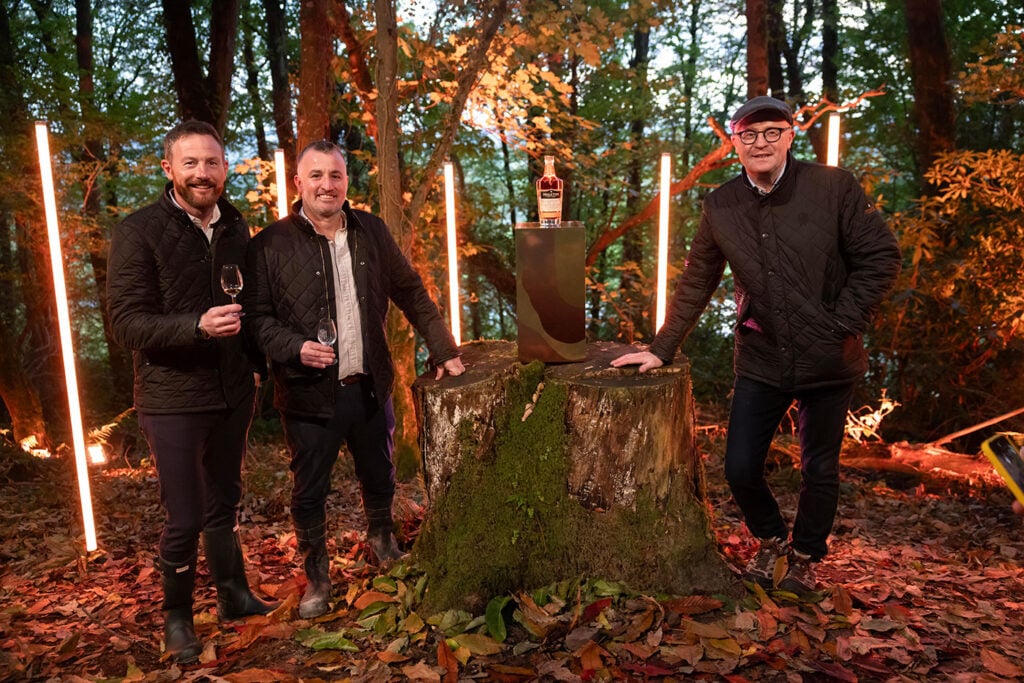
Kevin O’Gorman, Eric Ryan, and Derek Cronin at a twin chesnut tree stump that became a cask
From Waterford to Spain and back
The trees were felled in winter. At Midleton’s on-site cooperage, we learned how the logs were cut into 1.5-metre lengths and sent to Spain, with Galicia’s sawing expertise part of the reason for the journey. The Irish oak project seen in Midleton Very Rare’s Dair Ghaelach series had followed a similar route, with releases traceable to particular woodlands and trees. We were told there are currently about 150 Irish oak casks on site. Chestnut extends that existing interest in Irish-grown timber.
Drying requires care. If the moisture comes out too quickly, the wood can crack. The preparation also changes what the wood will eventually contribute to the liquid. A cask begins acquiring its character well before anyone fills it with whiskey. Midleton specifies two years of air-drying before the staves were lightly toasted and coopered into hogsheads. The casks were made through its relationship with the Antonio Páez cooperage in Spain, then returned to Ireland. The hogsheads described at the tasting were approximately 250 litres, filled in April 2021 for the secondary maturation that would take them into 2026.
Derek Cronin had spent three weeks at the Spanish cooperage, so there was an existing connection when it came to raising the casks. A carpenter before he joined Irish Distillers in 2019, he began his four-year apprenticeship under Ger Buckley in 2020 and qualified in 2024, becoming only the second newly qualified cooper at Midleton in more than 45 years. His training included time in Scotland, France and Spain. He now works on cask maintenance and projects within an operation holding more than two million casks.
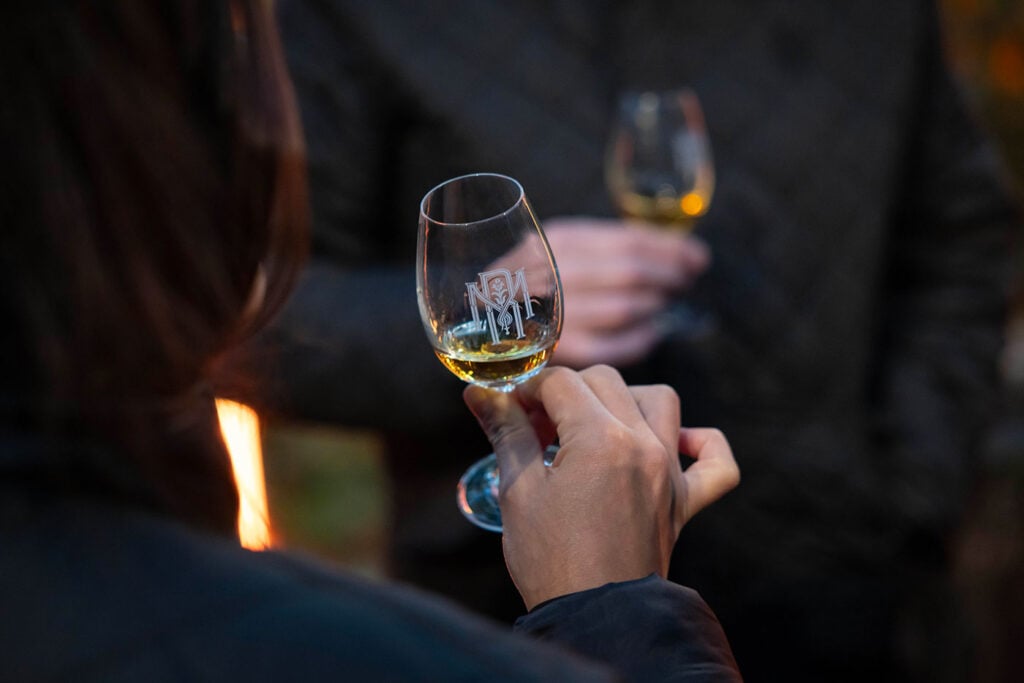
New whiskey is exciting, but a new cask really adds to the intruige
Worth the losses?
Unusual maturation doesn’t begin when a distiller picks a wood from a list. Someone has to know how it behaves under a tool, how readily it marks, how it bends and how well it holds the liquid.
Oak is the king of the forest, a sturdy ol’ reliable whose strength and liquid-holding properties help explain its dominance in cooperage. Chestnut was described as smoother and easier to work, but easier to mark too, and its greater porosity means higher losses. In this case, 29% in five years.
If that figure refers to liquid volume, it means roughly 71 litres remained for every 100 litres filled. The team also cited losses of around 16 to 17% in a single year from French and Japanese chestnut casks, so that’s something at least. I’m also not going to patriotically declare Irish superiority.
You’d need the cask specifications, preparation, filling conditions and warehouse conditions before you could create a national league table of chestnut.
Such as oak, again
In 2022, I wrote about Irish whiskey’s maturation opportunity, prompted by three words in the Irish Whiskey Technical File: such as oak. Irish whiskey can mature in wooden casks other than oak; Scotch whisky must mature in oak. It is a small distinction in the wording with considerable implications for the person buying the barrels.
“Wood has always played an essential role in shaping the character of our whiskeys, but with Irish sweet chestnut we saw an opportunity to explore something entirely new,” says O’Gorman.
“Moving beyond traditional oak, we wanted to understand how this exceptional wood could bring a new dimension to one of our finest whiskeys.”
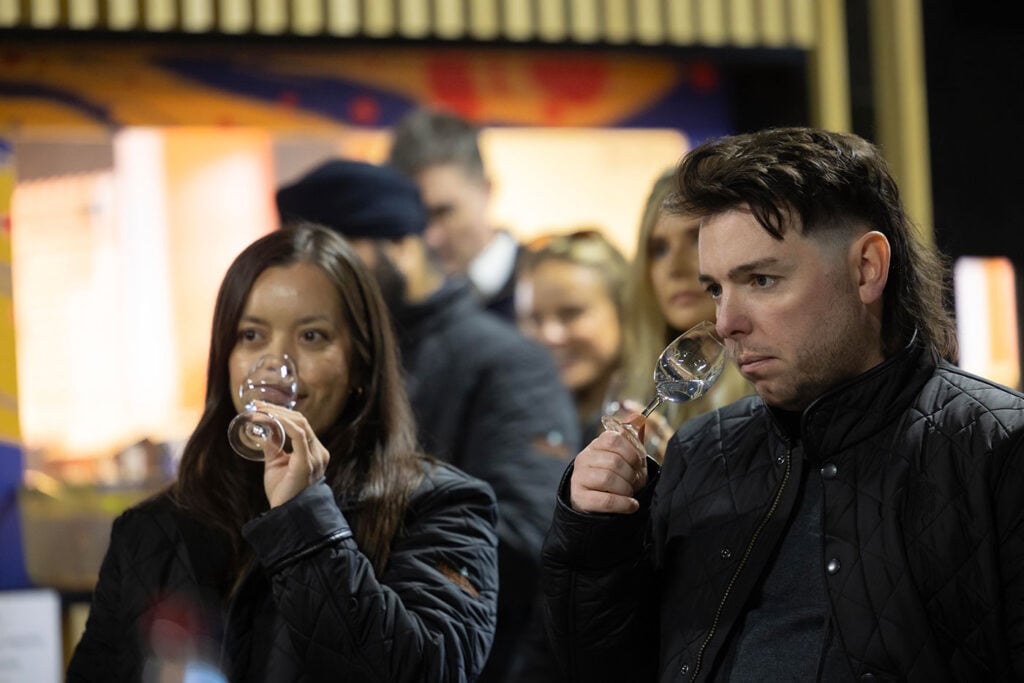
Yours truly taking this whisky business very seriously, as is Melita of Spirits Business fame
The distinction of Midleton Very Rare
Typically, these experiments are released under the Method and Madness banner, with releases featuring French chestnut, Japanese chestnut and Japanese cedar. The mature stock, length of the project and losses all help explain why the first Irish chestnut release is limited.
It’s a big sign of confidence in this whiskey that it bears that Midleton Very Rare name, not Method and Madness. There is a risk in projects like these that commit older whiskey to unfamiliar casks. But Irish Distillers has the means to take those risks, and a team more than capable of deciding whether the flavour developing is worth the whiskey disappearing, and when to stop.
O’Gorman joined Midleton in 1998 and oversaw its warehouse inventory from 2007. Eric Ryan joined in 2010, spent 12 years in brewing and distilling, and became maturation and innovation specialist in 2022. The project draws on people who know the distillates as well as the wood, with an inventory that allows them to consider age, cask type and fill number together.
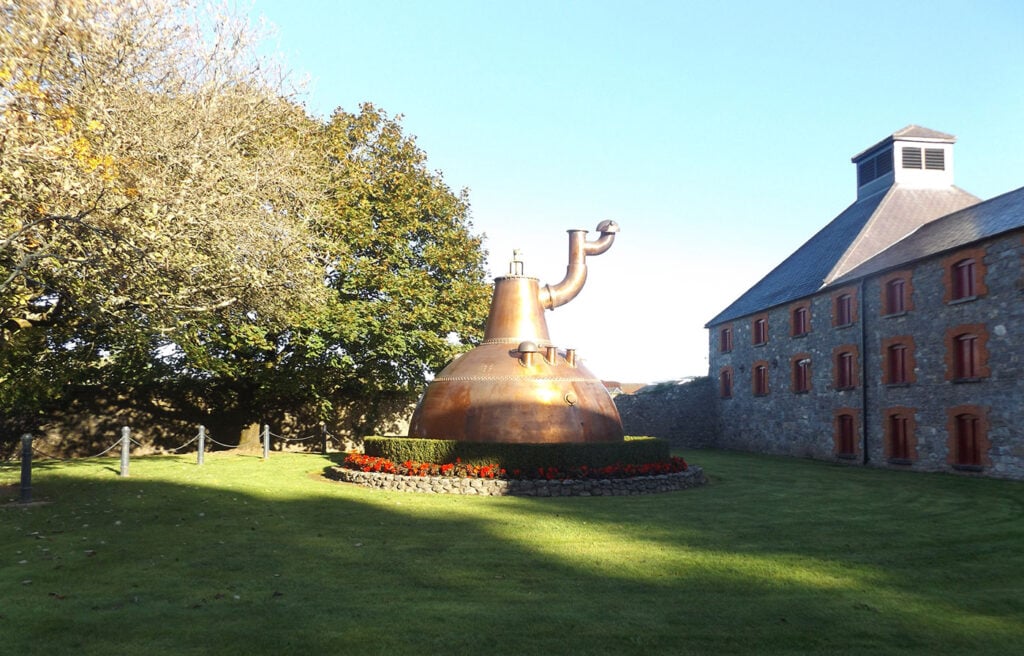
Midleton is home to a wide range of whiskeys
Tasting Midleton Very Rare Chestnut Edition
In the glass, the finished whiskey opens with a forceful hit of spice before its sweeter notes emerge. To be frank, at first I wasn’t sure about this. With subsequent tastings, it just got better and better. What I initially found to be a slightly overwhelming hit of aromatic, tannic spice developed into a range of complex and interesting notes, with the likes of chilli oil and cola cubes joining the more classic pot still spices of gingerbread and clove. The tropical fruit of the mature Trad makes itself known with glorious persistence, while sandalwood brings another aromatic reference. Chocolate and vanilla add sweet, creamy decadence.
It would have been easy to judge the chestnut entirely by how much it preserved of what I already liked. The Trad sample could, and should, still be bottled as its own release. So why interfere with something so good? Exploration has a cost. New worlds are challenging. My palate didn’t know Irish sweet chestnut. It does now. Five more years and a substantial loss of whiskey need to buy you something worth having in the glass. Exploration alone doesn’t excuse a wrong turn when the whiskey is in the glass, but Midleton Very Rare Chestnut Edition is simply very good. All’s well that ends well.
A second fill, a shorter maturation or a different balance of pot still styles could each reveal something else. It’s unlikely we’ll reach a place where Irish sweet chestnut is commonplace enough for it to become a consistent tool, but it does remind us that a little wiggle room in legislation can be a good thing. Such as oak gives Irish whiskey the capacity to surprise us.**

The new Midleton Very Rare Chestnut Edition
Midleton Very Rare Chestnut Edition Tasting Note:
Nose: Honey-drizzled red apple and caramelised orange peel, followed by Tunnock’s Milk Chocolate Caramel Wafer and vanilla. Nutmeg, cinnamon and fragrant sandalwood build around the sweetness, with a little nuttiness and an earthy woodland note underneath.
Palate: Big spice to start, with cracked black pepper and a prickle of chilli oil, before sweeter notes of red cola cubes, chocolate and vanilla emerge. Orchard fruits and bright orange peel bring freshness, while soft wood tannins and delicate herbs add depth to the rich, full-bodied pot still texture.
Finish: Long, with the fruit gradually fading to leave the warming pot still spices, sandalwood and a gently drying chestnut character. Chocolate sweetness lingers beneath the peppery heat.
*Disclosure: Irish Distillers hosted and covered the costs of the Midleton Very Rare Chestnut Edition press trip that informed this article. All opinions are the author’s own.
**On another note, the week in which your biggest whiskey producer releases a chestnut cask-finished whiskey is an interesting one for the Irish Whiskey Association to back the Scotch Whisky Association’s objections to the English Whisky GI, isn’t it?