Trade
Trade

For the past three years, Sam Barber has spent his working week at Wylye Distillery making whisky.
Not gin or vodka while the spirit matures. There’s no cask ownership scheme. Just whisky. Quite a fair amount of English whisky for a guy working out of a converted Wiltshire farmyard.
Barber built the equipment, secured the barley, established the process and filled the warehouse before making any meaningful movement to tell the world what he’s been up to. A lot of people only know there was a distillery there because it featured on Cooper King’s annual English Whisky Map.
Today, a press release finally dropped into the inbox. It reminded me I’ve been meaning to look into Wylye Distillery (pronounced why-lee, like the coyote) and some early research reveals that it might just be one of the most interesting projects in English whisky.

Say hello to Sam Barber, seen here at Wylye Distillery
Who is Wylye Distillery?
Since July 2023, Barber has filled well over 1,000 casks and built annual production to around 45,000 litres of pure alcohol. He has done so largely alone, using a half-tonne brewhouse, five temperature-controlled washbacks and two traditional Forsyths copper pot stills installed across a group of old agricultural buildings at Windmill Farm.
The first bourbon barrels reached three years old in late July 2026, but there’s no rush to bottle them. Some casks are already earmarked for 15 and 21-year-old releases. Patience is easier to preach than practice when you have more than 1,000 barrels sitting across the yard, so fair play.
The Wylye Valley has a long agricultural and malting history, with shallow chalk soils, fertile arable land and a relatively benign maritime climate well suited to barley growth. Barber’s intention was to anchor the distillery in those surroundings and carry out brewing, distillation, maturation and, eventually, bottling on one site.

Long fermentations, high reflux and precise cut points makes Wylye whisky what it is
How whisky is made at Wylye Distillery
The production process begins with laureate barley grown at Manor Farm, just over the hill from the distillery, before travelling to Warminster Maltings.
Built in 1855, Warminster is Britain’s oldest working maltings and still uses traditional floor malting. The malt then makes the short journey to Windmill Farm, where water drawn from the site’s chalk aquifer is used for mashing. From field to cask, the essential parts of the process take place within roughly 12 miles. That really is local. You could bloody walk that.
Wylye produces a slightly cloudy wort, run off gradually before distiller’s yeast is pitched for a long, temperature-controlled fermentation. Weak wort is collected while the rakes move gently through the grain bed, then reused as the first water in the following mash. That recovers extract and reflects Barber’s controlled, economical and repeatable approach. I like what I’m hearing.

The stillhouse is in the haybarn. It’s a farm distillery, yo.
Distillation and maturation
In a balanced double distillation, low wines are combined with foreshots and feints before being charged into the spirit still the following day. Steam is carefully regulated to keep the second distillation slow, encouraging copper contact as vapour rises through a long swan neck and an upward-sloping lyne arm before reaching a shell-and-tube condenser.
Barber makes an unpeated, malty new make with orchard fruit at its core. Bourbon barrels from Kelvin Cooperage in Kentucky are the bedrock of the maturation programme, but there are others profiles too: new oak, tawny Port and Douro red wine casks, as well as American, Spanish and French oak seasoned through wineries in Montilla-Moriles and Jerez-Xérès-Sherry. Pedro Ximénez and Palo Cortado are among the wines involved.
Bourbon casks give you a core of potential releases that zero in on distillery character, but the other casks are not there for fancy finishes. Barber is focusing on full-term maturation to study the influence of individual oak types, previous fills and warehouse positions while building a sufficiently broad inventory for future vatting.
The casks mature in dunnage-style arrangements in the Cowsheds, a 6,000-square-foot, L-shaped tin-roofed pole barn divided into four bays. The building embraces the valley’s seasonal changes, from temperatures below freezing in winter to the high thirties during summer. South-facing casks feel more warmth, while others sit in cooler areas with different airflow and humidity.
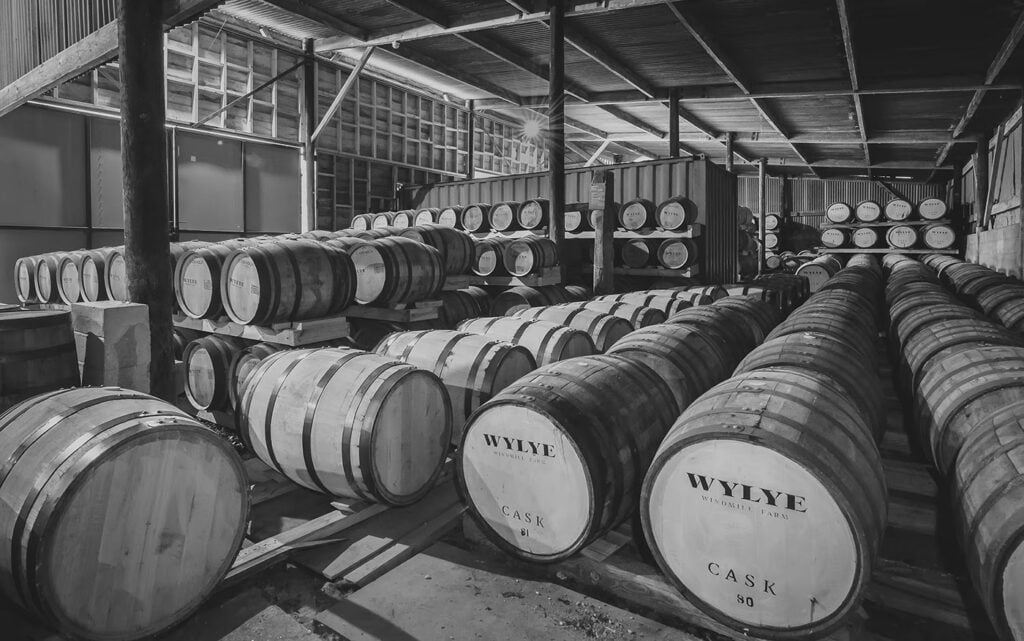
1,000 casks, full of Wylye whisky
Onto the future
The Stables, which are currently used to store malt, will at some stage be converted into a bottling plant. The distillery also plans to welcome visitors to its blending, tasting and dining rooms (complete with a bespoke bar, log burner, cosy interiors and growing collection of books on wine, beer and spirits!), but Barber does run the distillery alone, so it’s appointment only*.
This is where our first proper introduction to Wylye must pause. There are more things to learn about fermentation times, yeast selection, cut points, spirit strength, filling strength, cask specifications, warehouse variation, how Barber intends to assemble the eventual house style…
Most importantly, there are more than 1,000 casks containing spirit that it is imperative I taste as soon as possible for scientific purposes. I’ll have to make sure I visit in the near future to lift the floorboards, figuratively speaking, and examine the distillery in the detail it deserves. Good journalism is exhausting, but someone has to do it.
What can I say, Barber has piqued my curiosity, ironically by avoiding any ploy for attention. Now that he finally is asking, it seems only polite that we do.
*All enquiries to info@wylyedistillery.com.