Trade
Trade

The Dry Martini. There’s no cocktail like it for bringing out the purist in certain people.
You know the sort of thing they say: “Show the gin a bottle of vermouth, throw the vermouth in the bin and then drink the gin.” Noël Coward wrote, “A perfect Martini should be made by filling a glass with gin, then waving it in the general direction of Italy.” Hemingway liked a ratio of 15 parts gin to 1 part vermouth.
I used to order such booze-heavy concoctions, probably to try to look cool. But I actually much prefer my Martinis a little wetter.
Happily though, the purists are in retreat as fashion is swinging back towards something like the early editions. The drink (probably) evolved from the Marguerite: 2 parts gin, 1 part dry vermouth, a dash of orange bitters, and served straight up.
So, what is a Dry Martini, what makes one extra dry or wet, and should you make yours with gin or vodka? Let’s get into it.
Why is it called a Martini?
The name comes from the Martini & Rossi company, which released a dry French-style vermouth in 1900. People began ordering their Marguerites by the vermouth brand, and the name stuck. Or that’s the theory anyway; nobody quite knows.

How do you drink your Martini?
What is a dry Martini?
A classic Dry Martini combines gin and dry vermouth, diluted with ice and served cold, usually with a lemon twist or olive.
The word ‘dry’ originally distinguished the drink from earlier cocktails made with sweeter vermouth. Today, however, it is also used to describe the proportion of vermouth in the glass. Confusingly, the less vermouth a Martini contains, the drier it is considered.
There is no single official Martini ratio, but these are useful starting points:
Classic Dry Martini
A Dry Martini usually contains between four and six parts gin to one part dry vermouth. Our recipe uses a 6:1 ratio, giving the gin plenty of room while retaining the vermouth’s flavour and texture.
Extra-dry Martini
An Extra-dry Martini contains very little vermouth. Some recipes call for a quick rinse of the glass, while others use only a few drops. At the furthest extreme, it is essentially a glass of very cold gin with vermouth somewhere nearby.

Where do you drink your Martinis?
Wet Martini
A Wet Martini contains a higher proportion of vermouth. A 2:1 ratio is close to the style found in Harry Craddock’s 1930 Savoy Cocktail Book, while equal parts gin and vermouth make an excellent lunchtime Martini, particularly served over ice.
More vermouth means a softer, more aromatic drink with a lower alcoholic strength. Far from being a modern innovation, the wet Martini takes the cocktail closer to its roots.
Perfect Martini
A Perfect Martini does not mean one made without fault. In cocktail language, perfect usually means using equal parts dry and sweet vermouth alongside the gin.

Now that looks like a proper Martini
Gin Martini or Vodka Martini?
Gin is the traditional Martini base. Its juniper, citrus and botanical flavours give the cocktail much of its character, with dry vermouth adding aroma, texture and seasoning.
When choosing your gin, remember that there is nowhere for it to hide. Plymouth master distiller Sean Harrison explains: “The simpler the drink, the more the gin has to be balanced around aromas and tastes, the building blocks of flavour.”
A Vodka Martini is cleaner and more neutral, allowing the vermouth, garnish and texture to come forward. It can be exceptionally crisp, but it will not have the botanical complexity of a gin Martini.
Neither is automatically better. If you want a fragrant, characterful cocktail, use gin. If you prefer something cleaner and more austere, vodka is your friend. Just use a good one, because a Martini is a very unforgiving place to hide a mediocre spirit.
Choosing the best vermouth for a Martini
For me, Dolin is king, providing subtle herbal flavours and texture without masking the gin. However, I wouldn’t turn my nose up at Noilly Prat or even Martini Extra Dry.
Top bartender Ryan Chetiyawardana, aka Mr Lyan, makes a decidedly old-school version with Martini Extra Dry and Beefeater gin in a 10:3 ratio.
According to Harrison: “Dolin is my favourite vermouth and combines well with Plymouth Gin, however, I’d rather put Lillet into the glass with Plymouth. The flavours of Plymouth and Lillet are so well matched.”
Lillet isn’t strictly vermouth. It is an aromatised wine, but this demonstrates once again that Harrison is something of a Martini maverick.
Whichever bottle you choose, keep it in the fridge once opened. Vermouth is wine, not an immortal bottle of back-bar furniture.
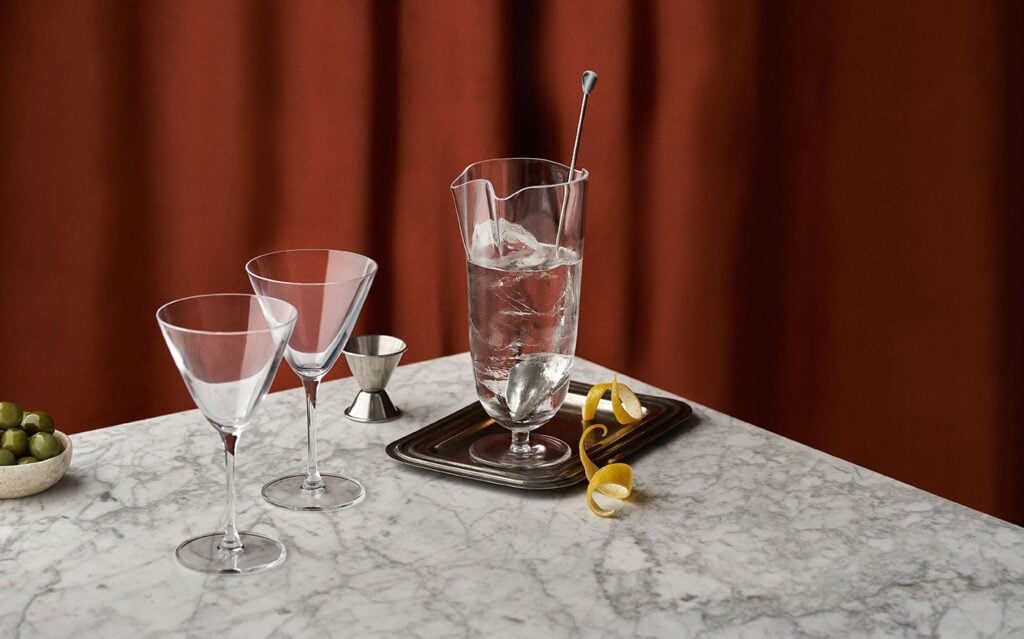
There are many ways to make a Martini, and to garnish it
Choosing your Martini garnish
The two classic choices are a lemon twist and an olive.
Alessandro Palazzi of Dukes Bar in London uses a strip of Amalfi lemon peel, expressed over the surface of the drink and dropped into the glass. I hate to disagree with Signore Palazzi over anything, but I find this too lemony and much prefer an olive or three.
Mr Lyan likes “extra everything, extra vermouth, orange bitters, twist and olive! Even a dot of absinthe”.
A twist and an olive. Why not? Who cares what anyone thinks? It’s your Martini.
What is the best glass for a Martini?
The familiar V-shaped Martini glass is the classic choice, although its wide rim and enthusiastic tendency to spill are not always practical.
A smaller Nick & Nora glass keeps the drink colder and is easier to carry. A vintage Port or small cocktail glass works rather beautifully, too.
Whatever you use, chill it thoroughly before pouring. A smaller glass is preferable to an enormous one because a Martini should be finished while it is still painfully cold.

Alessandro Palazzi with his famous Martini
The Duke’s Bar Martini
Once you have chosen your ingredients, the key is to make sure everything is as cold as possible. That means the gin, vermouth, glass and mixing equipment.
Alessandro Palazzi from Duke’s Bar in London serves his Sacred gin straight from the freezer. But don’t cut corners by making them in advance; Bernard de Voto, in his 1948 book ‘The Hour’, says that each drink must be made freshly: “You can no more keep a Martini in the refrigerator than you can keep a kiss there.” What a beautiful sentiment!
One thing most Martini lovers agree on is that James Bond is wrong. A Martini should be stirred, not shaken, because shaking introduces air and ice crystals and ruins the whole thing.
Finally, there’s the important question of how many you should have. Palazzi refuses to serve more than two, though, admittedly, his are enormous. I prefer to have two small cold Martinis rather than one large one. For De Voto, the ideal number consumed during the cocktail hour was two: “How fastidiously cold a second Martini is to the palate but how warm to the heart.” But, De Voto writes, you should never rule out a third: “Certainly I’ll have another one… one more, and then with a spirit made whole again in a cleansed world, to dinner.”
Classic Dry Martini recipe
Here’s my ideal dry Martini recipe.
Dry Martini ingredients
60ml Plymouth Gin
10ml Dolin Vermouth de Chambéry Dry
Lemon twist and two almond-stuffed olives, to garnish
How to make a dry Martini
- Chill a Martini or Nick & Nora glass.
- Fill a mixing glass or small decanter with plenty of ice.
- Pour in the chilled gin and dry vermouth.
- Stir vigorously for around 30 seconds, until thoroughly chilled and properly diluted.
- Strain into the chilled glass.
- Express a strip of lemon peel over the drink, then garnish with the twist and, what the hell, two almond-stuffed olives on a cocktail stick.
Serve immediately, as cold as possible.