Trade
Trade

I fondly recall a family excursion to visit the Cutty Sark in Greenwich during the 1960s.
I was only a young lad at the time; my brother and I had recently been given “crew cuts” by my mother (she really didn’t like the result!). As it was a typically damp British summer, we were both clad in those ubiquitous black or grey plastic macs that seemed to be the fashion of the era. I have a vivid memory of a black-and-white photograph showing the two of us standing proudly at the ship’s wheel. It was a fixture on my grandmother’s sideboard, or perhaps hung on her wall, for many years, though I fear it has since been lost to time.
I’ve been a fan of the Cutty Sark brand for some time, even collecting a few older bottlings over the years. It is also a whisky I fondly recall from my father’s office, where it always stood out for its bright yellow label and unique ‘Blended Scots Whisky’ tagline, rather than ‘Blended Scotch Whisky‘. Consequently, although it came as a surprise at the time, I was quite excited to learn that the Edrington Group had sold the brand to La Martiniquaise-Bardinet, the owners of the Glen Moray Distillery.
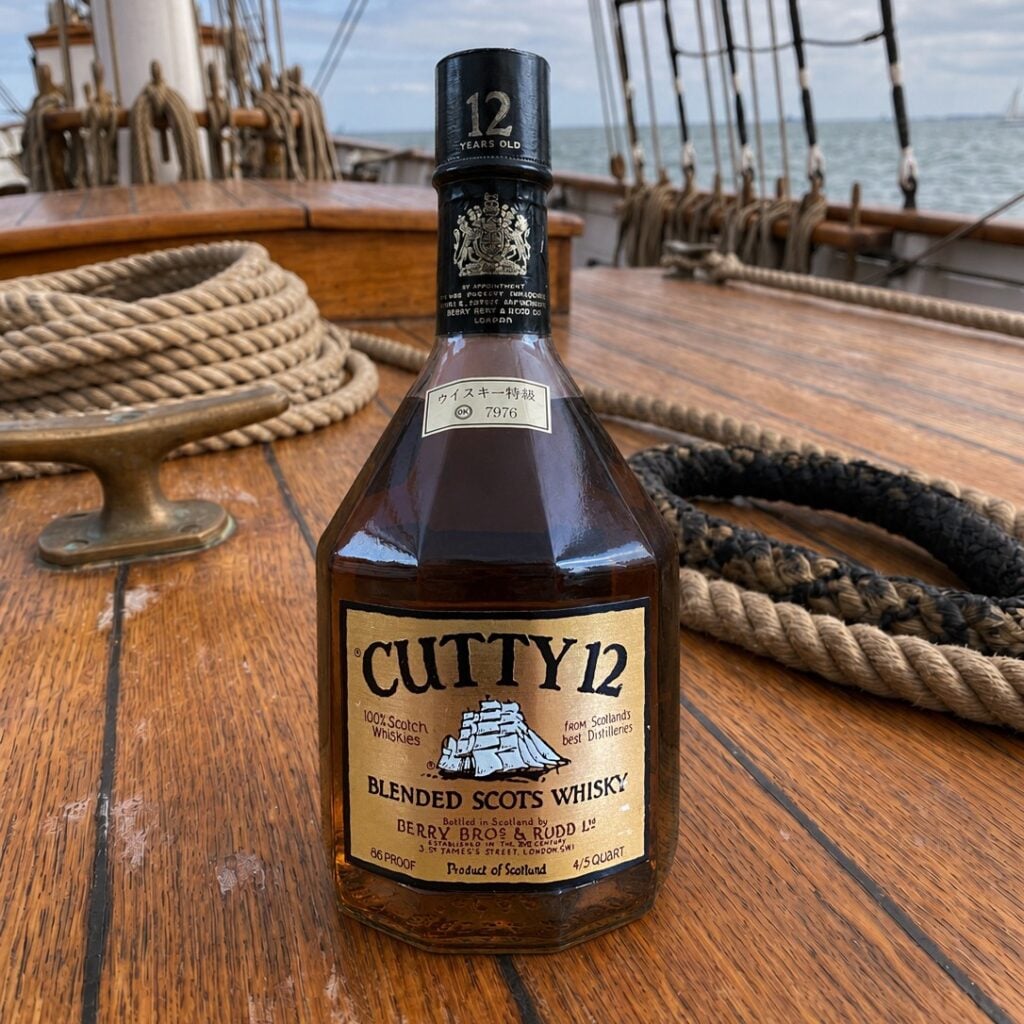
My prized Cutty Sark 12 Year Old*
Not the only fan at Master of Malt
I recall catching a glimpse of the old Cutty Sark exhibition at the Glenrothes Distillery visitor centre, which, though closed and a bit dusty, had officially opened in 1991 when the location was named the spiritual home of the Cutty Sark blend. Following The Edrington Group’s acquisition of the brand from Berry Bros. & Rudd in 2010, the brand home was unfortunately closed. Hopefully, all the historical artefacts have been securely preserved, and the exhibition will be able to reopen its doors in a new home in the future.
In late 2018, La Martiniquaise-Bardinet acquired Cutty Sark from the Edrington Group, leading to The Glen Turner Company Ltd. officially taking charge of the whisky brand. The transaction was formally completed in early 2019. Later that summer, I recall a visit to Glen Moray shortly after an expansion had increased its production to 5.5 million litres, driven by a new 11-tonne mash tun and an extended stillhouse wing. Subsequent plans to expand further were finalised by 2023, ultimately raising the distillery’s maximum annual capacity to 8.5 million litres. At the time, I asked when Glen Moray single malt would begin to be used in the Cutty Sark blend. There was no definitive answer, as the expansion plans at the time were to meet the Label 5 demand.
The Prohibition Blend, introduced by The Edrington Group in 2013, had long been a favourite and a staple in my whisky cabinet, and I was wondering when Glen Moray would start being part of the blend. It was Jake’s Whisky of the Month in August 2024.
The Cutty Sark brand celebrated its 100th anniversary in 2023, commemorating a century since its creation by Berry Bros. & Rudd in 1923. To mark the milestone, the brand launched a limited-run “Centenary Edition” created by Stephen Woodcock, his first key project after joining the brand in 2021. I was very privileged to be invited to the launch, held aboard the Cutty Sark in Greenwich, and I was able to tell Stephen just how good I thought it was. I’ve noted it was Jake’s Whisky of the Month back in June 2025, too. I’m not the only fan at Master of Malt!
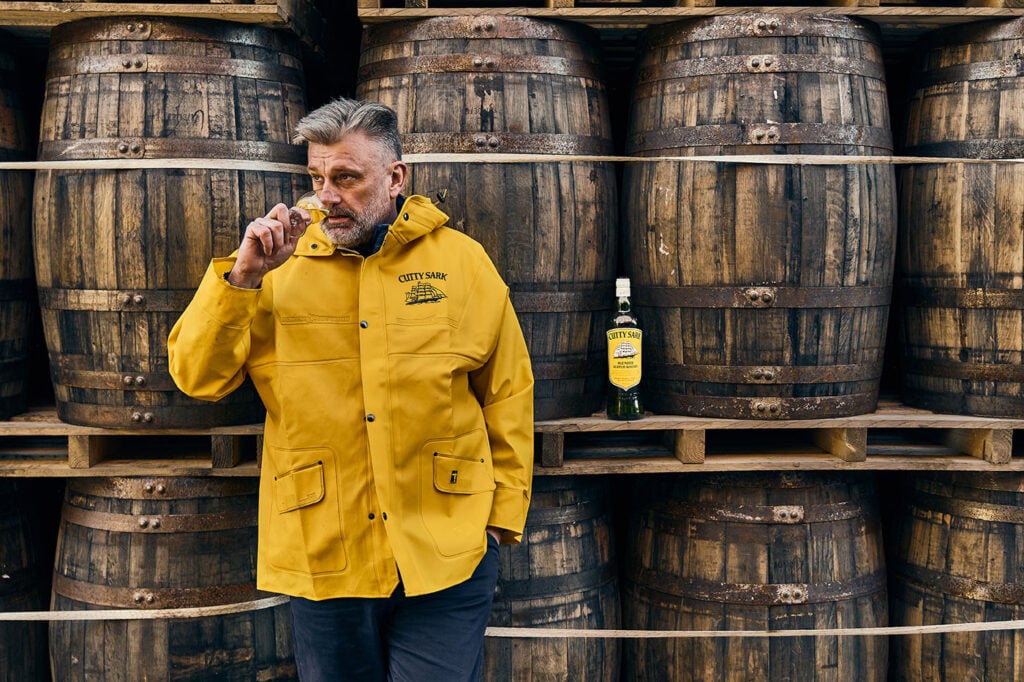
Woodcock is the head of whisky creation at La Martiniquaise-Bardinet
The Art of the Blend: Stephen Woodcock’s Cutty Sark Story
I first spoke to Stephen Woodcock back in the day, when social media was a lovely place, so when I met him in real life at the Bunnahabhain distillery back in 2018, I felt I already knew him well as a friend. Since then, I’ve watched his journey through the Scotch whisky industry with great interest.
After tasting the recently launched 17-Year-Old and immediately wanting to make this my Whisky of the Month, I thought it would be great to find out more about the brand and the man who has brought it together:
Stephen’s career began far from the blending room, starting with Diageo at the Dundashill Cooperage in Glasgow. As Stephen admits, “what I knew about coopering could probably have been written on the back of a postage stamp,” but that formative period—filled with the flexibility to learn and grow—provided the foundation for everything that followed.
His path took him from the cooperage to managing distilleries across Speyside and Perthshire, culminating in his role at the stunning Blair Athol. Yet, it was his time at Distell, overseeing operations for Bunnahabhain, Deanston, and Tobermory distilleries, where he truly found his calling. When the senior blender position opened up, Stephen stepped into the blending department. There, he discovered a passion for the industry’s long-term puzzle, fascinated by the challenge of managing inventory, decades into the future, to ensure the right liquid is ready at the right time.
By 2021, that journey brought Stephen to the La Martiniquaise-Bardinet group as head of whisky creation. Based at the Glen Turner facility near Edinburgh, he now oversees a portfolio that includes Label 5, Sir Edward’s, and the flagship single malt, Glen Moray. But his primary focus remains the legendary Cutty Sark.
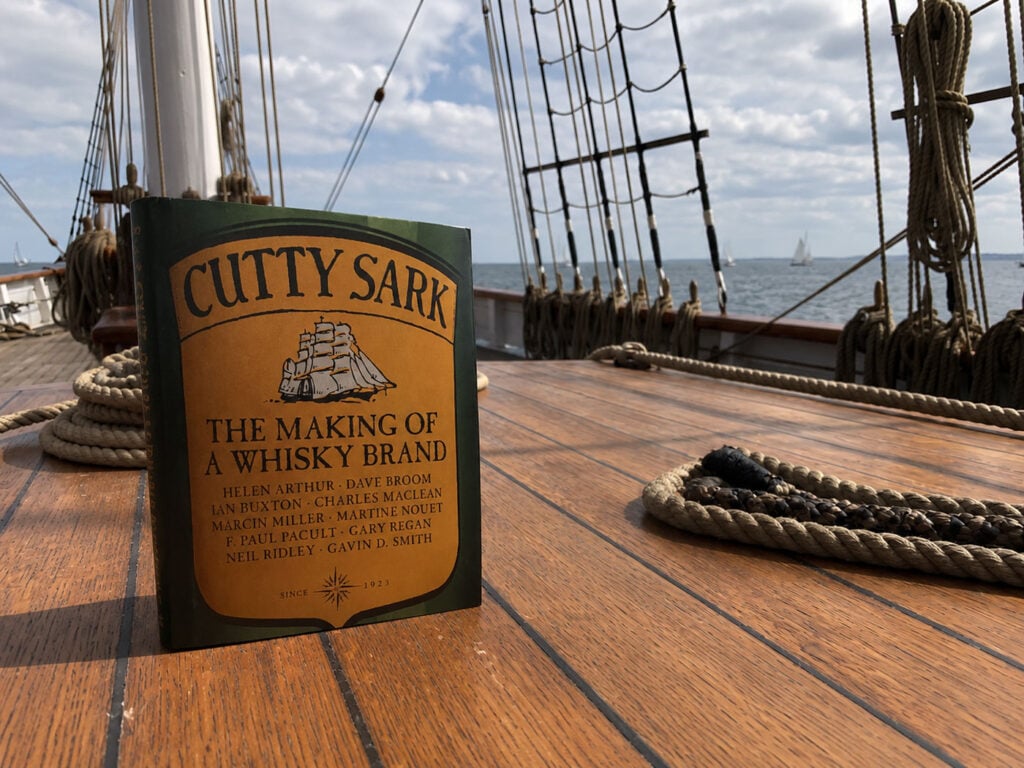
There’s a fabulous book about the whole story for further reading: Cutty Sark, The Making of a Whisky Brand**
History, poetry, bootleggers, and more
The tale of Cutty Sark Blended Scotch Whisky is rooted in an independent spirit and nautical adventure, born from the creative partnership between Francis Berry and Hugh Rudd at Berry Bros. & Rudd. Seeking to defy the era’s heavily peated conventions, they crafted a lighter, smoother, more accessible blend and named it after the legendary tea clipper. That ship, in turn, drew its name from the scantily-clad witch, Nannie Dee, a character from Tam o’ Shanter, the 1791 masterpiece by Robert Burns. In the poem, Nannie sports a “cutty sark”—an archaic Scottish phrase for a short linen nightdress or undergarment.
The ship’s original owner, John “Jock” Willis, was a great admirer of Robert Burns. It was the legendary imagery from that poetry that gave rise to not only the clipper’s title, but its striking figurehead, too: A representation of the witch Nannie Dee clutching the severed tail of a fleeing steed.
That spirit of exploration lives on today, particularly in the brand’s connection to the Prohibition era and Captain William “Bill” McCoy. As Stephen notes, that period defines the brand’s character: “There is something fascinating about that period in the brand’s history. It speaks to the independent spirit that has always defined Cutty Sark, a brand that was created to challenge convention and offer an alternative to the Scotch whiskies of the day. The Prohibition story reinforces that image of a whisky willing to buck trends and dare to be different.”
This philosophy of accessible, versatile quality guides the brand today, whether in the original blend, the higher-strength Prohibition Edition, or their new, more premium expressions.
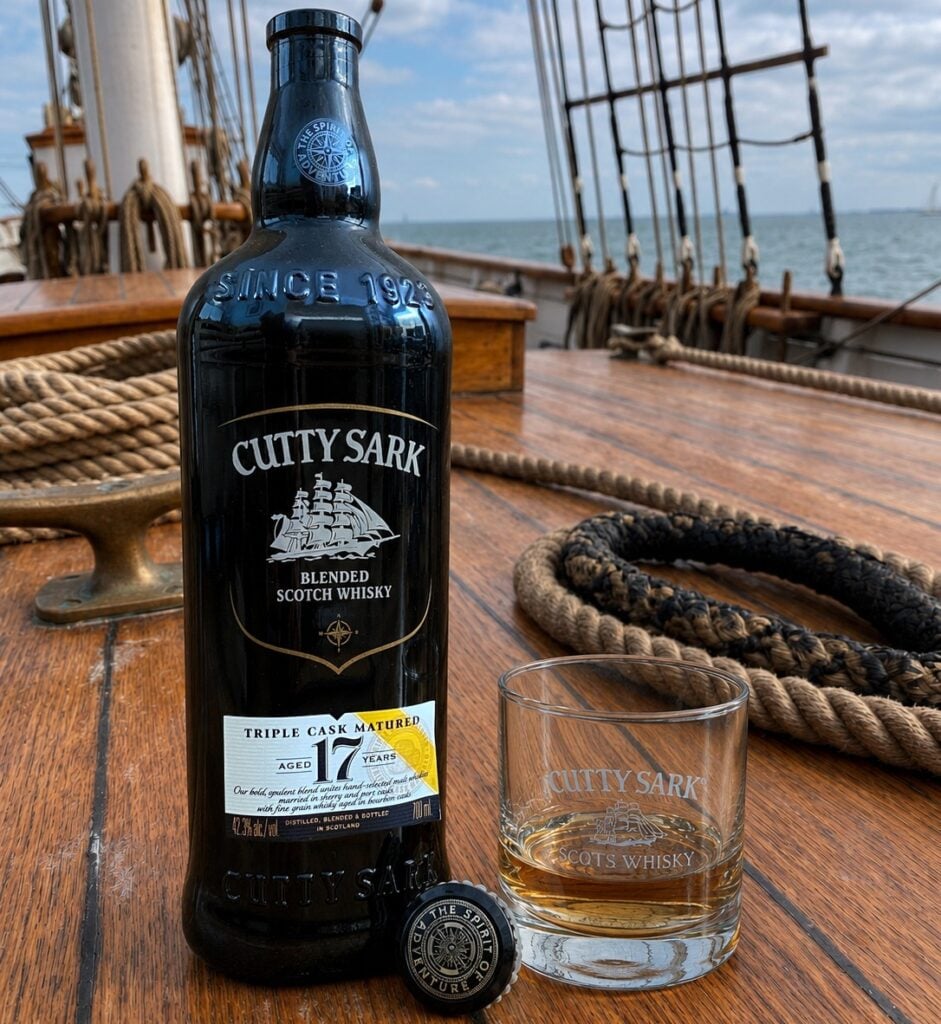
I love the bottle design, and the stopper is on another level!***
Cutty Sark 17 Year Old
The most recent chapter of this story is the Cutty Sark 17-Year-Old, and it’s my Whisky of the Month pick for August. I was poured a dram of this at a recent whisky festival, and it was an instant hit with me. Since getting my hands on a bottle, it’s grown on me even more. I love not only the whisky, but the bottle design, the stopper, and the presentation box, too! Top work all round!
For Stephen, this release was about premiumisation and depth, creating a whisky where the constituent malts could truly sing, underpinned by balanced, well-matured grain whiskies. The guiding principle for the project was simple: don’t rush. The malt components were vatted and then split between first-fill sherry and first-fill Port casks, allowing the flavours to marry slowly. “Ultimately, the 17-year-old was intended to send a very clear message: compromise was never an option. Every component had to earn its place in the blend, resulting in a whisky that delivers richness, complexity and sophistication whilst remaining unmistakably Cutty Sark.”
For Stephen, the project was also a triumph of collaboration. He emphasises that this wasn’t the work of one person, but a collective effort from a supportive team. On a personal level, he admits to a rare sense of pride in seeing his name associated with such a high-quality expression, a moment he looks back on with tremendous satisfaction.
Looking ahead, while Stephen hints that other age statements might be on the horizon, the current focus is on building the success of the 17-Year-Old. The brand continues to grow, particularly in the UK on-trade channel, with dedicated events planned for Repeal Day and a presence at upcoming festivals like Whisky Live Paris. As Stephen puts it, while he won’t give away all the secrets brewing in the background, the Cutty Sark spirit remains defined by its determination to explore, innovate, and add new, vibrant chapters to its historic story.
Have you tried it yet? I’d love to know your thoughts on any of the Cutty Sark range. I’m still searching for a few more old bottlings, and some other bits of Cutty Sark memorabilia. I’ve been looking for a while, and just last week, before this article was published, I found and purchased a 1970s Cutty Sark 12 mirror for the office. It is MAGNIFICENT!
I reckon I’d look pretty fetching in one of those yellow jackets, too, don’t you?
Much love, (Boutique-y) Dave

Taken at the helm of the Cutty Sark, September 2023****
Some Notes about Proof, Alcohol by Volume, and bottle sizes:
- It was back in 1980 that the UK made the official shift from the traditional “proof” nomenclature to the more modern Alcohol by Volume (ABV) system, following a directive from the European Economic Community. I find it interesting how the old British measurement differed from the American one; before the change, a typical spirit bottled at 40% ABV would have carried a 70° proof designation on the label.
- The landscape of British whisky measurements underwent a seismic shift on January 1, 1980, when the industry bid farewell to fluid ounces in favour of metric volumes. Before this regulatory pivot, the quintessential UK bottle stood at 26 ⅔ fluid ounces—roughly 757ml. This evolution towards modernisation happened in two distinct chapters: first, at the start of 1980, when spirits moved to a 750ml standard as fluid ounces were phased out; and later, on January 1, 1992, when EEC directives harmonised volumes across the continent, establishing the 700ml bottle we know today.
- From the 1960s through the mid-1970s, for the US market, bottles were marked as ⅘ Quart—a measurement representing 25.6 fluid ounces or roughly 757ml—and were consistently bottled at 86° US proof, which we recognise as 43% ABV. (US fluid ounces are not the same as UK fluid ounces!).
- US Proof, which is simply the ABV multiplied by two, was first adopted around 1848 when they defined 100 proof as exactly 50% alcohol by volume (ABV)
*Note the label details: ⅘ Quart and 86° Proof. I think in this case, these are US measurements which equate to 757ml and 43% ABV.
**Written by several well-known whisky writers, it’s out of print now, but I’m sure there are copies in secondhand book sellers.
***It seems to have a ceramic top, which, when I have enough of them, will become cupboard door pulls. That’s one of my old Cutty Sark tumblers, too.
****Photo taken by MoM legend Jake Mountain, no less.