
An Instagram message at the end of November 2021 introduced me to Retribution Distilling Co. It simply read: ‘Hello, random message of the week. Can I send you a new make spirit sample for some feedback?”
I’m not sure how I was qualified to review a new-make spirit. Still, I replied with my address, alongside some recommendations of actual distillers to consult for an expert opinion. In due course, the sample arrived just before Christmas, and over the Christmas break, I sat down with the sample and gave the founder, Richard Lock, some honest feedback. I tasted it alongside some other new-make samples that I had, and all was well, as I’m sure Richard already knew.
A year after our first conversation, Richard contacted me again. He shared his plans to start distilling peated spirit, using peat sourced from the local area. He also mentioned that he was experimenting with various malts while designing and building his own malt kiln. His memorable quote to me was, “How difficult can it be?”
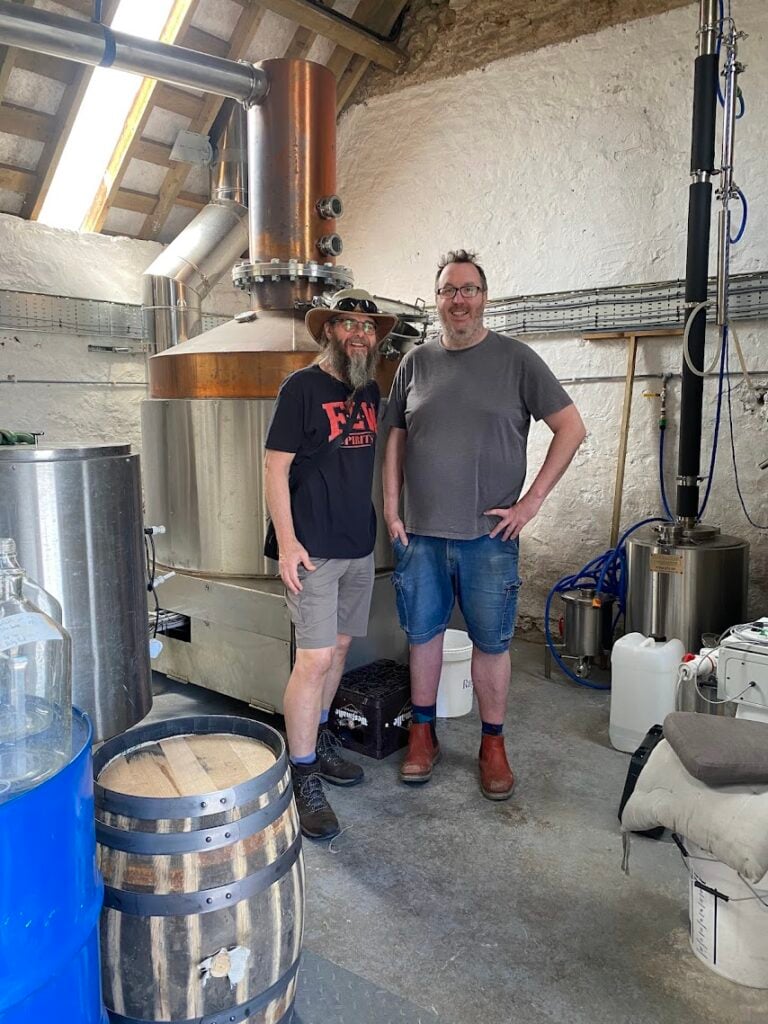
Say hello to Dave Worthington and Richard Lock
A deep dive into Retribution Distilling Co.
Richard founded Retribution Distilling Co. in 2020. Our initial in-person meeting was at the 2023 Rum Show in London. Although his enthusiasm was clear in our online exchanges, his deep passion for excellent spirits was even more evident when we met in person.
During my 2024 summer hols, I spent a fascinating afternoon visiting Richard at his small farm distillery near Frome, in Somerset. The operation is housed in converted old farm buildings, which originally served as a threshing barn and general farm buildings. Transforming the space into a functional distillery required extensive renovation work. The distillery’s evolution began with a single, 400-litre copper alembic.
Initially, the process was time-consuming: separate wash and spirit runs meant it took six weeks to fill just one 200-litre bourbon barrel. A significant improvement was made in 2022 with the arrival of a new, 1,800-litre direct-fired copper pot still, designed by Richard. This instantly streamlined operations, working in tandem with the original alembic, which was then dedicated solely to the spirit runs.
A trip to Retribution Distilling Co.
At the time of my visit, equipment was being relocated in preparation for the delivery of a new, larger spirit still, to replace the original alembic, expected by the end of that summer. All of those upgrades have been completed, and he can now fill the grand sum of three casks per week, all going well!
Converted old stone pig pens across the yard now serve as dunnage maturation warehouses. We tasted several exceptional casks here, including a fantastic single malt aged in a Chestnut Octave. We also sampled one of his initial peated malts, just a few months old, which was maturing in a Port cask. It had already developed a beautiful colour and a wonderful flavour. Outdoors, in a separate pen, was Richard’s custom smoker, used for Somerset peat kilning green malt sourced from Warminster floor maltings—a clear point of pride for him.
The derelict stone barn, previously situated behind the main distillery building, has undergone reconstruction to serve as a new maturation warehouse. This rebuild was completed in October and now accommodates around 70 casks. Richard is also hoping to start floor malting in this new barn before the end of 2026. Initially, just steeping and germinating the grain and using the green malt for production. Richard explained that the tricky and expensive part is having a kiln large enough to make full malting a viable option.
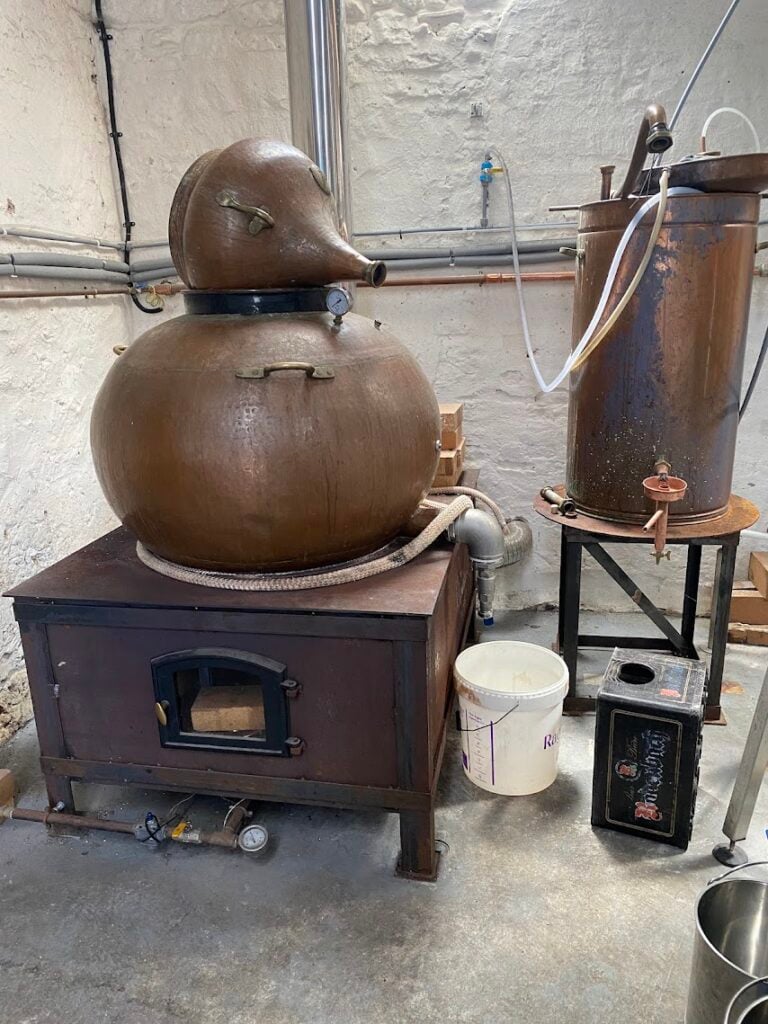
The original alembic still
The first Retribution Distilling Co. whisky
Retribution Distilling launched its inaugural single malt whisky in January 2025. This initial release consisted of approximately 130 bottles, each filled at a cask strength of 62%. He’s followed that up with three more releases to date.
I recently met with Richard at The English Whisky Festival. He was enthusiastic about some new make samples, which he’d produced using different yeasts sourced from local breweries. They were some of the most exciting things I tried that afternoon, and if you want to find out more about that, I recommend that you follow the Retribution Blog here.
Anyway, afterwards, I had a detailed discussion with him about his journey so far, current plans for the year, and his future ambitions for the distillery.
The beginnings – How did Retribution Distilling come to be?
Richard took a non-standard route into the industry. After school, he spent a couple of years in the Royal Navy before attending Plymouth University back in 2000 to study Marine Navigation. This led to work in the recreational diving industry, where he worked as a dive boat skipper and trimix/rebreather instructor. Although this did not pay very well, running a boat provided a massive amount of experience with engines and mechanical engineering. He returned to Plymouth University to study for a Master’s in Hydrography, finding that the oil and gas industry paid significantly better.
Around this time, he began running, participating in several 10k races, half marathons, and even an ultramarathon. However, this strenuous activity eventually ‘knackered’ his back, leading him to stop running and, as one does, pivot to homebrewing.
What started as a homebrewing hobby quickly became an obsession. This led to the installation of a commercial-quality, one-barrel brewery in the garden shed. Every spare moment was dedicated to the craft; I perfected different beer styles through relentless experimentation, reading every available book, and listening to every relevant podcast. It was a complete fixation.
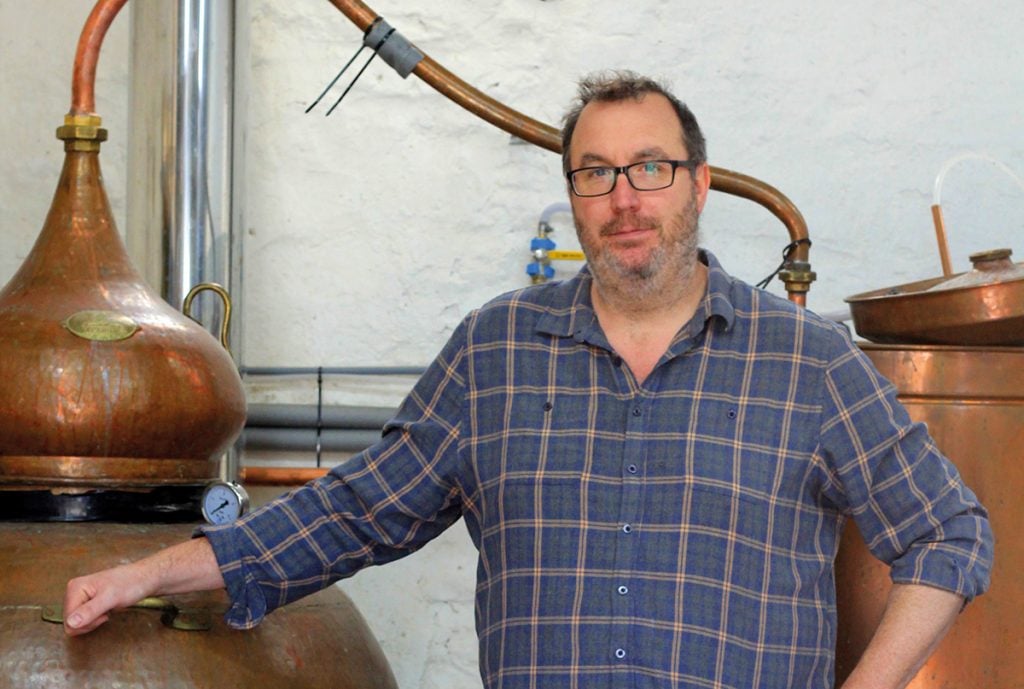
Retribution was founded by Richard Lock
Falling into English whisky
To finance his home brewing passion and save for a house, the founder spent a decade working internationally, from Norway’s Svalbard to South Africa, and Mexico to Indonesia. His time on survey ships provided him with valuable experience in control panels, equipment configuration, networking, and electrical fault finding. While working offshore, he pursued a third degree—a distance learning PGDip in Brewing and Distilling from Heriot-Watt—initially intending to establish a brewery. However, this academic experience introduced him to distilling, ultimately leading to the creation of Retribution Distilling.
Richard went on to say, “The inception of this journey was undeniably sparked by my studies at Heriot-Watt and observing the burgeoning English Whisky movement, coupled with a pure passion for crafting alcohol. While the process of producing exceptional beer is immensely satisfying, witnessing new-make spirit—be it whisky, rum, or vodka—flow from the still offers a thrill of an entirely different magnitude, especially when made from scratch with raw ingredients.”
It’s fair to say that the launch of the distillery was more of an organic process than a deliberate choice, starting with buying a still, experimenting in the shed, and then realising a license was necessary to avoid a problem—Richard essentially fell into it. The major transition was moving from the garden shed to the current location, which made the distillery a viable business. This was also a deliberate decision by Richard and his partner to ensure he did not return to working offshore. This decision was made after the arrival of their second child and the onset of COVID-19, driven by a desire to see the children grow up and allowing his partner to prioritise her career.
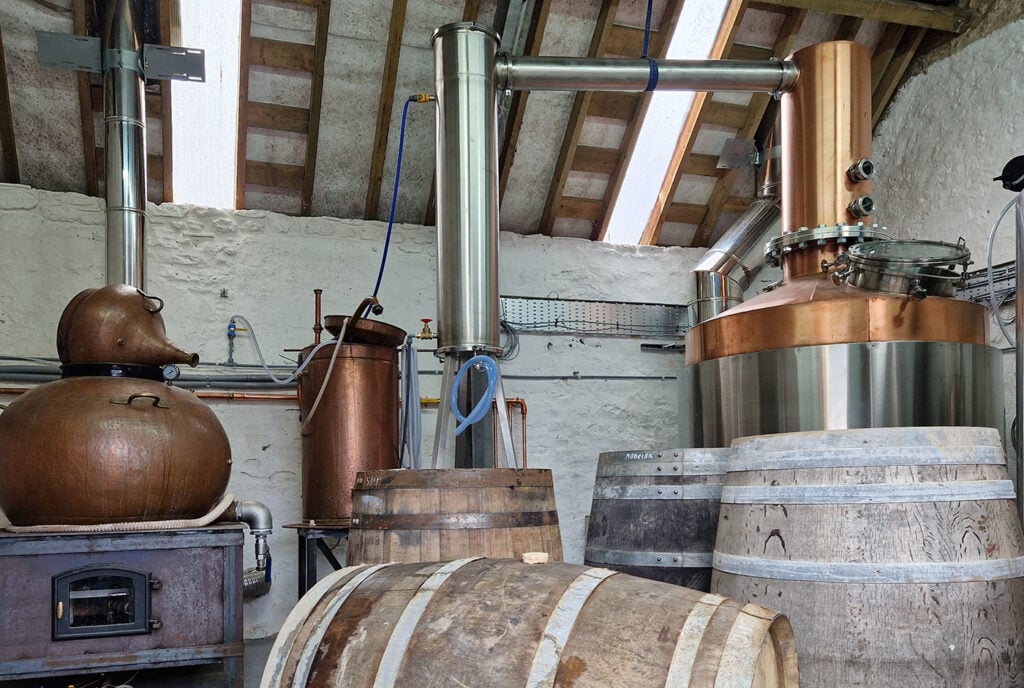
The distillery at Holwell Farm
Genius Loci – “Spirit of the place”
To explain the core mission or philosophy of Retribution Distilling, Richard emphasised the concept of Genius Loci, Latin for “Spirit of the place.” He explained that their work is fundamentally focused on flavour that is linked to place, stating, “It’s all about flavour that is link/tied to place, a lot of what I do at the distillery is because of where we are.” He also believes that the future of whisky is rooted in the past, pre-industrialisation and centralisation. This key links this history to a strong sense of place.
The distillery aims to position itself on the fringes of the English spirits landscape, producing high-quality, distinctive liquids. When visitors attend a whisky show or the distillery, the goal is for them to be impressed by the quality and uniqueness of the spirits. There is no intention of making standard single malt or a ‘Speyside’ style of whisky in England. He adds, “Where is the fun in using the same distillery consultants, steam-heated stills made in Scotland, the same yeast strain and barley varieties as everyone else!” There is no desire to compete directly with larger, established producers on price or volume.
Somerset is not traditionally known for its whisky, but the distillery benefits from its proximity to Warminster Maltings, located just 10 miles away, which is considered to produce some of the finest floor-malted barley in the country. Additionally, excellent barley growing regions are situated both to the east and west, though not directly in Somerset.
The location is significant because the Somerset levels are a vast peat bog. Retribution Distilling utilises Somerset peat to create England’s only English peated whisky, offering full traceability from the bog to the bottle. The proximity to Warminster Maltings allows the distillery to collect green malt weekly and peat it in the on-site kiln. The distillery is also currently experimenting with smoking grain using Applewood as an alternative to peat.
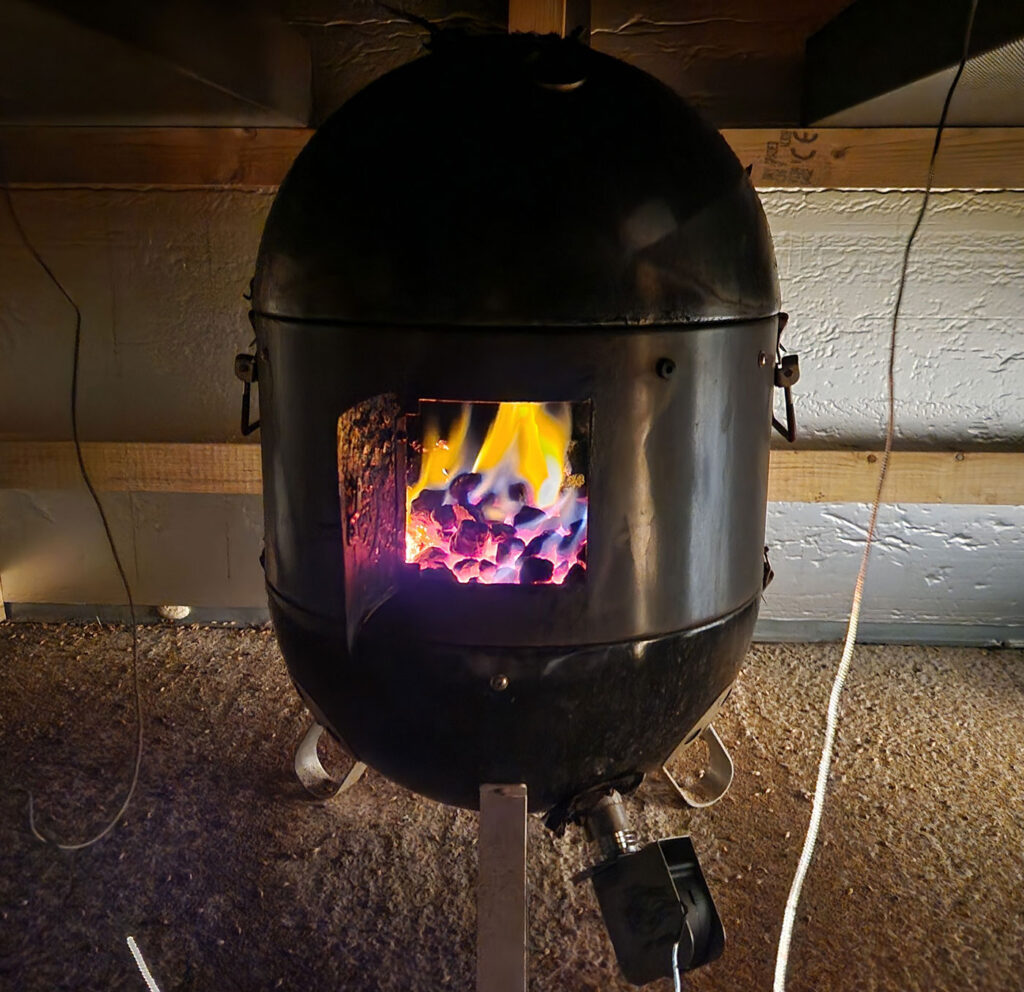
The smoker in action
Production and Craftsmanship
Retribution Distilling’s primary spirit is whisky, though the distillery focuses exclusively on single-cask releases, meaning there is no year-round core product. The first genuinely compelling liquid is anticipated to be ready for market later this year.
This is a complete ‘grain to glass’ operation, all conducted in Frome, Somerset. The majority of the whole grain, both malted and green malt, is sourced from Warminster Maltings, and all milling is performed on-site. A weekly supply of green malt is received, which is then peated and kilned at the distillery and stored until it is needed.
The malt is milled immediately before being transferred to the single infusion mash tun. A standard mash uses 500kg of malt; for the peated production, this is split into 250kg peated malt and 250kg Maris Otter malt. This process yields approximately 1800 litres of wort, which is transferred to the fermenter with an original gravity of 1.070.
Various yeasts are used to ferment the wort into wash, aiming for a final wash ABV of 8–9%. All fermentations last a minimum of 7 days. The capability to both heat and cool the fermenters allows the distillery to maintain a consistent fermentation profile regardless of the season.
The wash undergoes double pot distillation, first in the 1800L wash still and then in the 1,100-litre spirit still. Both stills are direct-fired using gas and were custom-designed by Richard and fabricated by Elite Stainless Fabrications in Swindon. The new make spirit is diluted to an ABV of 58–65%, depending on the specific cask type, before being filled into wood.

Richard with the new stills
Equipment and Raw Materials
The distillation equipment is central to the unique spirit character. Both the whisky stills and the vodka stills were custom-designed in-house and fabricated locally in Swindon. The stills are of a unique design; no other distillery uses anything like them. They were designed and made in England, which is very rare in English whisky production.
The whisky stills are English copper pot stills, featuring direct-firing—a method that significantly influences the wash still process and the final spirit profile. Both the wash and spirit stills have relatively short necks and downward-angled lyne arms. This design is key to producing a heavy, oily spirit with a creamy mouthfeel, which is enhanced by the Maillard reactions and caramelisation that occur in the direct-fired wash still.
The vodka still was also designed in-house, and is used to redistill the heads and tails from the whisky production up to 96.4% ABV. This process results in an exceptionally smooth and creamy vodka.
Primary raw materials are all locally sourced:
Grain/Malt/Green Malt: Warminster Malting.
Yeast: WHC Lab, and various breweries.
Botanicals: Beacon Commodities, Just Ingredients.
Water: Tap and Reverse Osmosis water.
Everything is produced in-house, with raw ingredients entering the facility and the entire manufacturing process taking place there. Buying industrial alcohol to produce vodka or gin does not align with the business philosophy, nor is it the desired identity for the distillery.
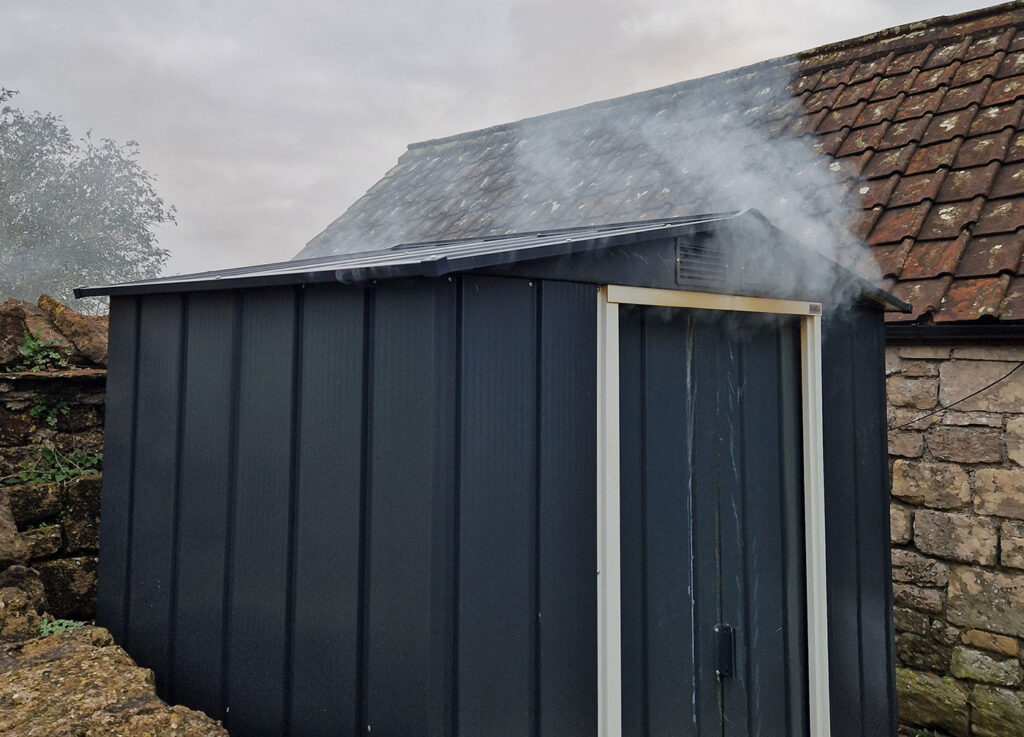
Looks like there’s a new Pope!
The smokehouse kiln
Which leads me nicely to the smokehouse kiln. The original kiln was installed in autumn 2023. It was a 6-by-4-foot metal shed lined with insulation and equipped with perforated stainless steel shelves. The design was based on images of Killowen’s peating shed, and after conversations with Matt McKay, who was working at Bimber at the time, and Richard Beattie from GlenAllachie. Matt and Richard gave Richard the confidence to proceed with the project and led him to think that classic statement, “How hard can it be?!”
Like always, though, Richard never looks to just copy or imitate, so he wanted to build a low-cost kiln that was capable of reducing the moisture level to a point where the malt could be stored at the distillery for a good few months. To do this, he utilises a hot smoker with temperature probes monitoring both air and grain bed temperatures in the kiln and controlling a pit fan, thus controlling the heat output of the smoker.
Richard loads around 90kg of green malt (moisture level 40%) into the kiln. It takes approximately 48 hours to kiln the malt, and they end up with about 60kg of peated kilned malt. He looks to have an end moisture level below 10%, which makes it stable for short-term storage.
In the storms of December 2025, the roof came off the shed. This meant a pause in production while they installed a larger shed to increase production efficiency. Richard has a plan for a 500kg malt kiln, which is a project for down the line, but would be a complete game-changer!
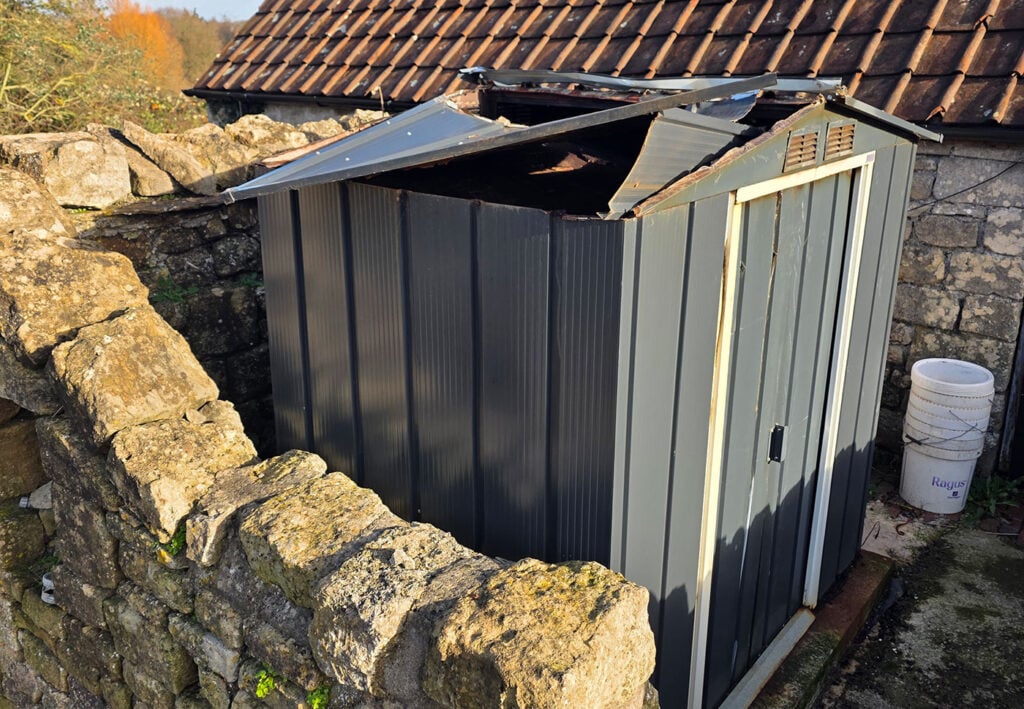
The damage from the storm
Challenges and a potential new site
A major current challenge is a persistent lack of space. At the current location, the distillery is unable to offer tours or any form of whisky tourism, which is beginning to hinder the growth of the business. The distillery is continually searching for a new site, but this is proving difficult to secure. Therefore, while there are many plans, the focus is on execution.
The distillery uses 100% renewable electricity. There are plans to investigate swapping to biogas for the direct-fired stills, plastic use is minimised where possible, and 100% recycled glass is used. Its proximity to Warminster Maltings results in a very low-mileage whisky product.
I asked Richard if anything had gone wrong while he had been setting up the distillery. “One memorable blunder occurred during the construction of the original firebox for our first 400L copper still: I incorrectly cut the opening in the top of the firebox too large for the still’s base. Fortunately, since the material was metal, I simply welded an extra piece back in to fix the mistake!”
Another issue arose after the first incident was recalled: the original industrial paella burner used under the wash still, which cost around £4000, proved to be ineffective. This has since been replaced with industrial ribbon burners, purchased for a fraction of the cost. Richard explained, “This kind of trial-and-error, however, is to be expected when designing equipment from scratch; getting it right on the first attempt is rare.”
Retribution Distilling Co.’s current product portfolio consists of the following:
Whisky
- PR002 Single cask Single Malt English Whisky. Bourbon cask. Direct-fired stills, floor malted Laureate Barley and using a blend of brewing and distilling yeast. (Maybe hard to find now, although a couple of bottles were available at Master of Malt at the time of writing.)
- PR003 Single cask Single Malt English Whisky. Fully matured in an oloroso cask: Direct-fired stills, floor malted Maris Otter Barley, and using a blend of brewing and distilling yeast. Available at Master of Malt.
- PR004 Single cask Single Malt English Whisky. Fully matured in a PX cask: Direct-fired stills, floor malted Maris Otter Barley, and using a blend of brewing and distilling yeast.
Rum
- Pure Single Rum: A cask-aged rum, fermented for a minimum of 7 days and distilled in direct-fired copper pot stills, aged for 3 years in a bourbon cask from Jim Beam, aged and bottled all in Somerset.
Gin and Vodka
- Retribution Vodka, a grain-to-glass vodka made from the heads and tails recovered from whisky production, and re-distilled in direct-fired copper pot stills and the vodka column still.
- Just Juniper Gin, a grain-to-glass single botanical gin, using Retribution Vodka as the base spirit, and one botanical – juniper to produce a truly unique gin.
What’s happening in 2026:
Releasing this year are a single cask 3-year-old rum aged in a Madeira cask, coming in March, and three single cask whiskies for later this year. With a fair wind behind him, there should be some seasonal vodka and gin releases too.
The first Somerset peated whisky is planned for release in 2027, and Richard is also working on smoking green malt with Applewood for an Applewood-smoked new make. He has also just laid down 2 small casks filled with high-ester newmake, taking some rum production techniques and applying them to new make spirit production.
Retribution Distilling is driven by a passion for flavour, which manifests in a list of planned experiments focusing on various combinations of malted and unmalted grains, as well as yeast strains. Their concepts are primarily generated through industry conversations with suppliers, other distillers, and independent bottlers, and by examining historical distillery practices.
The resulting ideas are then refined by integrating a local dimension, all underpinned by the guiding belief that high-quality inputs invariably lead to high-quality outputs. Richard is also looking to experiment more with Single Pot Still mash bills, using Rye, and further mashes using different breweries’ ale yeast. Everything they do is a limited edition. Their biggest release to date has been about 360 bottles.
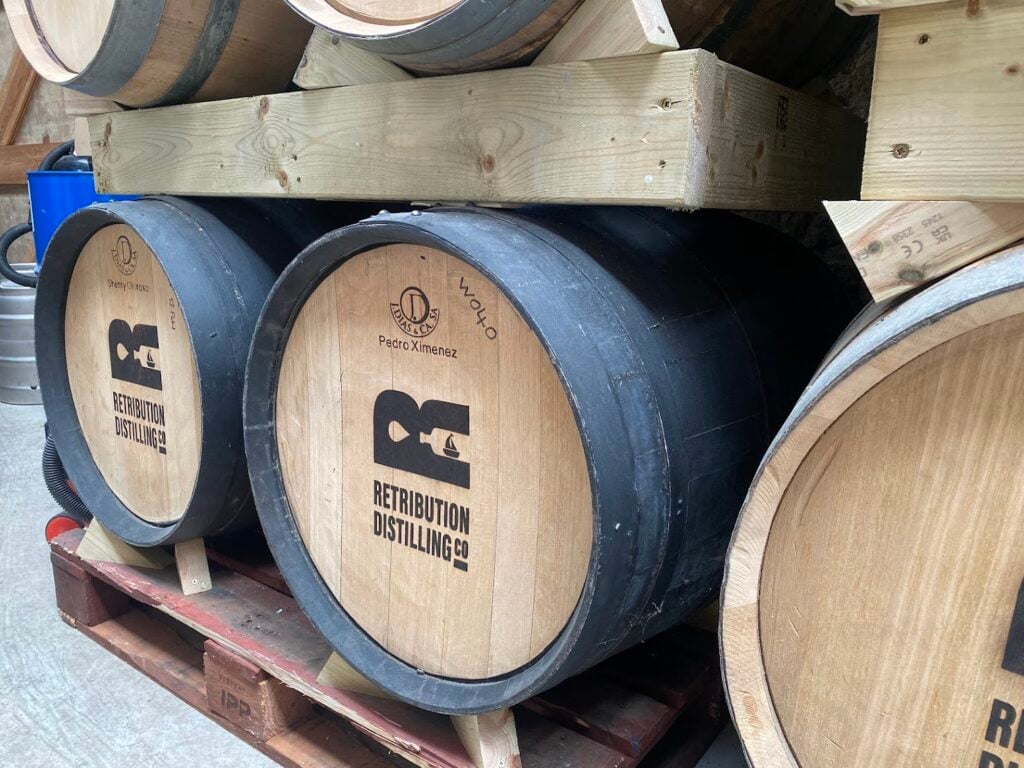
Casks resting at Retribution
Retribution Distilling in the Market
Retribution Distilling targets a modern, open-minded whisky audience that prioritises flavour over traditional markers like age statements or colour. The company currently employs a diverse sales strategy, selling directly to consumers and through both on-trade (bars) and off-trade (shops) channels. A key business focus is the expansion of their retail and bar presence. Complementing this is a major push for “Club Retribution,” which aims to build a strong community around the distillery to foster greater transparency and communication about their work.
Currently, there are plans for Richard to attend the following events this year: Bristol Whisky Festival, Croydon Whisky Festival, Birmingham Whisky Festival, Midlands Whisky Festival, English Whisky Festival, and hopefully the Kendal Whisky Festival. There could be a couple of others added to this list, too, so look out for him! There are a few bottle shop tastings booked in too. Spirited in Bristol, Givino in Fome, and Nickolls and Perks in Stourbridge are currently scheduled – keep your eyes out for their social channels.
Marketing efforts are purely organic. Richard’s primary focus for this year is to significantly increase the number of tastings and barrel tops he hosts. This will allow him to connect with more people, let them sample the product, and directly share the distillery’s story. Direct sales to the customer are currently an interesting area. The two segments that seem to perform well are the bargain basement supermarket end and the premium/super premium category; the middle ground is currently challenging.
Therefore, the focus is on communicating the brand story and providing samples to demonstrate why the spirits justify their price tag, as simply being ‘craft’ or ‘small batch’ is insufficient. Richard told me that when it comes to trade sales, the biggest challenge is usually reaching the right person and then getting the product into their hands. Up to this point, the majority of sales have been via phone and email, and there is a recognised need to increase time spent out on the road.
Just remember, all of the above has been undertaken by Richard on his own! His email signature lists his job title as founder, distiller, brand ambassador, and head cleaner.
Future Plans
Richard lays out an ambitious three-year vision for Retribution Distilling. The ideal scenario involves relocating to a beautiful, large, historic farm building, employing a small, dedicated team focused on producing some of the country’s finest spirits. This move is essential to capitalise on whisky tourism and establish a visitor centre, which will allow the team to showcase their work. This growth will, in turn, facilitate an increase in employee numbers and significantly broaden awareness of their operations.
As for advice for prospective English craft distillers, Richard stressed the challenging nature of the current market. He emphasised the necessity of having established routes to market from the outset, alongside a significant amount of capital that one must be happy to risk. Richard is continually seeking the right investment partner to help fund Retribution Distilling’s growth. Future investment would be directed toward three key areas: relocating the distillery, increasing production capacity, and hiring additional sales and production staff.
The next major milestone? The release of a Somerset Peated Single Malt Whisky. He believes this will be a truly unique offering in English whisky, something no other distillery is likely to produce.
