
Reports this week reveal that Mark Reynier, former owner and founder of Waterford Whisky, is seeking to buy back €12 million worth of bulk whisky stock from the company’s receivers.
This is the first material development in the Waterford story for some time. The business entered receivership in November 2024 after failing to secure further funding, with debts of close to €70 million reportedly owed to HSBC.
The proposed acquisition, first reported by the Waterford News & Star, would involve maturing whisky stock currently under the control of Interpath Advisory partners Mark Degnan and Daryll McKenna. Based on Waterford’s 2022 filings, total stock was then valued at €40 million on a cost basis, with an estimated retail value of more than €100 million. That stock continues to mature in bond at Stafford Bonded’s warehouse in Tramore.

Quiet, demure, unopinionated, it’s Waterford founder Mark Reynier!
Reynier’s fight “until his last breath” to save Waterford
Reynier’s move reflects a desire to preserve at least part of the original vision. He has previously said he would fight “until his last breath” to save Waterford. At present, there is no indication that Reynier is bidding for the Waterford brand itself, the distillery, or its intellectual property.
Those assets are being handled separately under the receivership process. Without control of the IP, stock alone does not constitute a revival of Waterford as a going concern. It is, though, a strategic foothold.
Tennessee Distilling Group was reported to be in exclusive talks to acquire those assets for around €6 million. Earlier rescue attempts collapsed, and no confirmed outcome has emerged since those negotiations began. If the distillery is sold without the bulk of the maturing stock, it would likely re-enter the market in a very different form.
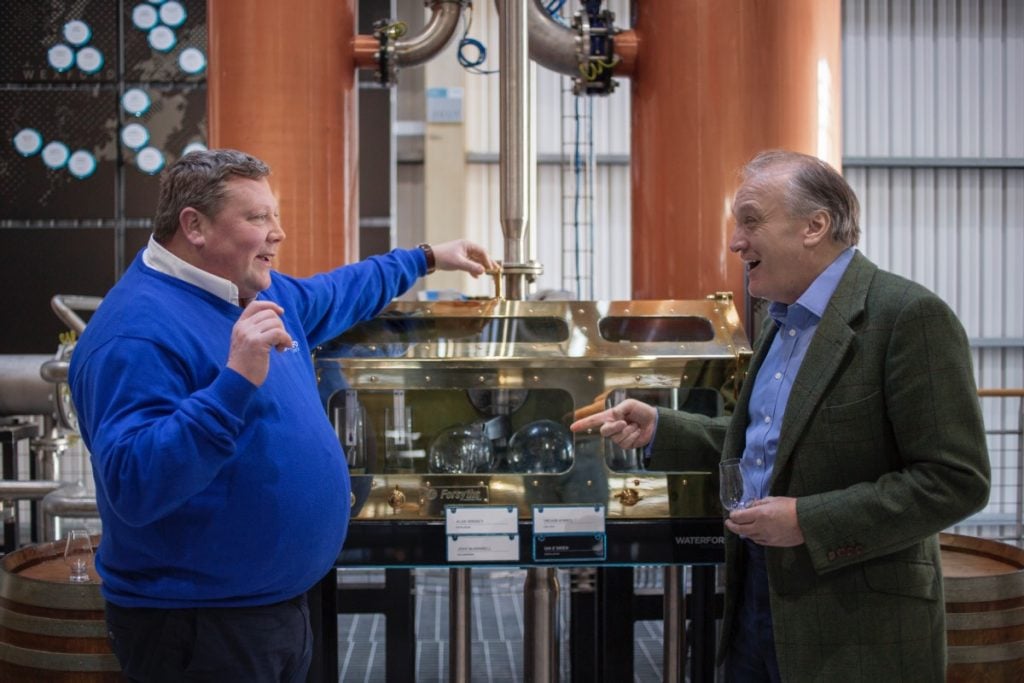
Mark Reynier at Waterford
How Waterford ended up here
Waterford was founded in 2014 with an ambitious premise: terroir-driven Irish single malt backed by radical transparency and granular traceability. Every bottle carries a QR code detailing farm origin, soil type, and agronomic inputs. It was a continuation of Reynier’s work at Bruichladdich, rooted in his belief that wine logic could apply to whisky.
The problem was timing, scale, and market reality. The brand launched in March 2020, days before Ireland entered the COVID lockdown. That alone would have tested any new distillery. But Waterford’s business model also relied on sustained premium demand and patient capital. Rising production costs, higher interest rates, and a global slowdown in spirits sales through 2023 and 2024 exposed the fragility of that equation. Difficulties with its US importer compounded the problem, restricting access to what should have been a key export market.
Crucially, Waterford was not alone in building inventory during the pandemic. Larger players did the same, but with far deeper reserves and broader distribution. When demand softened, Waterford lacked both the pricing flexibility and the consumer base needed to clear stock without eroding brand value. To be both new and to have a real vision is a tough gig. It’s a great shame things panned out this way. The early whiskies were vibrant, revealing, and individual in a crowded market.
Reynier’s interest in the stock could be romantic, pragmatic, or both. It seems less a turnaround and more like an asset-level decision presently. Mature whisky has intrinsic value, particularly when acquired below production cost. It can be bottled, sold on, or potentially redeployed into another brand structure. Reynier already owns Renegade Rum, and his career suggests he is comfortable playing a long game with liquids, even when corporate structures fail.

Waterford cuts a solemn figure in whisky at present, but hope is there
A sign of something positive?
It would be nice if this story were heroic, one where the founder battles on and the whisky is saved from the brink. The reality is more prosaic. This is a complex unwinding of an overextended business in a contracting global market. Reynier’s bid, if successful, secures whisky, not Waterford as it was.
The interest in the stock underlines that the liquid itself is sound. The physical plant and brand concept still have perceived value within the wider industry, too. People respect Waterford and want it to succeed. This is, at last, a genuinely positive signal since the doors closed.
What comes next? That will depend. Stock without a brand is inventory, and a brand without stock is a promise. Waterford’s future, if it has one, rests on whether those two things meet again. Under conditions that this tough market will actually support.
