
My introduction to Circumstance Distillery, based in Bristol, came as That Boutique-y Whisky Company began developing our ‘Home Nations Series’ in 2021. Our initial aspiration was arguably ‘The Full English’ series, but some English distilleries were not ready to participate at that time.
Circumstance, however, was an exception. The team there provided us with a truly innovative offering, resulting in the youngest ‘whisky’ we have ever bottled, at a mere 40 days old!
Obviously, we couldn’t call it a whisky due to that pesky Immature Spirits Act 1915, and the fact that it had never been aged in a wooden vessel! So it was bottled under the That Boutique-y Spirit Company logo. It was a spindle-aged malted wheat spirit, matured in an inert drum with charred English oak spindles suspended in the spirit, serving as the cask additive and contributing colour and congeners. At the same time, the char removed any harsh congeners.
Developing a taste for Circumstance
Why did we buy this? Because we’re whisky geeks, and this really sparked our curiosity. It was experimental, unconventional, innovative, and genre-defying. This is still the youngest ‘whisky’ we’ve ever bottled, yet it’s jam-packed with flavour: Oodles of tropical fruits, mango, papaya and apricot.
I started seeking them out at whisky festivals, and in 2023, they released their first rye whisky (Huzzah!) We bought a second cask from them around this time as well. While not a rye whisky, it had passed the 1915 Immature Spirits Act maturation requirements, being at least three years old, and matured in an oak vessel not exceeding 700 litres! Labelled as a single grain whisky, the mashbill for this was all barley; 85% malted, and 15% unmalted. It had been matured in a new, medium-char European oak cask. Unconventional, but once again very tasty!
While I have not yet visited Circumstance Distillery, I caught up with some of the team at last November’s English Whisky Festival in Birmingham and tasted some of the new rye whiskies, which were, of course, a highlight of my afternoon! Afterwards, I got in touch with the founder, Liam Hirt, to discuss his journey so far, his current plans for the year, and his future ambitions for the distillery.
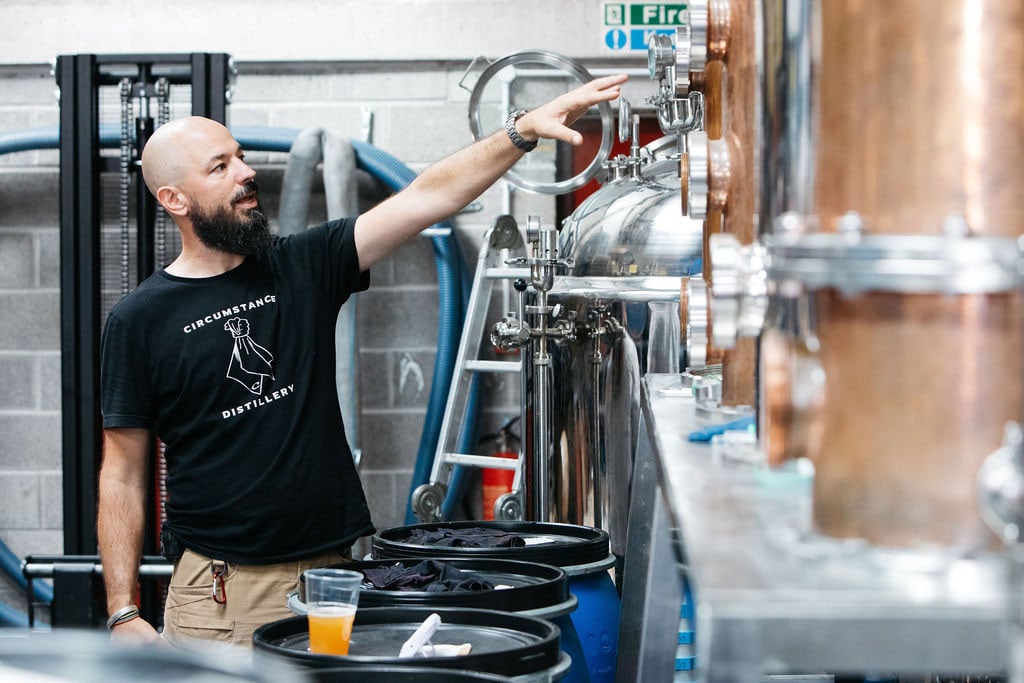
Say hello to Liam Hirt of Circumstance Distillery fame
The beginnings of Circumstance Distillery
Liam explained that he has always loved spirits, but in his youth, he never gave distillation much thought. To him, it was something done in big distilleries by head distillers who were more engineers than craftspersons. In his twenties, Liam went through a period of extreme boredom and underutilisation in his day job, so his mind had plenty of time to wander. It often wandered to spirits, but mostly mixing and drinking, until one day it wandered into distillation.
The more he thought about it, the more feasible it seemed. He decided the best way to understand what he would be doing was to build his own still. He built a few stills from metal stove-top pressure cookers and copper piping. This was the turning point. Distillation suddenly lost its mystery. He could understand it and do it. The easiest thing to distil is gin, and that’s what he did. He got very good at it and eventually took the leap and turned it into a business. It was easy back then at the start of the gin boom. He moved the gin business into its own premises and continued on his distillation journey. The next step was obviously creating his own spirit from grain.
At this point in his life, Liam had discovered a distillery in the US called Blue Ridge Distilling Company, which makes a whisky called Defiant. This whisky changed his opinion about what a whisky could be, and it was that whisky that opened his mind to the possibilities within whisky and permitted him to be more experimental in his thinking. That’s when the idea for the Circumstance Distillery began to take shape.
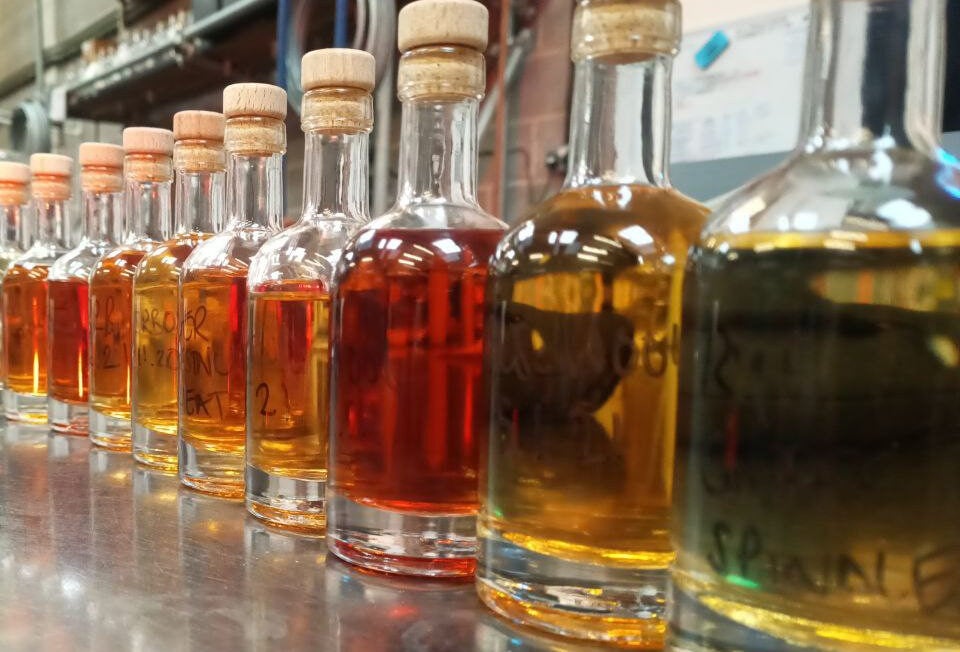
Few distilleries are as experimental as Circumstance
How did Circumstance Distillery come to be?
Liam’s motivation for launching a craft distillery stems from his interest in exploring whisky’s full potential, rather than being confined to its current form. He is committed to an approach that will never be mainstream, and if it were to become so, he would likely have moved on. Unlike a large distillery, whose economics would demand “safe bets” such as producing single malt, his smaller operation allows him the freedom to avoid those constraints.
Flavour comes first. Every decision about the whiskies is based on that, not yield, cost, or marketing. This focus is apparent in the final product. Super long fermentations are used, which is an inefficient use of equipment, to make a whisky that isn’t a single malt. Neither a finance department nor a marketing department (if such departments existed at Circumstance Distillery) would be happy about that, but the liquid speaks for itself.
The distillery doesn’t fit within the current English spirits scene, according to Liam. The belief is that no one else in the UK is doing anything close to what Circumstance Distillery is doing. Its place is on the international whisky stage, alongside other experimental, flavour-focused distillers. Even within that grouping, Circumstance still considers itself somewhat unique. This approach is precisely what the identity of English whisky, as championed by The English Whisky Guild, should embrace and integrate.
Bristol is the city where Liam grew up and later returned. The city has had a huge influence on the founders and, by default, the whisky. Bristol is fiercely independent, politically radical, and frequently defies the status quo. It also has a wonderful tradition of dissent and direct action. The hope is that the distillery is as independent, radical, and defiant as the rest of the city, and that the city is as proud of the distillery as the distillery is of it.
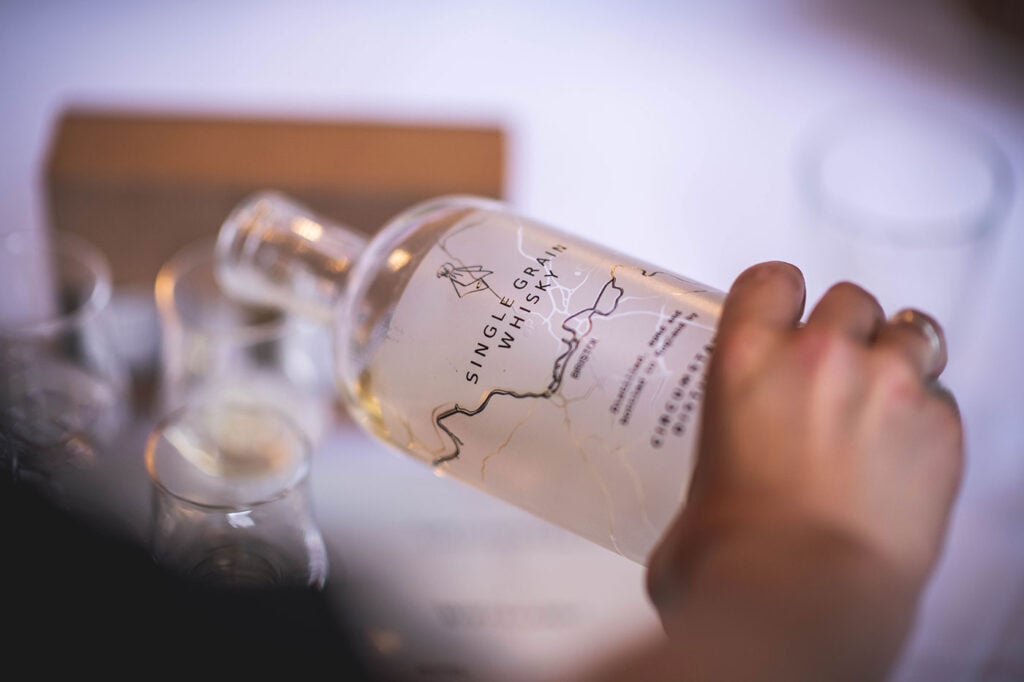
Circumstance creates whisky like very few others
How Circumstance Distillery makes whisky
The production process at Circumstance begins with the grains. Multi-grain mash bills can include malted barley, unmalted barley, malted rye, and malted wheat. The grains are mashed by hand on-site to produce a very high-density clear wort.
The wort is transferred to the fermenters where the yeast is pitched. The choice of yeast contributes up to 20% of the new make spirit’s flavour, so yeast selection is very careful. Mostly brewing yeasts are used that produce many wonderful esters. The fermentation is allowed to run for longer than at any other distillery, at 14 days. This is done to maximise the amount of ethyl lactate in the wash, which adds a lemony creaminess and oily mouthfeel to the new make spirit.
After the two-week fermentation, the wash is distilled through the hybrid still, which consists of a pot, copper whisky hood, and copper four-plate column. The new make spirit is then diluted to cask filling strength before being put into casks for a minimum of three years.
The whisky-making process at Circumstance Distillery is different primarily because of the focus on the stages before distillation, as this is where the majority of the flavour is created. The distillation process itself focuses on preventing burnt flavours by utilising a pot with an oil jacket and encouraging a significant amount of copper contact to remove sulphides and promote the fruity characteristics of the spirit. While this distillation method may not be unique from a global perspective, within the UK, it is believed that no one is distilling in quite the same way, as most stick to the double pot still method.
Overseeing all of the above is their head distiller, Andrew Osborne. Andrew handles the day-to-day operations and many other things besides.
Sustainability plays a huge role at Circumstance. If an activity cannot be performed sustainably, its practice should be questioned entirely. The distillery was one of the first B Corp-certified in the industry and has maintained accreditation for over six years. All production is organic, and all energy is sourced from renewable sources.
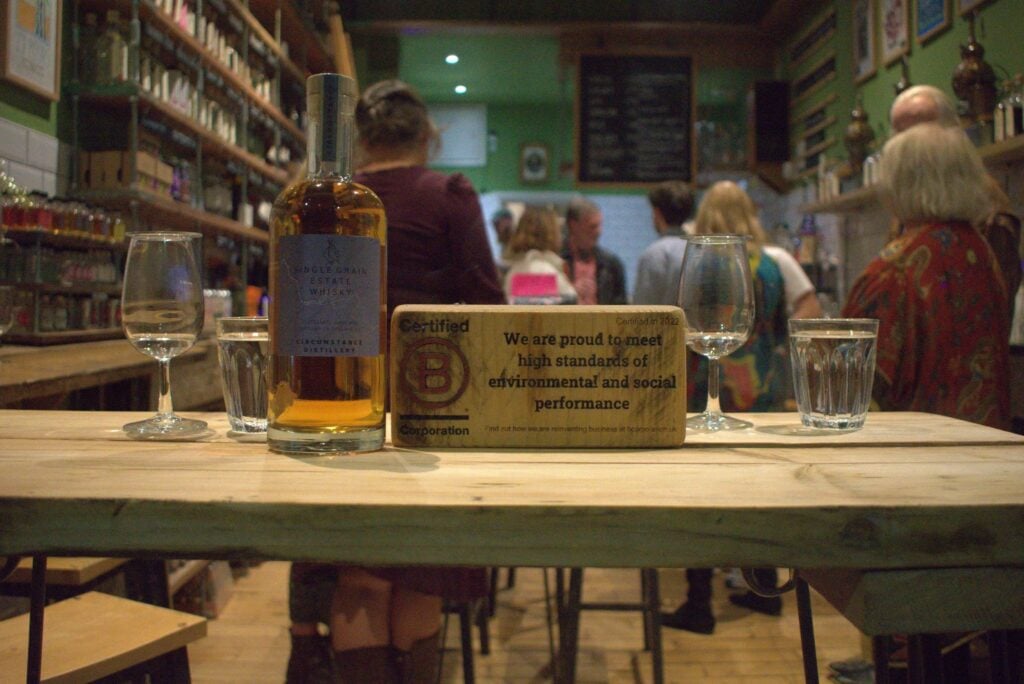
Circumstance has been a certified B Corp for the last six years
Heritage Grains
Only organic grains are used, which are sourced locally within 50 miles of the distillery, and malted locally at Warminster Malting, the UK’s oldest floor maltings.
When using barley, Laureate is the predominant variety, but the distillery does not stop there. The team likes using heritage grains because they were bred for flavour rather than yield. Favourites include Maris Otter and Plummage Archer, with the former being the preferred choice. It was very popular in brewing in the 1970s, but was largely replaced by the 1980s. The sole rights to the grain are actually owned by a consortium of grain merchants, one of which is the distillery’s maltster, Warminster Maltings. Maris Otter is considered to have a slight edge over Plummage Archer; Plummage tends to make a sweeter new make spirit, while Maris Otter makes a fruitier new make spirit.
Liam has also taken a look at malts that are not renowned for their flavour – most notably lager malts. The idea behind using these malts was to allow the flavours of the yeast to shine through more. Liam told me that what they have produced is really interesting and really delicious, and reminds him of the Rice Spirit they released a few years back.
Yeasts
Liam explained to me that yeasts are extremely important to them, stating, “I think a flavourful yeast can contribute up to about 20% of the flavour of the new make under the right conditions. We mostly work with brewing yeasts, but have ventured into mead and other strains. The types of yeast we use most are saison yeasts, Bavarian wheat yeasts and mead yeasts, but even within those categories, there are many different strains. Selecting a saison yeast strain, for example, for a particular mash might involve going through the ester profiles of numerous strains from different suppliers before testing the best candidates on an actual mash. “
Water
The water that they use is reverse osmosis-purified tap water. Liam expanded, “There is plenty to explore with water, which we will when we have a bit more time and space.”
Stills
Their hybrid still is an electrically heated pot with an oil jacket that ensures uniform heat to the wash, which prevents burning. The four-plate column and dephlegmator can create a phenomenal amount of copper contact during the distillation process. Both of these factors are important to producing the delicious fruit-forward new make that the distillery is known for.
Everything is produced in-house, with raw ingredients entering the facility and the entire manufacturing process taking place there. Buying industrial alcohol to produce their spirits does not align with the business philosophy, nor is it the desired identity for the distillery.
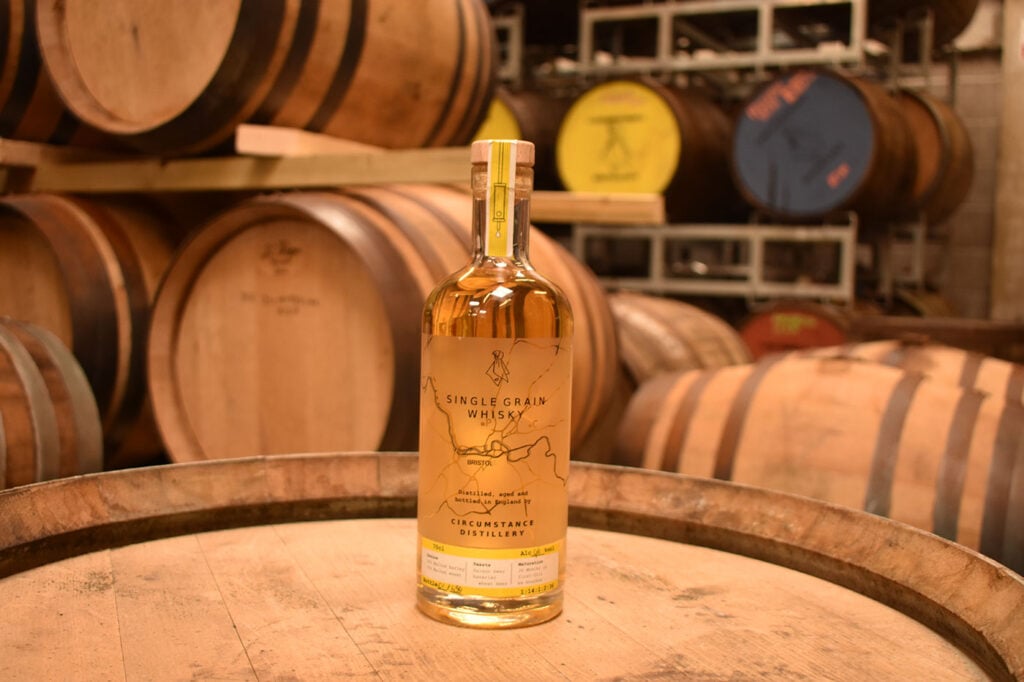
The Single Grain Estate Whisky
Circumstance Distillery’s current product portfolio
The main whisky produced is the Single Grain Estate Whisky. Alongside this, there are ‘rolling releases’ of Organic Single Grain Whiskies based on the three main mash bills. These rolling releases maintain a core identity but evolve. The next rolling release is likely to be based on the malted barley/unmalted barley mash bill that has been fully matured in an oloroso sherry cask. This would be the first full maturation sherry cask whisky to be released.
Whisky
Organic Single Grain Rye Whisky – created using a mash bill of 51% maled rye and 49% malted barley.
Organic Single Grain Wheat Whisky – crafted from a distinctive mash bill of 70% organic malted wheat and 30% organic malted barley.
Organic Single Grain Whisky – a whisky from organic malted barley, unmalted barley and roasted barley.
Rum
Single Estate Aged Rum – 100% South American molasses transformed through a distinctive 14-day fermentation using traditional mead yeast.
Single Estate White Rum – Crafted from 100% pure cane molasses through an extended 14-day fermentation using two specially selected yeast strains.
Single Estate Spiced Rum – Using their white rum as the base, it is delicately infused for 2 weeks with orange zest, fig, cacao, oak, cassia bark, allspice, vanilla, and ginger.
Gin and Vodka
Organic Vodka – distilled from organic British wheat.
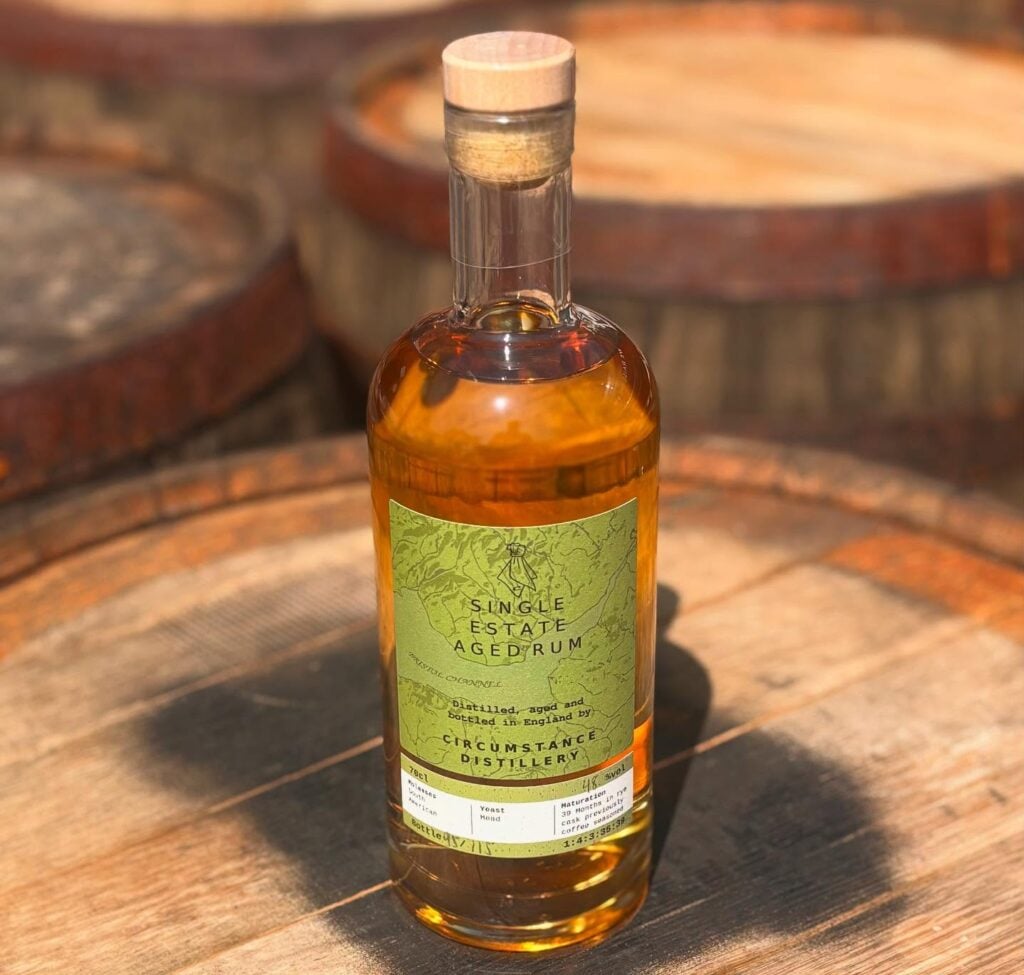
Circumstance Distillery makes rum and white spirits, too
What’s happening in 2026
The current distillery is 3,000 square feet. A new site of 4,000 square feet has been secured, and production will be moving to this new site in Bristol over the coming months. The extra space will allow for laying down more stock, increasing production, and the potential for some more experimental mashes.
Liam is pretty excited by the new product development and new recipes that they’ve been working on. The approach is simple, as it goes back to their core principle: flavour first. When guided by flavour creation rather than copying other distilleries, playing it safe, or maximising yield, the distillery becomes a giant playground.
Liam went on to tell me that inspiration can be found in some unexpected places. “Recently, there has been interest in co-fermentation. This was inspired by the small co-fermentation movement in California, where grapes and apples are grown side-by-side, and are fermented together to produce a wine-cider hybrid. There are also some amazing apple and cider producers in this part of the country, so experiments have been conducted with co-fermentations using apples and grain. They are still young but are quite amazing.”
They are currently exploring co-fermentations whereby apples and grain are fermented together, and Liam also wants to try a honey and grain co-ferment.
This year, there will be some small, limited releases for their club members: ‘The Circ Club’, which will also be available as ‘distillery exclusives’ to customers who visit the distillery. While there is no defined ‘visitor centre’, distillery tours are available whenever there is someone in the building. Either Liam or one of the distillers will show guests around and guide them through an extensive tasting!
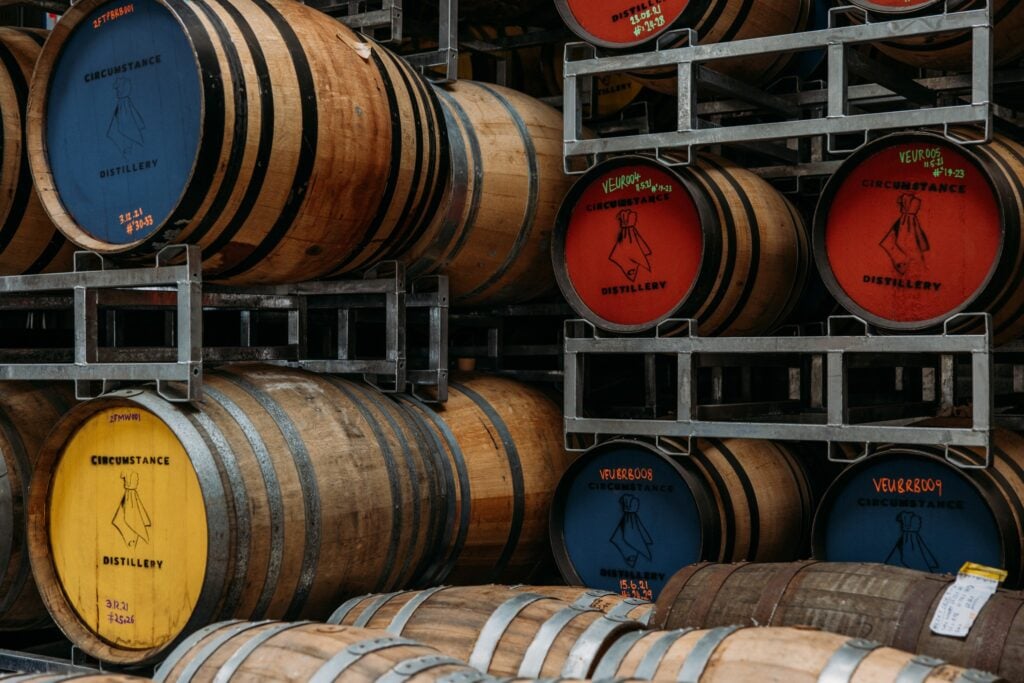
Maturation at Circumstance Distillery is another thing that’s far from ordinairy
Why make Scotch in England?
I asked if there were any plans to pursue and develop the charred oak spindle maturation process. This is one of the most innovative ideas I’ve seen in whisky maturation. It makes complete sense as it is a scientifically sound application of maturation chemistry, primarily by leveraging the principle of surface area to achieve rapid and controlled extraction of flavour compounds from charred oak.
Liam told me that they are still using spindles, but not as much. He explained, “I feel like we are walking a fine line between being considered ‘experimental’ and being considered ‘novelty’. We set out our stall early on regarding spindle ageing, and we are currently in a period of releases from traditional casks. I think the cask releases just remind everyone that we aren’t ‘novelty’ or trying to ‘cut corners’. We will be back to some spindle releases soon.”
Our first Circumstance release was an outlandish innovation on traditional whisky ageing by using charred English oak spindles. This technique leverages the principle of surface area to accelerate and maximise flavour development. Unlike traditional cask maturation, where the spirit slowly interacts with the inner surface of staves over many years, the direct immersion of multiple, charred spindles dramatically increases the wood-to-liquid contact. This not only allows for the rapid and controlled extraction of desirable compounds, achieving a desired flavour profile far more quickly, but also represents a highly efficient and resource-conscious use of oak. By utilising smaller, prepared pieces of wood more effectively, the distillery can achieve complex maturation with greater consistency and reduced reliance on large, decades-old oak trees.
Just let this little piece of information sink in: One average American white oak tree typically yields enough wood to produce one to two standard 53-gallon bourbon barrels. While some estimates suggest a slightly higher yield of 2-3 barrels for larger, mature trees, the industry standard for a 100-year-old tree is generally cited as two barrels.
Another of my controversial opinions: This type of innovation should definitely be incorporated into English Whisky, too. Why follow all of the Scotch Whisky rulebook? I don’t want Scotch Whisky made in England!
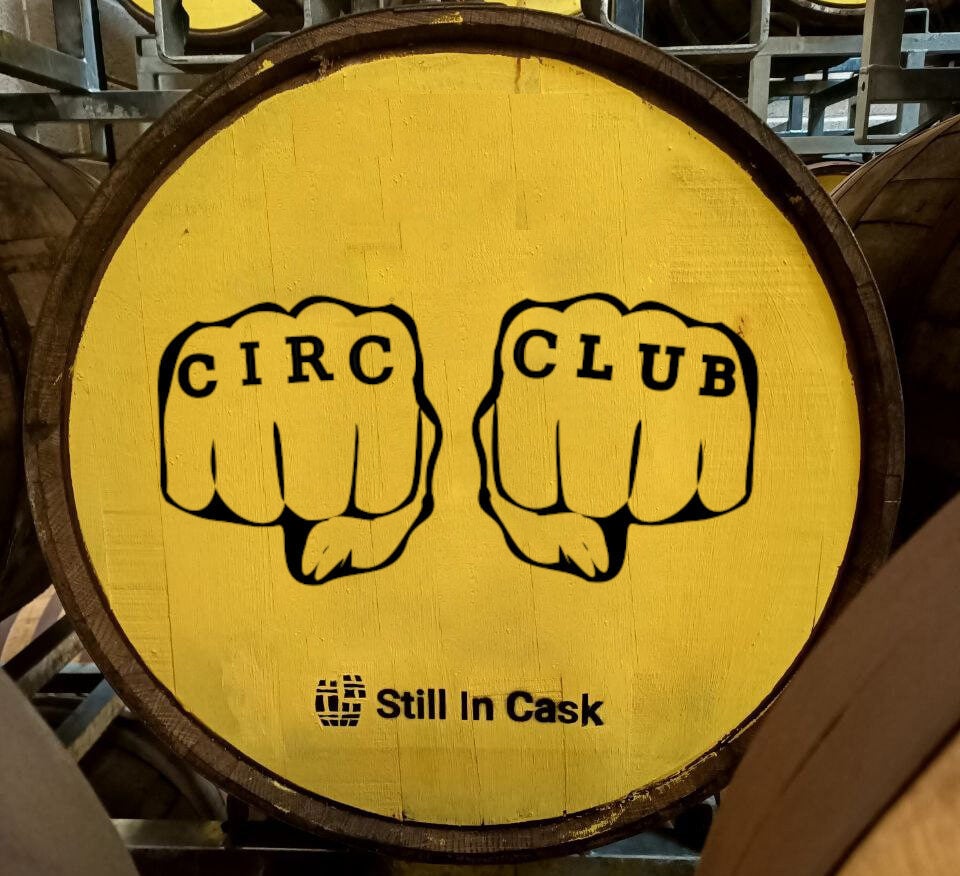
The Circ Club promises some interesting releases
Circumstance Distillery in the Market
Liam explained that their ideal customer is probably the ‘exploring enthusiast’. These customers tend to embrace whiskies that are ‘different’ and often seek out whiskies like this one. They often like to recommend their best finds to other enthusiasts. The goal is to get some liquid in their hand.
A proportion of the distillery’s on-trade customers have faced difficulties over the last couple of years. The challenges in the hospitality sector have introduced a significant level of risk, leading the distillery to prioritise the on-trade less. The distillery’s main focus has been Direct-to-Consumer (DTC) and off-trade, and this is expected to continue for the foreseeable future. They are also focusing on selling cask shares through stillincask.com. This allows customers to engage in cask ownership simply, without the risk and cost normally associated with it.
Storytelling is central to Circumstance Distillery’s ethos, as Liam explained. For them, a genuine narrative reflects a clear comprehension of their role within the centuries-old, global history of whisky. Bristol’s pre-WWII bombing past includes one of the UK’s oldest whisky distilleries. The current approach mirrors the original’s use of hybrid-type stills and multi-grain mash bills. While rooted in this tradition, the revived Bristol whisky scene—and Circumstance’s output—is distinctively modern, seeking to contribute a new chapter to the whisky story rather than merely repeating an old one.
The distillery has faced challenges in the market from the very beginning. Two hurdles need to be overcome to gain customers, and success is not always guaranteed. The first hurdle is that the whisky is English, not Scottish. Customer understanding and acceptance of English Whisky is improving, but slowly. If that first hurdle is cleared, the second hurdle is even higher – it is a single grain whisky and not a single malt whisky. This is often the biggest barrier, as grain whisky is still seen as an inferior category to malt whisky. The approach is often to ask customers to think of their favourite single malt and then to imagine that 5% of the barley was unmalted, which added an oilier mouthfeel and made the flavour more complex. The whisky they are imagining is no longer a single malt; it is a single grain whisky. This approach doesn’t always work, but education is the key.
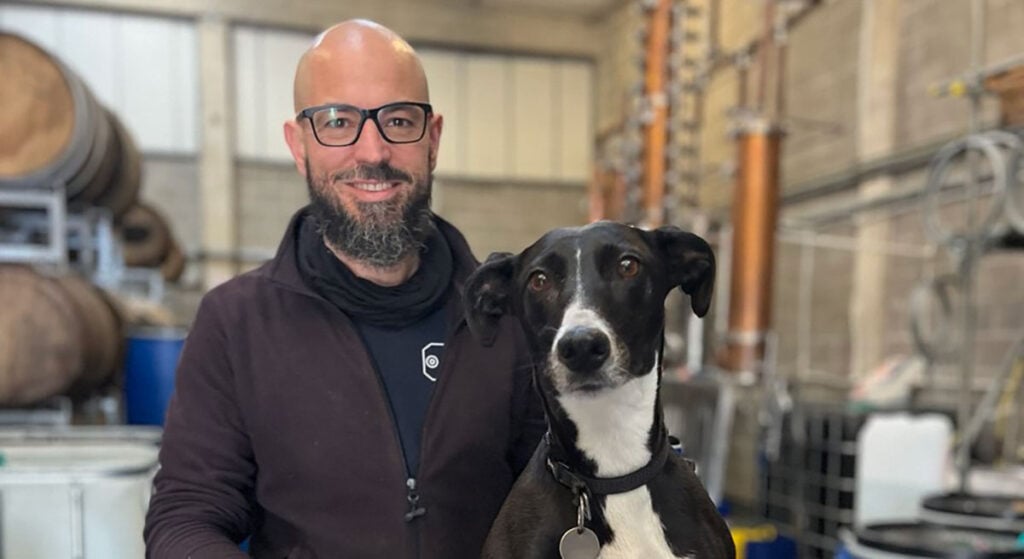
Every distillery needs a dog
Future Plans
Liam offers advice for aspiring English craft distillers, acknowledging that while the sector has become more challenging over the last 5-10 years, partly due to continuous increases in excise duty, the English Whisky community remains very supportive. He enthusiastically invites prospective distillers to “come and get involved!”
Regarding financing, Circumstance Distillery has been difficult to manage as a bootstrapped venture. However, this self-funding has provided Liam with the freedom to pursue unconventional, and potentially “commercially questionable,” choices, such as focusing on creating unique, amazing whisky instead of the more traditional single malt. While Liam is not actively seeking investment, he is open to considering it, as he consistently generates more ideas than he currently has the time or money to pursue.
When I asked Liam about his next major milestone, he revealed that he can’t really think beyond moving the distillery at the moment. “It’s going to be complicated” were his parting words!
