Different types of rum
There are various ways, and various disagreements when it comes to classifying rum. Let us guide you through the weeds.
RUM CLASSIFICATION
POPULAR CATEGORIES
Authors:


Reading time: 7 minutes
There are many types of rum. You can’t really talk about them without first understanding the question: “What is a rum?” But we already did that in our How is rum made guide. The cliff notes are: one sole definition is tough because the spirit is so varied. How rum is communicated and sold all over the world is different.
Because of that, there’s a lot of debate over the best way to categorise the spirit. How do you define something that defies definition? Plenty have tried, many have failed, and no true consensus has been reached. Will rum ever be categorised satisfactorily? Who knows. But here, we’ll cover the many ways rum is classified, and hopefully clear things up a little.
Colour
- Rum is often split by colour into white rum, gold rum and dark rum, although as we'll discuss, that doesn't tell you very much about the spirit at all.
Rum is often described through colour. And even though it’s not a colour (to the unimaginative that is. Yes, I’m talking to you Ms. Walker, my Year Two art teacher. Spiced brown is a thing), spiced rum is often listed alongside the colours as a similar classification.
Colour is by the far the most prevalent way of categorising rum, and is how most people first learn about rum. We even do it on our site...
… which is not to say we should. Colour as a means to identify rum is controversial. The use of caramel colouring is permitted in various countries across the world. This means many darker rums present as being older or mature, but don’t reflect how they were made or how long they’ve spent in barrels. This is of course also true of other brown spirit categories like whisky or brandy, but they’re not marketed or presented by colour in the same way. Because rum is also bottled clear, or ‘white’, people naturally differentiate it from darker rum by its appearance alone.
But those colours are not fully regulated, so they can’t tell you everything about the rum in front of you. You might expect a darker rum to be sweeter, more rich, and intense. But if a white rum has just been coloured, that won’t be the case. Imagine someone painting a marshmallow with brown food colouring and telling you it's toasted. Don’t confuse colour for flavour. A rum’s colour might reveal nothing about the spirit.
Still, it is worth us taking you through each category of white, gold, and spiced because they remain the most popular designations and you don’t want to be standing at a bar looking like a confused chicken when people are talking about gold rum. I’m not sure why I picked on chickens then. Alliteration, probably. The world, much like rum categorisation, is not fair.
What is white rum?
- White rum is either bottled without having been aged in wooden casks, or has been aged in wood but then had its colour removed through filtration. Very little can be known about its character from the colour alone and there is enormous variation between white rums.
We kick things off with white rum. Why, isn't that the cheap thing you find behind a bar that tastes like bad vodka or coconut and needs to be drowned in cola? No, no it is not.
Well, it can be, but that’s not all white rum is. White rum covers an enormous spectrum of rum bottled clear, or even aged then filtered spirit. White rum can be made from molasses or cane juice, it can be column or pot distilled (the former is more common). It can even be aged and then filtered. Remember? When I said that two seconds ago?
Usually, though, when we’re talking about white rum, we’re referring to a spirit bottled unaged, or just rested for a short time. But that doesn’t mean it lacks complexity or maturity. A lack of colour should not be confused for a lack of character. White rum is made all over the world and while there are some common flavour profiles you may associate with it, such as fresh, vibrant, and fruity, this is probably the most varied of styles within the colour spectrum.
The kind you’re most probably most familiar with, the likes of Bacardi, do dominate the category. Highly mixable, versatile white rums became the stars of the rum world during the second half of the 20th century, from Tiki Bar theatrics to the simple pleasure of a rum and coke. Order the latter at a bar, and it’s likely they’ll pour Bacardi by default. Very mixable white rums absolutely have their place, as anyone who’s ever enjoyed a Mojito will tell you, and help the category grow. But they don’t have a monopoly on this style.
White rums can also include the bold, high-strength funky creations coming out of Jamaica, like the famous J Wray and Nephew. Havana Club Añejo 3 Year Old, meanwhile, is aged for three years in bourbon casks and then filtered, hence its white colour. Then there’s rhum agricole, a style originated in French Caribbean countries like Martinique and Guadeloupe that is made by fermenting and distilling sugar cane juice. This is a full-bodied, grassy, and complex rum that could never be confused with being bland. The same goes for other sugar cane juice spirits, like Brazil’s national spirit, cachaça.
White or blanc
Clear, or almost clear, but a whole world of different flavours, intensities and production methods.
Explore white rum
Although white rum is far from homogenous, you'll need a solid bottle for countless famous and classic rum cocktails from the mojito to the daiquiri.
What is spiced rum?
- Spiced rum is made from rum that is sweetened with sugar and seasoned with the likes of vanilla, citrus peel, and aromatic spices like cinnamon, nutmeg, and ginger.
The spiced rum category is the most common and established when it comes to flavoured rum. It’s a lot of people’s first rum. They’re on every backbar, supermarket shelf, and online retailer, with names like Captain Morgan and Sailor Jerry providing affordable, readily available spirits that keep the parties-and-pirates vibe that rum is so often associated with alive.
It’s a double edged sword, however, and spiced rums aren't exactly popular with rum ‘connoisseurs’. That’s because technically, according to the EU, a rum cannot be flavoured. Hence why a lot of ‘spiced rum’ bottlings don’t have the word "rum" on the label. But there are lots of genuinely brilliant spirits that have natural, quality flavourings and if they help people into the wonderful world of rum, we’re all for them.
Ultimately, the category is simple, with the previously mentioned sugar, vanilla and classic spices or some variation thereof being added to rum. The additions can give it colour, but usually additional colour is added by the producer to create a consistent, 'marketable' appearance.
There is now a huge variety of other rum-based flavoured spirits and rum liqueurs as well. Increasingly we’re also seeing rums distilled with botanicals akin to the way gin is made, which is not much of a departure from spiced rum but certainly a different approach.
Spiced and flavoured rum
From vanilla and traditional spices, to popular flavoured spirits featuring cherry or coffee
Explore spiced rum
Think rum sweetened, flavoured and seasoned with vanilla, cinnamon, nutmeg and other complimentary flavours and ingredients.
What is dark rum?
- Dark rum may have been aged for a long time in wooden casks, or that ageing period could have been much shorter, or it could be unaged. Some or even all of its colour may have been artificially added.
We don’t know about you, but dark rum makes us think of molasses. The thick, sticky raw material of rum is possibly best expressed in this style of rum, which is also most associated with aged rum.
There are no restrictions on how you make dark rum, however, because it’s not a legally defined style (none of the colours are). It can be cane juice or column still produced. But what you’d expect usually is still a molasses-based, pot still or blended creation that’s heady and rich, and also aged. It might, however, have not been aged, with dark colour coming from caramel. Or it could be aged and have additional colouring from caramel too. Some of these can be so intense in colour you’ll see some referred to as black rums, but that tells you nothing about the time it may have spent actually ageing in wood.
If the dark rum is aged, that maturation can be aided by the intense tropical heat you get across the Caribbean as well as South and Central America. This climate enhances the expansion and contraction of the wood barrels, making them more porous to force the spirit in and out of the oak and increase interaction. This adds all of the flavours present in wood (vanilla, tannins) as well as the alcohol that was previously in the barrel, typically bourbon adding toffee and coconut or the raisiny, nutty sweetness of sherry butts.
Classic examples of dark rum include backbar favourites Lamb’s and Gosling’s Black Seal. But dark rum also includes the dunder-heavy, funky rums of Jamaica, the slick and sweet Cuban creations from the likes of Havana Club, the bright, fruity rums of Barbados distilleries like Mount Gay, the robust, full-bodied rums Angostura makes in Trinidad, the solera-sational Guatemalan rums of Ron Zacapa, and the Demerara style developed in Guyana, historically on the ships of the Royal Navy.
As the likes of Pusser’s demonstrate, the history of dark rum and the navy officers go hand-in. This style is sometimes referred to as navy rum, probably because for a long time sailors were given a daily tot of dark rum. In Britain, this tradition was finally scrapped on 31 July 1970 – known as Black Tot Day. A solemn day, indeed.
What is gold rum?
- Gold or amber rums get their name from their bright colour, but the colour doesn’t mean anything.
You guessed it by now, right? That golden hue could come from the casks (usually bourbon) the rum was aged in. It could come from additional colouring like caramel. It could be both. The word gold, like all colours in rum, isn’t protected. I can’t emphasise that enough.
When people talk about golden rums they’re often referring to mellow, medium-bodied, delicately sweet creations, but there’s a lot of variation within this category too. There are quite of lot of rums that are termed golden that are blends of pot and column stills rums, and they could be made with molasses or cane juice.
The Duppy Share Caribbean Rum, Lost Years Four Island Rum, and Neptune Rum would all be good examples of what people term a golden rum. Often golden rum is a good mixer, a way to change up your Mojito and master the mighty Mai Tai. I would argue all rum is golden. A sweet elixir of the gods. But I was told that wasn’t helpful. So here we are.
Dark rum & gold rum
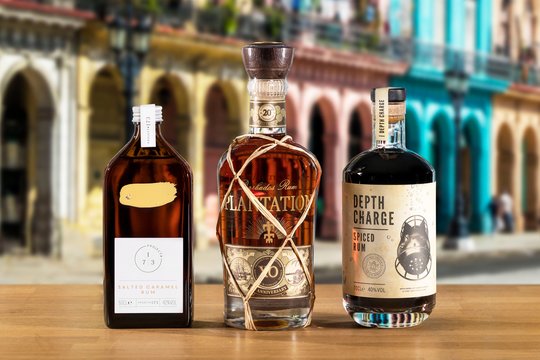
Here are some 'not white' rums at different prices, all definitely worth trying!
Explore dark rum
Whether well-aged or younger, pot or column still (or a blend of both), from naval and Demerara rums to elegant Cuban creations and more – dark rum offers a broad church of flavours and variety!
Outmoded colonial categorisations
Rum origins can be traced back to the Caribbean, as well as Central and South America. Its history is inextricably linked to colonialism and much of the early markets in these regions were controlled by colonisers, typically Spanish, French, or British. You can see their influence in the various ways rum is spelt across the world: ron, rhum and, of course, rum, respectively.
These three imperial powers had a legacy on not only what the spirit was called, but how it was made. Each empire had its own preferences and resources to call on, which influenced the style of rum that was made in their colonies. As such, rum has been explained in three categories – French, English and Spanish style.
We don’t do this, because while colonial categorisations were often used in the past, they’re nebulous, restrictive, and reductive. They don’t adequately account for variations in production, say to distinguish if a product is made from molasses or cane juice, if it’s pot or column distilled, if it’s blended etc. But it also fails to give appropriate credit to the people who were actually making the rum.
Barbados was more than an extension of Britain. As was Cuba to Spain, or Martinique to France, to give a few examples. It’s also becoming increasingly obsolete as the rum world opens up. There are thriving rum scenes in the likes of Australia, Thailand, and even the UK.
But we do have a duty here to inform. It’s necessary to cover what people mean when they say a British, French, or Spanish-style rum for the purposes of clarity. You don’t want to be standing at a bar looking like a confused chicken when people are talking about Spanish rum. That’s right, I have it out for chickens. Their eyes scare me. Sue me.
- 'British style' – Typically, British colonies like Barbados and St. Lucia made rum with molasses, rather than cane juice, which was fermented for a long time with cultured and/or wild yeasts. They’re often a blend of pot and column distillates, but there’s diversity in the category, from the bolder, full pot-stilled rums from Jamaica to the rich, dark demerara creations from Guyana.
- 'French style' – The French style of rhum was made in the likes of Martinique, Guadeloupe, Reunion Island, and pretty much refers to the creation of agricole rhum. That means rhum made with sugar cane juice, not molasses, that were fermented for up to five days with cultured yeasts and then column distilled. Martinique itself has one of the strictest rum regulations to this day.
- 'Spanish style' – Spanish style ron is vast in terms of examples, stretching from the Caribbean with the likes of Cuba, Trinidad and the Dominican Republic, to Central America (Puerto Rico, Panama, Guatemala), South America (Venezuela) and as far as the Philippines. There’s great differentiation between the islands to the ron made in Central and South America, where flavours and sweeteners are more common, but to be honest this is just one symptom of a wider problem of grouping ron by colonial categories. These rons were often molasses based, fermented with cultured yeasts for only a couple of days, and then distilled in single or multi-column stills. It’s common for these producing nations to make multiple base rums that are blended to make the final product, to use carbon filtration to achieve a certain colour and smoothness, and to create ron cask-driven flavours.
Classifying by production: Gargano and beyond
Both the previous classifications, which I’ve called and colour and colonisation, are often considered inadequate because they reveal nothing to little of how the rum is made, which is going to impact its taste above all. Production and provenance are of increasing concern and form the backbone of newer categories that are emerging.
A good example would be the The Gargano Classification. Established by Luca Gargano, of Velier rum fame, he was inspired by Charles Gordon’s ‘Pure Malt’ Glenfiddich bottling to create a framework to distinguish craft rums (those rich in different substances besides alcohol) from industrial rums (which mainly contain ethanol) based on distillation method.
The Gargano Classification separates rums into the following categories:
- Pure Single Rum – rum made from molasses with 100% batch pot still distillation
- Pure Single Agricole Rhum – rum made from cane juice that was 100% distilled in a batch pot still system
- Single Blended Rum – rum made from a blend of 100% traditional column and pot still rums
- Traditional Rum – rum made entirely from traditional column still distillation
- Modern Rum – rum made from modern or industrial multi-column distillation
Meanwhile, the word ‘Pure’ refers to a 100% pot still rum and the word ‘Single’ means all of the rum was produced at a single distillery.
100% Pot still rum
Batch distilled a bit like a single malt whisky (although usually with a different setup)
Age and geography
Some people simply classify rum by geography. In this sense, countries are the categories. This can be useful, especially for rums made in the likes of Cuba, Jamaica, and Martinique, who have Geographical Indications (GIs) or a strict body of legislation that governs rum creation. But not every country has that, so geography is too narrow a field on its own.
Age too is problematic because different countries have individual ways of governing what age needs to be declared on the label, if they govern it at all, so comparing one 15-year-old rum with another may actually tell you nothing about the spirit.
Our best advice is to learn as much about the rum in front of you as you can, specifically into how it was made, then taste for yourself. The rum world is still very much figuring this out. But the more you learn, the more you understand and the more you enjoy. Don’t get bogged down too much by classification. It’s a very wide world, rum.
Jamaican rum
Famed for their expressive, ester-forward, funky rums, many marks are made in Jamaica.
More rum guides
Find out more about rum, a truly amazing spirit, such as how it's made or classic cocktails and serves...