


Old Pulteney is now 200 years old. I recently went to Wick, Caithness to see the whisky distillery and take in the local sights. Because you can’t understand Pulteney without seeing Wick.
The classic image of a Scotch whisky distillery is a valley, a river, fields of barley doing their golden shimmer for the brochure. Pulteney is not that. Far up Scotland’s north coast, closer to the Faroe Islands than London, it’s built into a town and appears as a sudden yet unassuming site as you move through the streets.
Whisky is the most famous export in Wick. But this town once lived and breathed herring. At its peak in the early-to-mid 20th century, thousands of boats were working the harbour, with huge quantities of fish being landed, cured, packed, and sent south. James Henderson founded Pulteney in 1826 to serve the herring capital of Europe. It made whisky for a hard-working port town, not for tasting rooms and travel retail shelves.
The herring trade has gone. Pulteney has not. Ownership changes, industrial shifts, the collapse of the local fishing economy, even a dry period. Temperance laws once closed pubs in Wick and helped silence the distillery for decades. The distillery remains.
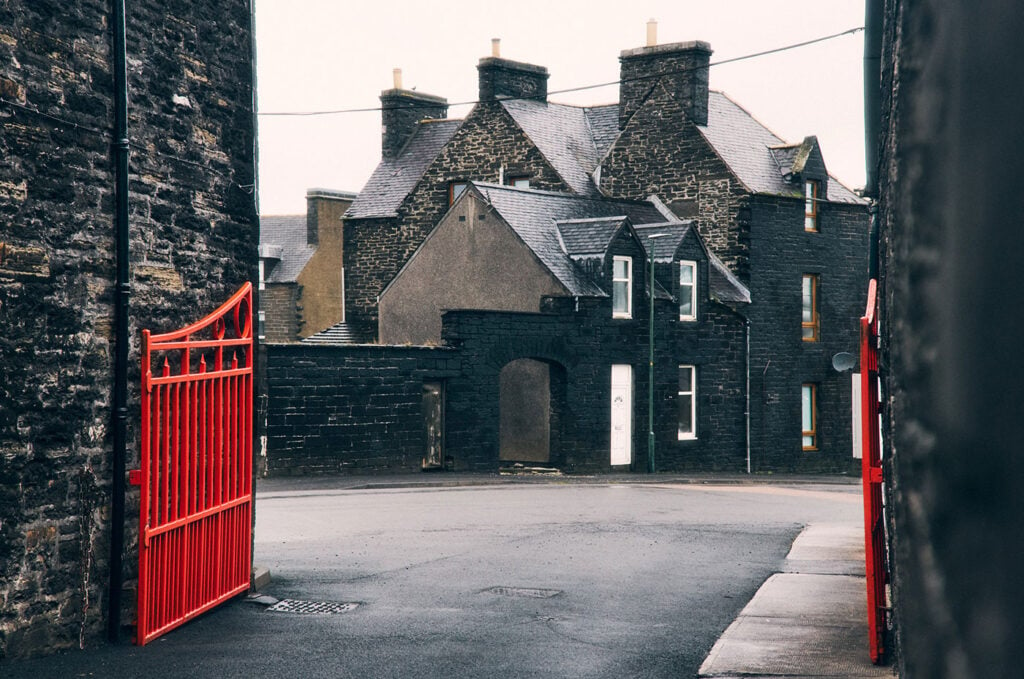
Welcome to Old Pulteney Distillery
Putting the old in Old Pulteney
Pulteney is a survivor. It’s also wonderfully odd. You would never build a distillery like this from scratch. The stillroom is tight and awkward. Equipment wasn’t so much designed but negotiated into position. The original thatched roof of the filling store is slate today. Apart from that, serial Victorian distillery profiler Alfred Barnard would recognise it. It’s not big, but it is charming.
The distillery chugs out a steady 1.3m litres of alcohol a year, though 1.9m is the capacity. Pure, soft water comes from Loch Hempriggs, carried by a lade that predates the distillery and was built in the early 19th century. The barley varieties are Sassy, Diablo, sometimes Laureate, all from Bairds Inverness, creating about 418-9 litres of whisky per tonne. A strain grown eight miles outside of Wick also being trialled. The old Porteus mill does what it was built to do: process five tonnes of unpeated malt barley into grist every two and a half hours without fail.
In stainless steel washbacks, fermentations can run to 115 hours if it carries over weekends, building fruit and complexity. They use dried yeast and if the bag doesn’t smell like strawberries when opened, it doesn’t get used. The wash still, with its great bulbous boil ball and flat top, helped inspire the shape of the Old Pulteney bottle. The lyne arm twists away, while worm tub condensers add texture to the spirit and the picture.
Push and pull is the heart of Pulteney.
Clear wort and long fermentations bring brightness and fruit, while short stills and worm tubs pull the spirit back towards oil, heft, and savoury depth. Tasting a new make sample at 68.8% ABV (casks are filled at this too), it’s beefy with hamster cage maltiness, a bell pepper vegetal quality, briney, a bit of warming citrus, and a touch of cinnamon.
To taste it has so much bite and funk. With water you get some of the vibrant, elegant, fermentation led flavours of tropical fruits we see in the whisky.
Add maturation and it all develops into a spirit that manages to be briny, oily, fruity, leathery, floral, sometimes faintly funky, sometimes beautifully tropical. At its best, it tastes like lemon peel, salt, banana sweets, dunnage air, polished oak, all carried in from the harbour on a wet coat.
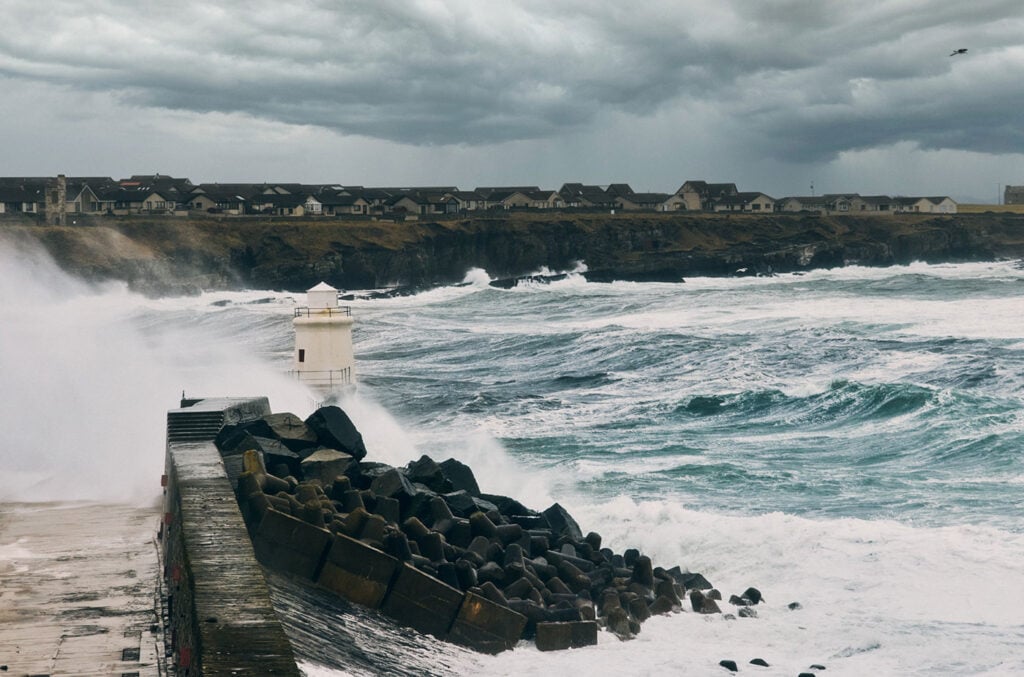
And welcome to Wick
Idiosyncratic whisky in an idiosyncratic place
Pulteney is often called The Maritime Malt. Yes, whisky marketing can squeeze the life out of a perfectly good idea if you let it. Here, the locals swear to its accuracy. You can peek at the North Sea from the dunnage and racked warehouses, which aren’t so much exposed to Wick’s cool, humid, salt-edged climate as they are purposely subjected to it. Distillery manager Malcolm Waring has spoken about the importance of keeping maturation local often. As a hometown boy who was first a boat-builder, he knows as well as anyone why it matters.
The cask profile here is roughly 95% American oak bourbon casks, the rest mostly European oak sherry. They all age on site in both traditional dunnage and racked warehouses where low temperature scales and high humidity complete the maturation environment picture. The oldest whiskies here date back to the 1970s. More on that very soon…
Negotiations are ongoing with Highland Council (decision imminent) to build four bonded warehouses close to the distillery. The distillery’s owners are International Beverage, which also boasts Balblair, Knockdhu, Speyburn, and Balmenach in its Scotch stable. Sarah Burgess joined in a new role as master of whisky creation in 2025 to spearhead production across the sites.
These are backers willing to spend money. Pulteney is now in 107 countries. The visitor centre – referred to as a “brand home” – has undergone a major refurbishment to mark the 200th anniversary. On 20 June, a free-of-charge open day (register on their website) promises merriment and new sights. Things are looking bright.
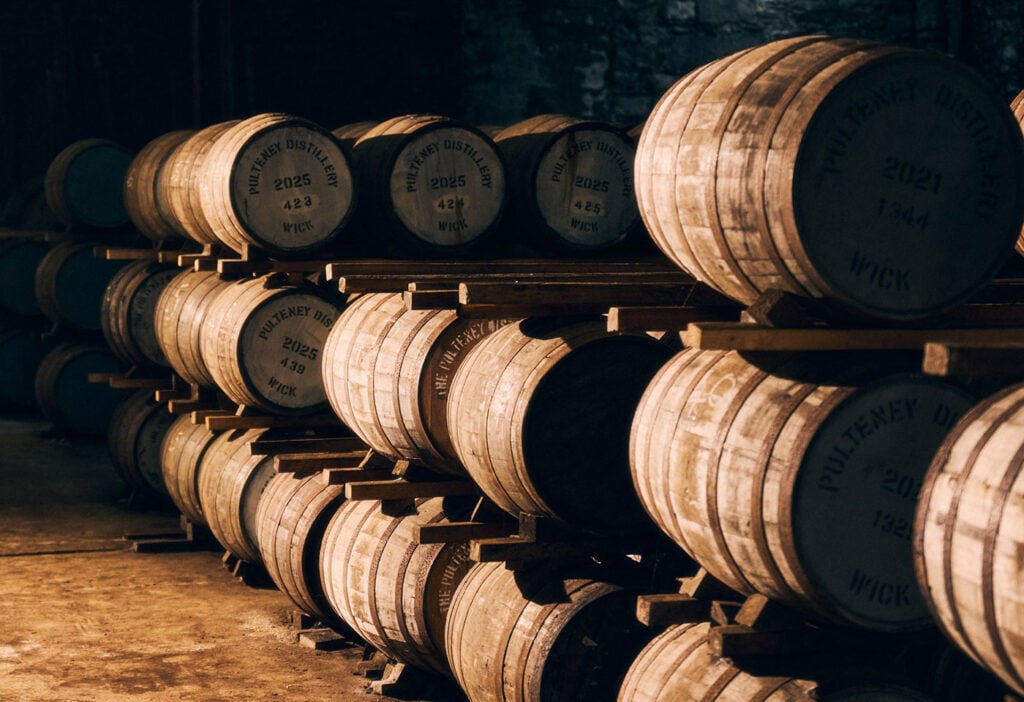
For two centuries whisky has been made here
Whisky, whisky, whisky! Old Pulteney two hundred years in
Speaking of bright things, there’s new whisky to talk about… For the 200th anniversary, the distillery has leaned into the idea of Pulteney as the Manzanilla of the North. A new 200th Anniversary Distillery Exclusive was first matured in American oak bourbon casks, then given further maturation in Manzanilla and oloroso casks. Manzanilla brings salinity and savoury dryness, oloroso adds depth and sweetness, and bourbon keeps the distillery character in view.
Then two older anniversary releases push the story further. Luxury trophies, yes, but also evidence of a distillery with time in its bones and warehouses. First, Old Pulteney 30 Years Old. Matured in American oak casks and refined in European oak casks, which Waring personally hand-filled all those years ago, and limited to 1,000 bottles.
Then, Old Pulteney 50 Years Old. Four casks, predominantly American oak with European oak as a gentle seasoning. The standard Glencairn Crystal decanter for whiskies this age completes the picture, and the packaging is pretty, all sand-etchings of ocean waves and weathered driftwood chic. Each whisky sings in its own right and there are tasting notes below that paint a more complete picture. They were easy to write, each single malt gives you a lot of inspiration. As celebratory releases go, they are certainly befitting such a big year.
The might of Pulteney’s past demonstrates why there’s a buzz around its future. The people here know their whisky, and they know Wick. It’s not a postcard place and it doesn’t produce a postcard malt. This a working coastal whisky from a working coastal town. At 200 years old, Pulteney remains one of Scotch whisky’s great coastal originals: fruity, briny, oily, odd, and it should never be polished into blandness.
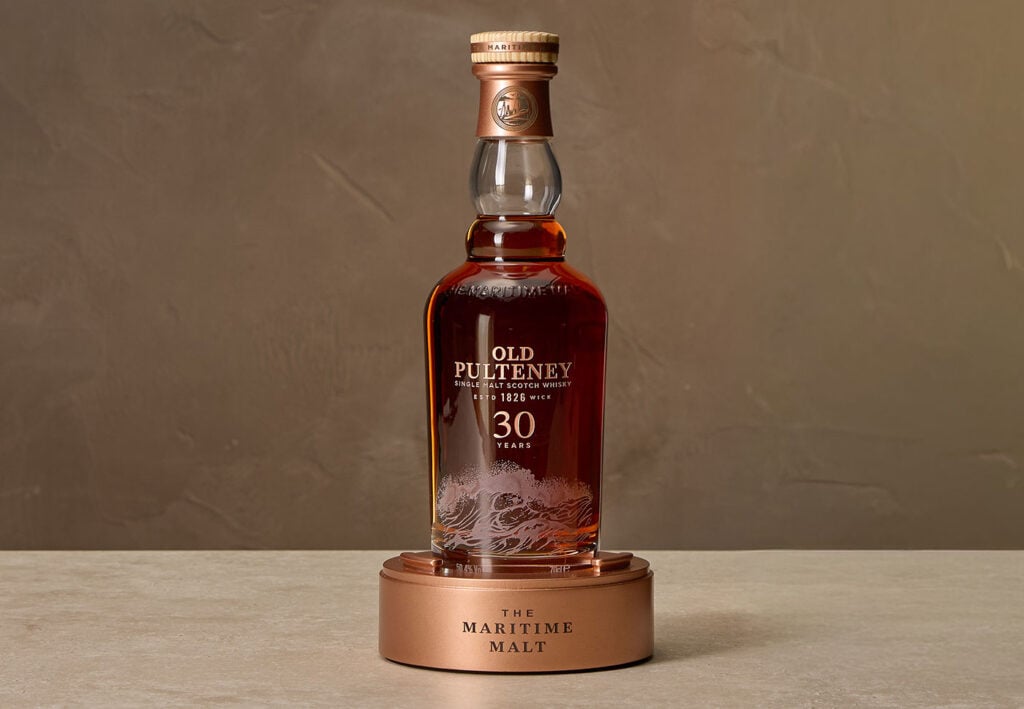
One of three major releases this year
Old Pulteney 30 Years Old Tasting Note
Nose: Marmalade on brown toast, lime peel, vanilla candle, hazelnut, brown sugar, nutmeg pastries, apricot, and charred pineapple give us a bright and sweet opening. Then wet stone and dunnage warehouse minerality, pennies, barnyard funk, and HB pencil give it a complex depth and backbone.
Palate: Brine and tropical fruit and autumnal spice and boiled sweet roundness and marmalade again. It’s got bite and vibrancy but also aged depth, a nice balance of the two. It’s old sherry in a way you’d recognise. There’s also cola laces and chilli nut dust and a little red meat iron and even some chartreuse. Loads going on here, then it all occurs again when you leave it for a while and return.
Finish: Long and juicy and lively and lovely.
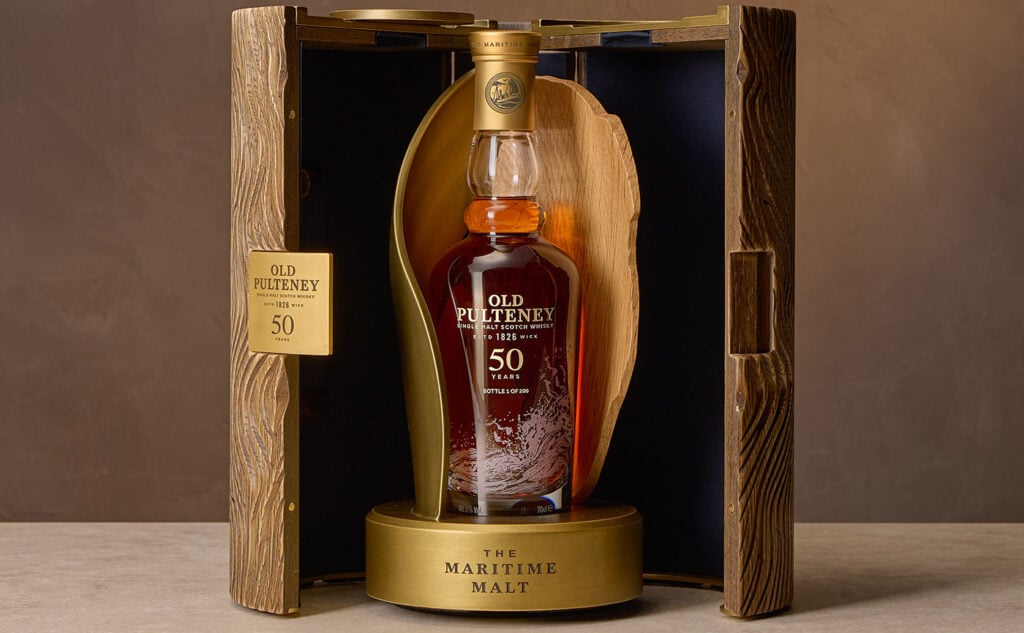
The oldest official distillery release to date
Old Pulteney 50 Years Old Tasting Note
Nose: So delicate and perfumed with Parma Violet sweets, tropical fruit chunks, grapefruit, and Pulteney brine. There’s a deep murky farmy funk that seeps through slowly adding complexity but never enough to mess with the initial prettiness. The sherried European oak, orange, and winter spice are prevalent again, as is dark chocolate truffle, chopped herbs, toasted almonds, lychee, and flint.
Palate: Vivid and luscious with more stone and tropical fruit brightness at the core, citrus oils, with liquorice and marzipan give us texture, while toffee apple, old cigar leaf, and curry spices sit underneath.
Finish: Sparkles away for an age. Like pixie dust.



