More Phoenix Than Dragon: How Welsh Whisky Rose from the Ashes


We’re exploring the revival of Welsh whisky in celebration of St. David’s Day (1 March).
For large swathes of the 21st century, whisky has been experiencing unprecedented growth. What is so striking about this change is that it goes beyond the traditional whisky strongholds of Ireland, Scotland, America, and Japan. Over 50 countries around the world are now home to whisky distilleries.
You wouldn’t have necessarily guessed that an early adopter of this trend was Wales. Then again, the Welsh are well used to being undersetimated. Yes, it was back in 2000 that whisky was revived in the land of dragons and Simon Davies.
Was there whisky ever made in Wales before the dawn of the 21st century? Of course! Let’s take a look at that history together.
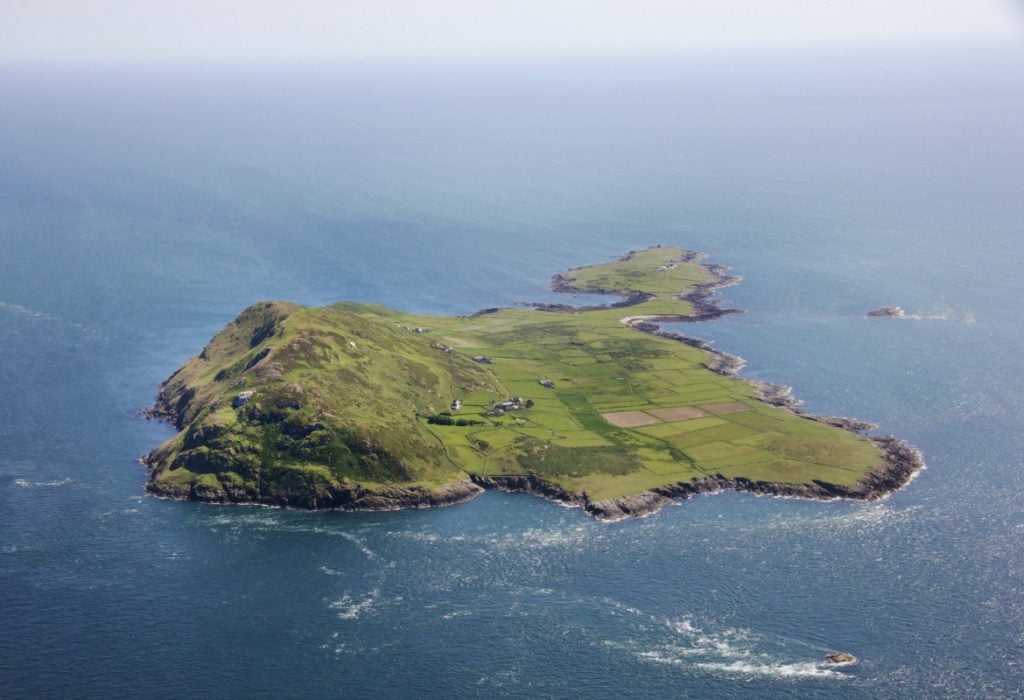
It’s hard to imagine that Welsh distillation could have begun here
From humble beginnings
There are countless stories about Wales and its long history of alcohol production. One tale suggests that Ireland’s beloved St. Patrick was actually Welsh, and enlightened the UK with distillation techniques he learned from his time in France. Another tells of Reaullt Hir ‘The Great Welsh Warrior’, distilling ‘chwisgi’ (whiskey) from braggot (mead made with both honey and barley malt) brewed by the monks of Bardsey Island in AD 356. Then there’s the ‘Mead Song’, which was uncovered in a manuscript of the 6th century Tales of Taliesin, which tells of Welsh distillation.
These legends have been widely disputed. Archaeology suggests there were small stills throughout Wales around the 4th century, but we know little else about this discovery. Yet there’s plenty of heritage when it comes to the art of whisky distillation, aside from the tall tales.
There’s a veritable pipeline of Welsh whisky talent that left for America. Jack Daniel’s grandfather is Welsh. Southern Comfort was initially made by Welsh distillers. Evan Williams, the first commercial distiller in Kentucky, originally hailed from Dale in Pembrokeshire. Records show his family opened a distillery there in 1705. He left Wales for the US. By 1783, he was producing Evan Williams bourbon.
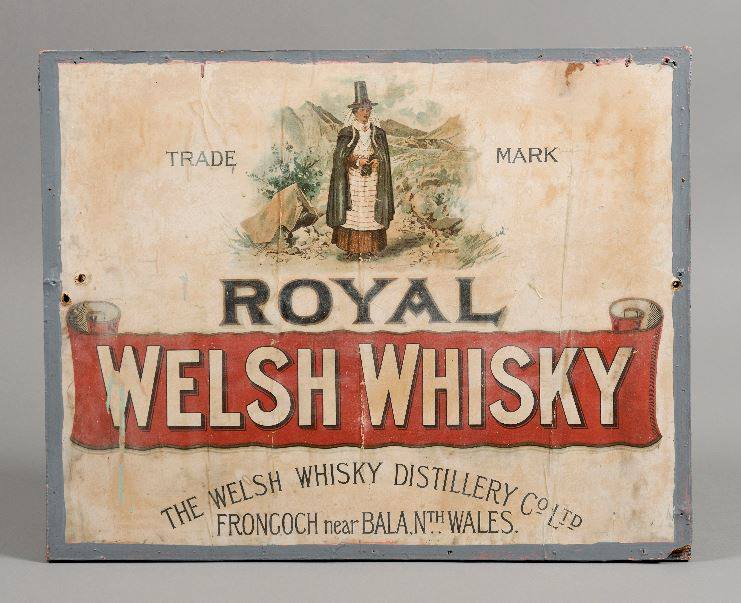
The Welsh Whisky Distillery Co, all those years ago
The decline of Welsh whisky
We may never know quite how much whisky Wales produced at its peak. Records are patchy, and a fair bit of spirit likely slipped quietly into local trade. But by the turn of the 20th century, the direction of travel was clear. Welsh whisky was on the ropes.
The last serious standard bearer was the Welsh Whisky Distillery Company at Frongoch, near Bala, founded in 1889. It arrived with ambition and deep pockets, raising £100,000 in capital, roughly £12 million in 2018 terms. Plans projected capacity at 150,000 gallons per year, which would have made Frongoch the 17th largest malt distillery in the UK. On paper, it looked formidable. In reality, it struggled. By 1910, the company had been liquidated.
The climate did it no favours. Wales had strong Nonconformist religious roots, and the temperance movement held real influence. This was not polite disapproval over a cup of tea. It was organised, vocal, and at times aggressive opposition to alcohol production and sale. Distillers were not exactly operating with the wind behind them.
The ironic blow of the Immature Spirits Act
Then came the decisive blow. In 1915, during the First World War, Chancellor David Lloyd George introduced the Immature Spirits Act. The legislation required whisky to be matured for at least three years, aiming to curb excessive drinking and protect the war effort. It formalised a practice that now underpins Scotch whisky’s quality credentials.
In the long term, that three-year rule helped position whisky as a premium product. In the short term, it squeezed already struggling producers. English, Welsh, and Irish whisky were all in steep decline by this point. The legislation did not create that downturn, but the net effect was clear. Scotch, better capitalised and more established, consolidated its dominance, while Welsh whisky slipped into silence for the better part of a century. The only Welshman to ever be Prime Minister dealt an accidental blow to his own and served up Scotch on a silver platter instead.
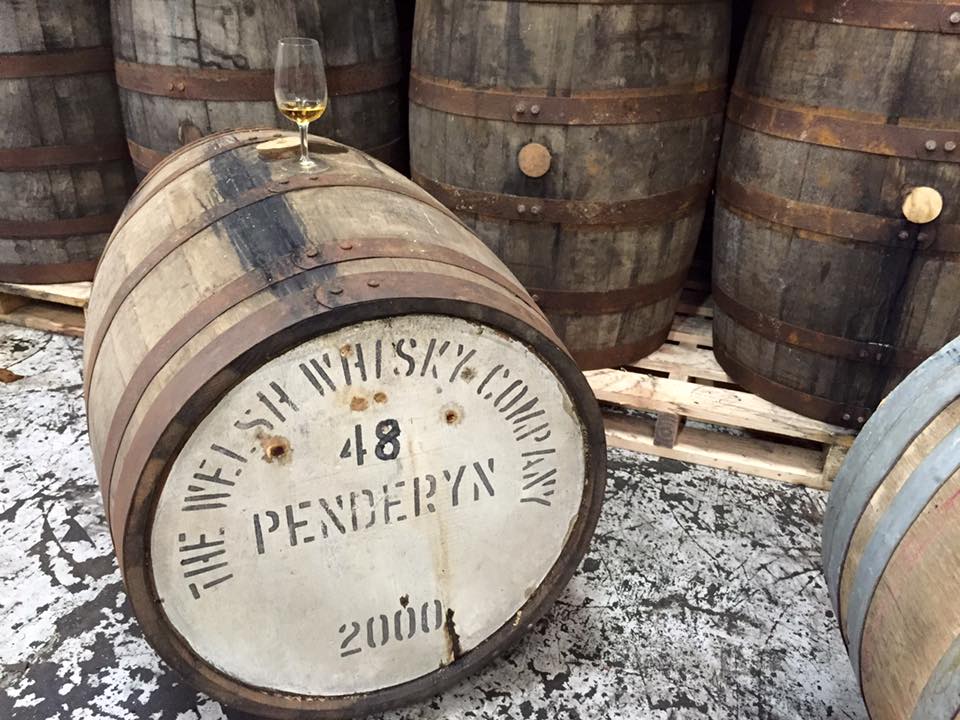
An early Penderyn edition, ready to change the whisky world
Back with a bang
Serious attempts to revive Welsh distilling did not gather momentum until the 1990s. Then, at the turn of the millennium, The Welsh Whisky Company, now known as Penderyn Distillery, built a distillery in the Brecon Beacons National Park and fired up the stills in 2000.
On 1 March 2004, St David’s Day, Penderyn launched the first commercially produced Welsh whisky in over a century. That release marked a genuine turning point. It put Wales back on the modern whisky map. Penderyn has since carved out a credible position in the global whisky community by backing innovation while leaning confidently into its national identity.
Style drove that success. Working with the late Dr Jim Swan, Penderyn developed a distinctive house character and anchored it in Penderyn Madeira Finish. The team matured the spirit in Buffalo Trace bourbon barrels before finishing it in Madeira wine casks on Swan’s recommendation. The result earned strong reviews and gave Welsh whisky a clear, recognisable profile to drape its dragon flag over.
Over the past two decades, Penderyn has grown from one site in the Brecon Beacons to three distilleries across Wales. It opened its second in Llandudno in 2021 and then a third in Swansea in 2023. Today, the Brecon Beacons and Swansea distilleries each produce around 400,000 litres of pure alcohol per year, while Llandudno adds roughly 100,000. That gives Penderyn a combined capacity of about 900,000 LPA, or up to 2.3 million bottles annually.
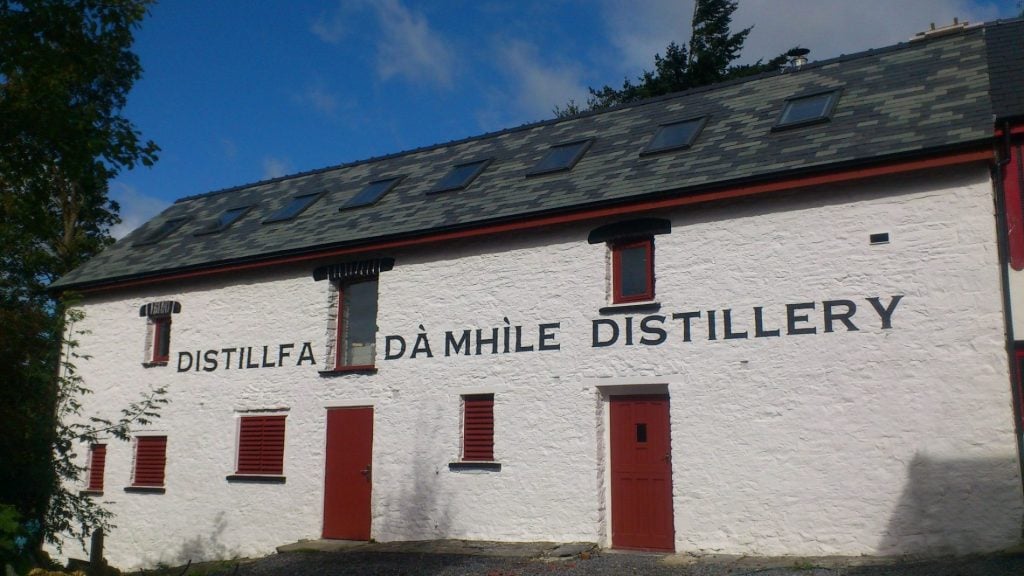
Dà Mhìle Distillery has joined the noble cause
The cavalry arrives… kinda
Penderyn hasn’t carried the whole modern Welsh whisky revival well on its shoulders. Though it certainly has done the heavy lifting, others have gradually joined the charge.
In 2016, Dà Mhìle Distillery near Llandysul bottled its first organic single grain whisky. The distillery runs on organic principles, sources locally where possible, and produces everything from organic gin to whisky with a clear environmental ethos. When it released that first whisky, it did more than add another label to the shelf. Under EU rules at the time, Wales needed at least two active whisky distilleries to count as a recognised producing nation. Dà Mhìle helped secure that status.
A year later, Aber Falls Distillery opened at the foot of the Carneddau mountains, near the gateway to Snowdonia National Park. Backed by significant investment from Halewood and a clear tourism focus, Aber Falls arrived with scale in mind. It built a striking visitor centre, produced gin and liqueurs from day one, and laid down single malt with the ambition to become a flagship North Walian producer. Where Dà Mhìle leaned into organic craft, Aber Falls combined regional pride with commercial muscle, aiming to put Welsh single malt in front of a far broader audience.
And more to come
In the Welsh Wind Distillery near Cardigan added another layer in 2018. It installed copper pot stills, including a 5,000-litre whisky still, and pushed a grain-to-glass approach using locally grown barley that it malts, distils, and matures on site. It has since expanded its storage and maturation capacity, reinforcing its commitment to keeping production rooted in Wales.
The distillery also unveiled Brychan, positioned as the first blended Welsh malt whisky in over 20 years, bringing together single malts from across the country into one collaborative release.
Smaller operations such as Coles Distillery and Anglesey Môn Distillery have since entered whisky production. By the early 2020s, around seven distilleries operated or developed whisky in Wales. Most remain modest in scale. Collectively, they have ensured that Welsh whisky no longer stands on a single pair of shoulders.
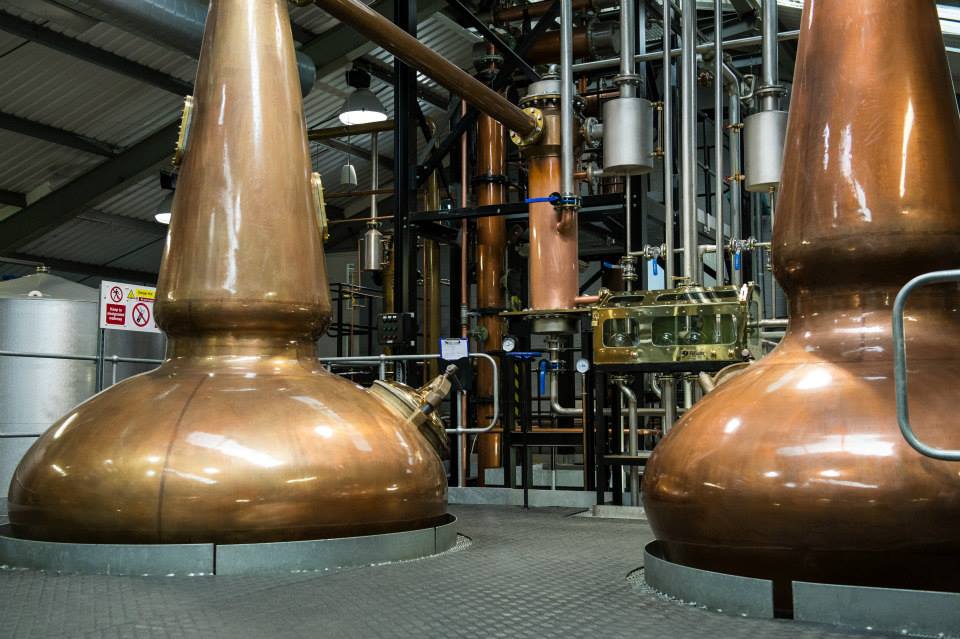
The future is as bright as the stills at Penderyn!
Welsh Whisky is well and truly back
In 2023, Single Malt Welsh Whisky secured Protected Geographical Indication status under the UK GI scheme. That gave the category legal protection on par with Scotch. The rules are clear. To carry the name, the whisky must be made and matured entirely in Wales, follow the official product specification, and protect its provenance. Locking in the standards signals to the wider world that Welsh single malt stands as a recognised category in its own right.
The political nods came earlier. Former First Minister Carwyn Jones called Penderyn one of the great Welsh manufacturing success stories of recent times. Former UK Prime Minister Theresa May publicly pledged to enjoy a Welsh dram at Christmas in 2017, the same month Penderyn announced record annual sales. Symbolic, perhaps. Still satisfying.
The real victory sits elsewhere. This revival happened on Welsh terms. Producers built a style that does not imitate Scotch or Irish whisky and did not rush the process to chase headlines. They took the long road and made something distinct.
There is a Welsh word, hiraeth. Some take it to mean ‘homesickness’, or ‘yearning’. Others attribute a grander definition: ‘A sense of loss for an ancient land’. Perhaps drinking authentic Welsh whisky allows an individual to tap into something elusive and very Welsh. A drop of hiraeth. St. David’s Day seems as good a time as any to celebrate that.
From all of us at MoM, Dydd Gŵyl Dewi hapus.
This article was first published on 22 February 2018. It was updated and re-published on 26 February 2026.
1 Comment




