Was Glenfiddich really the first ever single malt whisky?

Tobermory
Ian Buxton
Ian Buxton
Share:

An email making bold claims about Glenfiddich arrived at Master of Malt HQ last week. We had our doubts about its veracity so we turned it over to whisky writer and industry veteran Ian Buxton for his take. And here it is!

In what I laughingly refer to as my line of ‘work’ I’m exposed to a fair amount of nonsense from over-exuberant PR agencies (one day, I must offer you a selection of their better howlers).  Mostly this can be put down to inexperience or an excess of enthusiasm but this week my inbox positively glowed with some nuclear-weapons-grade spinmeistering from Glenfiddich’s agency Porter NovelliBack in 1969, they would have you know, “Glenfiddich was changing the world of whisky as we know [it, sic], launching the first ever SINGLE MALT WHISKY – they were all blends before the summer of ’69!” (their bold face and block caps).

Well, that got my attention, as did the claim that Glenfiddich opened the world’s first ever distillery visitor centre (I hope you’ve noticed the bold face and block capitals, by the way).  Let’s deal with that first: distilleries have been welcoming visitors since the 19th Century as Alfred Barnard would testify and, while they may not have had purpose-built facilities, Tobermory was actively welcoming visitors from the early 1920s (look closely at the bottom two lines on the door).  Glenfarclas opened their doors at much the same time as Glenfiddich – so closely in fact that they could hardly be accused of ‘copying’ their Speyside rivals. As so often, two people independently had the same great idea at much the same time, though it was hardly revolutionary. These, in fact, are mere striplings: the Palais Bénédictine was opened in 1888, beating Glenfiddich by a mere 81 years, and as Scotch whisky began life in the 15th Century at Lindores Abbey we can be sure that the hospitable monks were welcoming medieval visitors more than 500 years ago.  
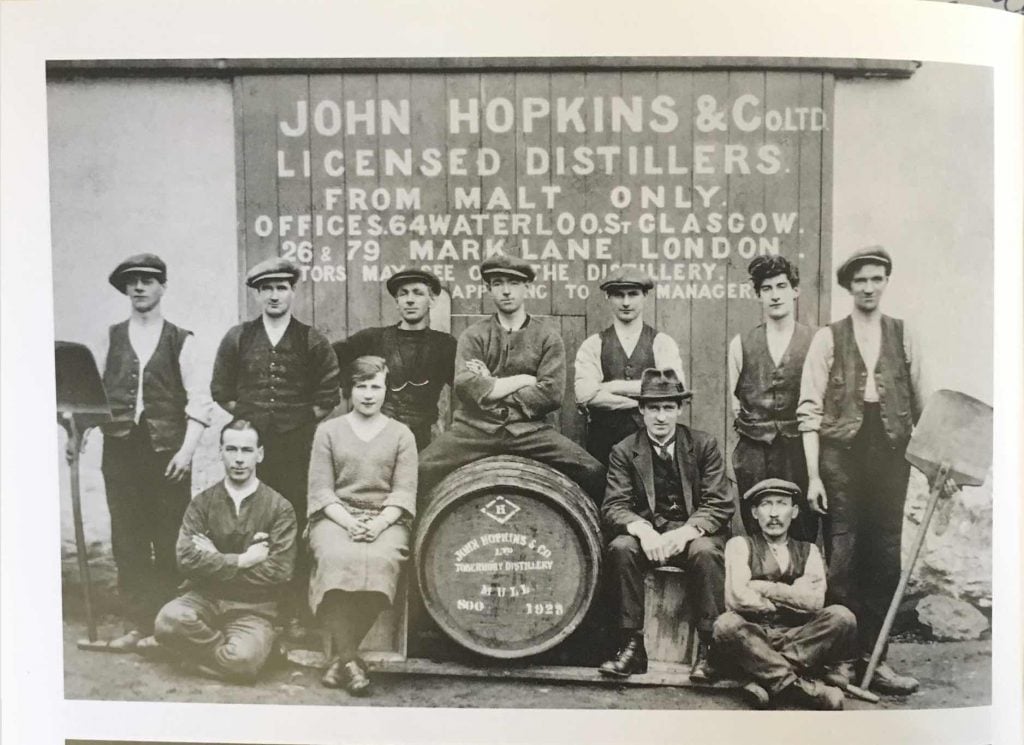
Tobermory

Tobermory has been welcoming visitors for a long time

So that’s a pretty daft claim that ill becomes a brand with a great track record of innovation but one that we could probably ignore if it hadn’t been offered with the remarkable assertion that all Scotch was blended prior to 1969.  Really? Who knew? 

Where to start?  Well, Macallan’s then Chairman George Harbinson, was able to assure his presumably happy shareholders in 1963 that “the sale of Macallan in bottle is gaining momentum with a steadily increasing demand for the over 15 year old from the south of England”. Or perhaps with Professor George Saintsbury who in his hugely-influential Notes on a Cellar Book (1920, but still in print), disparages grain whisky as “only good for blending” and points the reader to Glendronach, Clynelish (now known as Brora) and Smith’s Glenlivet as single whiskies of note.  His admirer Aeneas MacDonald in his Whisky (1930, but also still in print) devotes the whole of his book – a genuine first, by the way – to singing the praises of single malt.

But for writers in the early part of the twentieth century to be championing single malt it had to have been around for some time.  Well, of course it was: blending greatly boosted Scotch whisky’s fortunes from the late 19th century at the expense of single malt but it never went away.  Connoisseurs such as Saintsbury, MacDonald and Sir Robert Bruce Lockhart (Scotch, published 1951) make that abundantly clear. Earlier writers too, sang its praises.  I call to the witness stand Robert Louis Stevenson who in his poem The Scotsman’s Return from Abroad apostrophises Talisker, Isla or Glenlivet as one of his three “king o’ drinks”. And that, of course, brings us to Glenlivet of which Sir Walter Scott was to write “it is the only liquor fit for a gentleman to drink in the morning”.
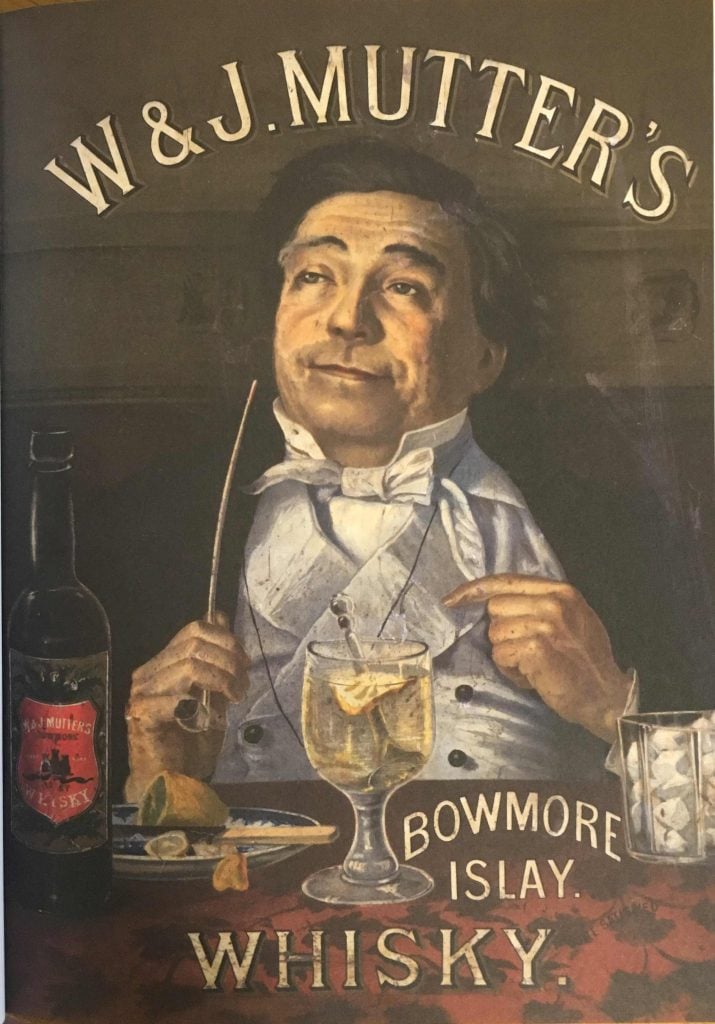
Bowmore advert

Advert for Bowmore whisky from before 1969

Now, Chivas Brothers’ The Glenlivet may have dropped its claim that it was “the single malt that started it all” but the Glenlivet name was highly prized.  Did not King George IV on his famous Brigadoon-style visit to Scotland in August 1822 demand a glass of Glenlivet whisky, then technically illegal and most certainly not blended? So valuable was the Glenlivet name that in 1884 J. G. Smith had to go to law to obtain the sole right to use the definite article in marketing his whisky as The Glenlivet.  As soon as Prohibition was repealed in 1933 his successors were exporting to the USA with such success that just twenty years later some 27 other brands had applied Glenlivet as a suffix to their drams. But even before Prohibition certain Islay whiskies, notably Laphroaig and Bowmore were well known in North America.  Bowmore were even advertising in Canada in the late nineteenth century. Need I go on – well, just one more example.  Royal Brackla was advertising its whisky and the Royal Warrant it received from King William IV in the 1830s.

Oh, and just for Porter Novelli’s benefit, Glenfiddich was being sold in Scotland well before the Second World War and Glenfiddich Pure Malt dates from 1903 at least.  How do I know – well, I found this picture on their website! Perhaps the PR team should take a look!  

Though he has neither a beard nor any visible tattoos or piercings, Ian Buxton is well-placed to write about drinks.  A former Marketing Director of one of Scotland’s favourite single malts, his is a bitter-sweet love affair with Scotland’s national drink – not to mention gin and rum, or whatever the nearest PR is pouring. Once, apparently without noticing, he bought a derelict distillery. Follow his passionate, authentic hand-crafted artisanal journey on the Master of Malt blog.  Or just buy his books.  It’s what he really wants.
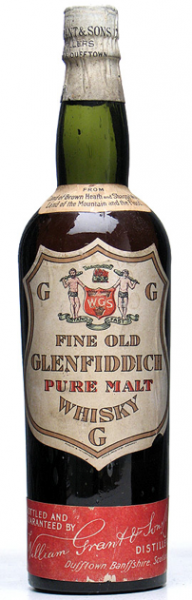
Glenfiddich

Glenfiddich malt whisky bottle c. 1903-1908

15 Comments

Reb Mordechai
Reb MordechaiJanuary 19, 2023
I know this topic is cold but I’d like to give you my tuppence worth. Blended Whisky was effectively the only type of Scotch Whisky available outside of Scotland (where single malts were only sold in specialist stores or directly from the distillery) until the early 1960s. Almost the entire output from Malt Whisky Distilleries went into blending. Only an insignificant percentage was bottled as “Pure” or “Straight” Malt Whisky (as it was called back then), and this was only available in a handful of exclusive outlets and Department stores outside Scotland. The book quotes you used about drinking Malt Whisky (if I am not mistaken) came from authors who either lived in Scotland or had access to Malt whisky from connections with distilleries or from exclusive outlets like Berry Bros of London. So, in my opinion, these examples do not prove that Single Malts were available before the 1960s at all, but in fact show that they were only available to a very small minority of privileged individuals. Glenfiddich Pure Malt was (according to my research), indeed the very first widely available “Pure Malt”, released onto the world market in 1969. Others however followed quickly making their Malt Whisky widely available around the world. If someone could direct me to any advertisement for Pure 100% Malt Whisky before the 1960s, I’d be obliged. That’s the only thing which would prove they were available.
NOEL MOITRA
NOEL MOITRANovember 24, 2021
I am surprised at this comment: “As soon as Prohibition was repealed in 1933 his successors were exporting to the USA with such success that just twenty years later some 27 other brands had applied Glenlivet as a suffix to their drams.” This epic tale did not see the 20th Century, running its legal course between 1870-1884. Paul Pacult, in his book: A Double Scotch, has devoted an almost full chapter to the suffix Glenlivet, pages 145-152. It is a complete story. Extracts: –In 1870, John Gordon and his father travelled to London together to officially register the name “Glenlivet” as their proprietary trademark. –All through the 1870s, word reached the second-floor offices of The Glenlivet that yet more malt whiskies were appearing in Edinburgh, Glasgow, Aberdeen, and London touting the name made famous by the patriarch of the Smith family. –Court case filed in London in 1881. Countersuits alleging that he didn’t have exclusivity to the word Glenlivet began being filed in late spring 1883. In May 1884, an indenture and deed of agreement was signed by the parties and ratified by the courts. John Gordon also consented not to obstruct the use of the name for 10 specified distilleries: Aberlour, Benrinnes, Cragganmore, Linkwood, Glenlossie, Macallan, Glenrothes, Glen Grant, Mortlach, and Glenfarclas. This provision made clear that the term Glenlivet had to be preceded by the actual name of the distillery and that the names were to be separated by a hyphen. Thus, GlenlossieGlenlivet, Glenrothes-Glenlivet, Macallan-Glenlivet, and so on became legal names. The 28 distilleries that had used the Glenlivet suffix were: Aberlour-Glenlivet Aultmore-Glenlivet Balmenach-Glenlivet Balvenie-Glenlivet Benromach-Glenlivet Coleburn-Glenlivet Convalmore-Glenlivet Cragganmore-Glenlivet Craigellachie-Glenlivet Dailuaine-Glenlivet Dufftown-Glenlivet Glenburgie-Glenlivet Glendullan-Glenlivet Glen Elgin-Glenlivet Glenfarclas-Glenlivet Glen Grant-Glenlivet Glen Keith-Glenlivet Glenlossie-Glenlivet Glen Moray-Glenlivet Glenrothes-Glenlivet Imperial-Glenlivet Longmorn-Glenlivet Macallan-Glenlivet Miltonduff-Glenlivet Speyburn-Glenlivet Tamdhu-Glenlivet
phillip rudge
phillip rudgeOctober 3, 2021
Notwithstanding Glenfiddich’s “preposterous” claims, Helen Arthur in her “Single Malt Whisky Companion” book clearly states that market placement, advertising and availability of their (GF) single malt revolutionized the whisky world market, making the SM overall share rise tenfold from roughly 1% to over 10% nowadays! Cheers.
Joseph Lucca
Joseph LuccaAugust 22, 2020
Hi Ian Re Glenfiddich A few years ago, possibly 2013, 2014 by the time it arrived in Australia, Glenfiddich released a no age statement The Original, to commemorate 50 years since the first single malt was exported outside of Scotland. The well presented whisky came with a booklet, which made this claim. Fact or not, it stated that in 1963 it was the first exported single malt Scotch whisky, no mention of being the first single malt. For me it was good, as it was my year of birth, and made a good gift for my father, ad it was the year that he first became a father. J. Lucca
Serg
SergDecember 25, 2019
So, what does that line on the photo “Tobermory has been welcoming visitors for a long time” actually says? The line at the bottom – two last lines on the door…Anyone? Does it say – “Visitors may see on the distillery?” What about the very last line? Thanks!
Frank
FrankJune 14, 2020
“BY APPLYING TO THE MANAGER” is my best guess.
Bob
BobJuly 12, 2019
So Ian B, If you are wrong about the visitors center should you not amend it in the article?
Andy fairgrieve
Andy fairgrieveJuly 12, 2019
Hi Ian Glad to see you done your homework on the Glenfarclas opening date. Suppose if you drink enough fours years later seems pretty much the same as four years earlier ? look forward to seeing you up here in the near future
Ian Buxton
Ian BuxtonJuly 12, 2019
That’s up to the Editor. I don’t have access to the story once it’s up. Hence my correction. That’s the limit of even my superhero powers!
Ian Logan
Ian LoganJuly 8, 2019
Hi Ian, J.G. Smith didn’t use the Indenture of 1884 to guarantee the use of the definitive article I am afriad to say. All the document did was protect the trademark that already existed. There is no mention of the word “The” in it at all. Glenlivet had tradmark registration in parts of the US before Glenfiddich was even built so was certainly there long before the end of Prohibition. Ian Logan
Ian Buxton
Ian BuxtonJuly 8, 2019
Thanks; nice to hear from you. I’ll have to check back on my source material to see where this story originates. Ian

Leave a Comment
