Trade
Trade

With recent disagreements among the English whisky industry about a proposed GI for the category, we take a closer look at some of the problems in trying to define English whisky. What is – the meaning of whisky?
Earlier this year I attended an event hosted by Lucy Britner, sometime Master of Malt contributor and editor of Drinks Retailing, at the London Wine Fair about English whisky. The purpose of the panel was to try to define English whisky. There was Alex Wolpert from the East London Liquor Company, Charlie Echlin from the Oxford Artisan Distillery, and Rob Patchett from the Cotswolds Distillery.
They are three very different producers with the Oxford Artisan specialising in rye and corn American-style whiskies, the Cotswolds making Scottish-style single malts, and the ELLC making both rye and single malt. Everyone seemed to agree that with such a disparate industry, any regulations would need to have a light touch. Wolpert said, “nobody is aspiring to Scotch rigours” and Echlin described the burgeoning category as “New World.”
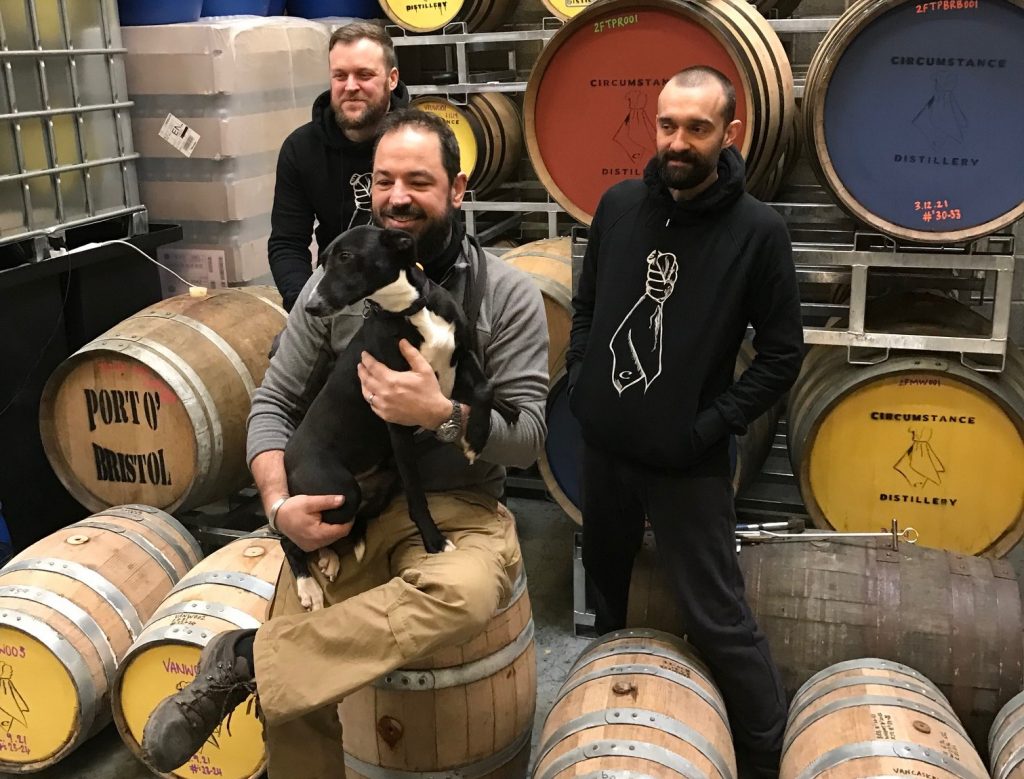
Liam Hirt from Circumstance, centre holding dog
Trying to define English whisky?
The English Whisky Guild (EHG) was announced in April this year with 17 members, including all of the above, out of 21 producers currently selling whisky, and a set of draft regulations has recently gone to the Department for Environment, Food and Rural Affairs (Defra). The organisation has only been in existence for a few months and already one member has left. The Circumstance Distillery in Bristol is not happy with a rule about copper pot distillation for single malt whisky, as we reported on the Nightcap: 9 September. Founder Liam Hirt said: “The proposed requirement to double distil in pure copper pot stills will prove both a barrier to entry and stifle innovation, and has nothing to do with ensuring quality or preserving traditions.”
The proposed regulations are not public but Tagore Ramouta, co-founder of the Oxford Artisan Distillery and a driving force behind the EHG, sent me the particular sections that had caused the problem:
“English Whisky is summarised as a spirit: Made from UK Cereal Grain and Water, Distilled in England from wort created in England and Matured in England in Wooden Casks, such as oak (but not limited to), of no more than 700 litres for a minimum of 3 years.
Malt English Whisky is as above plus the spirit must be batch distilled in a copper pot still; Malt English Whisky must be distilled for a minimum of two times.”
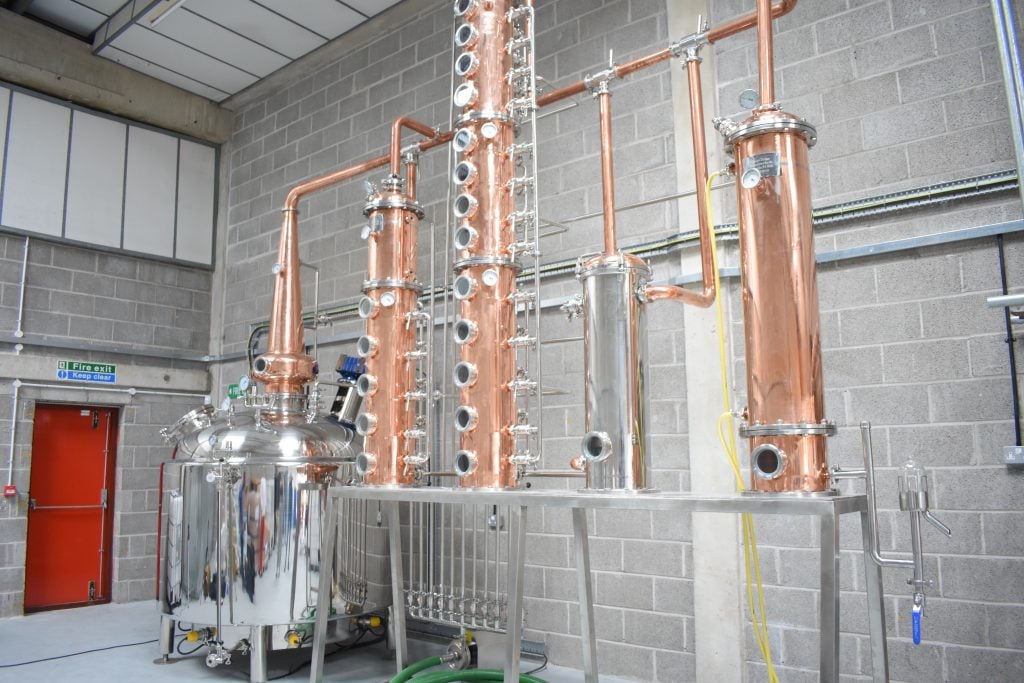
The stainless steel still at Circumstance that is causing all the problems.
Copper-bottomed
The conflict is over the last line concerning ‘Malt English Whisky’. There seems to be some confusion over whether it’s the pot or the column that is the problem as Ramouta followed up with “Note the definition of Grain English Whisky allows distillation via a column.” But the actual sticking point, according to Stephen Russell from Copper Rivet in Kent, which makes a column malt, is the copper pot still. Circumstance uses a stainless steel one. Distiller Abhishek Banik from Copper Rivet explained: “They insist on copper pot distillation, but you are allowed a column, not continuous distillation, double distillation, first through a copper pot and then through a column. Pot and column is not caught out with those rules.”
I asked for clarification on why they had this particular rule. Ramouta said: “GI promotes that Malt English Whisky should be batch distilled to conform to the standard.” Banik explained that it is to do with copper contact. Malt whisky especially produced without sufficient copper contact can produce sulphurous aromas. Liam Hirt from Circumstance, however, is adamant that his whisky, the first release had a 85% malted/ 15% unmalted barley mashbill, gets plenty of copper contact in the column and having tried some I can attest that there are no peculiar sulphurous smells. “It makes great whisky because the amount of copper contact through bubble plates in a small column is much higher than using copper pot stills,” he said. Furthermore, there are certain Scotch whiskies like Craigellachie famed for their sulphurous smells despite copper pot stills
Stephen Russell thought the rule was vague enough to allow Circumstance’s whisky to be classed as an English single malt. Hirt, however, was worried that vague rules might at some point be enforced in a strict manner, especially if any of the drinks multinationals move into English whisky. As we have seen with the arguments in Ireland over what constitutes single pot still whiskey, it’s not always helpful when one large player has such an influence over regulations.

Abhi Banik and Stephen Russell from the Copper Rivet Distillery
Big boys versus small boys
Russell thought that it was “good that Liam Hirt is making a fuss.” He and others at Copper Rivet have admitted that there were divisions in the English whisky guild; “big boys versus small boys” with the larger producers making more Scotch-style whiskies. Banik said “There were two camps of people and it took a long time to coalesce and sing from the same hymn sheet.” Banik told me he personally wasn’t bothered about non-copper pot stills, Copper Rivet instead really wanted stricter rules on mashing and fermenting all taking place under one roof – something that doesn’t happen with all English whiskies.
According to Banik, the idea with the rules was to create something stricter than EU regulations but allowing more room to experiment than the SWA (Scotch Whisky Association). There’s been some off-the-record muttering that some of the bigger members of the EWG have been unduly influenced by Scottish rules and are far too close to the SWA.
Who needs rules anyway?
The big question is, why have rules above the basic EU ones anyway? While at the moment, all the English whiskies that have come on the market, at least the ones we have tasted, have been made to a high standard, the aim is to protect the words “English whisky” from substandard products. Tagore said: “It will in essence be a quality mark for consumers. In addition it will protect English Whisky producers and consumers from “passing off” of a product produced elsewhere to differing standards.”
I can understand why the English Guild is necessary. You don’t want a situation like you have in Japan where the words ‘Japanese whisky’ on a bottle are no guarantee about provenance. But with English whisky so diverse and unformed, it does seem odd to have such strict rules over distillation methods especially as whiskies like Cotswolds, ELLC, and Circumstance largely sell on their own reputation rather than as English whiskies. If the GI goes through then products that don’t conform, like Circumstance’s single malt, won’t be allowed to be called ‘malt English whisky’. It seems very unlikely that this will have any effect on sales.