Trade
Trade

With the week around St. George’s Day being defined as English Whisky Week, I’m continuing my series of deep dives into some of the English distilleries that have been exciting me. The Spirit of Birmingham is up next.
Quite rightly, there is a lot of talk about English whisky at the moment. The category has grown immensely since The English Distillery, celebrating its 20th anniversary at the close of this year, began operations in December 2006, producing England’s first single malt English whisky.
The distillery in Roudham, Norfolk, holds the distinction of being the first purpose-built whisky distillery in England in over a century. For several years, it was the only major producer. While it’s true that the cider maker Hicks and Healy had previously laid down some single malt whisky, The English Distillery was the first of its kind.
English single malt whisky
Both distillers produced single malt whisky, a term that, as you may recall, was defined by the Scotch whisky industry a long time ago.
While the term ‘single malt’ still confuses non-whisky drinkers occasionally, single malt Scotch whisky is defined by the Scotch Whisky Regulations 2009, a set of laws passed by the UK government based on standards maintained by the Scotch Whisky Association. These regulations require it to be 100% malted barley, distilled in copper pot stills, at a single distillery, and aged for at least three years in Scotland.
Other countries have adopted this to their requirements, following on from what has always been. However, I’m concerned the English Whisky Guild is pushing forward with not quite 20 years of history.
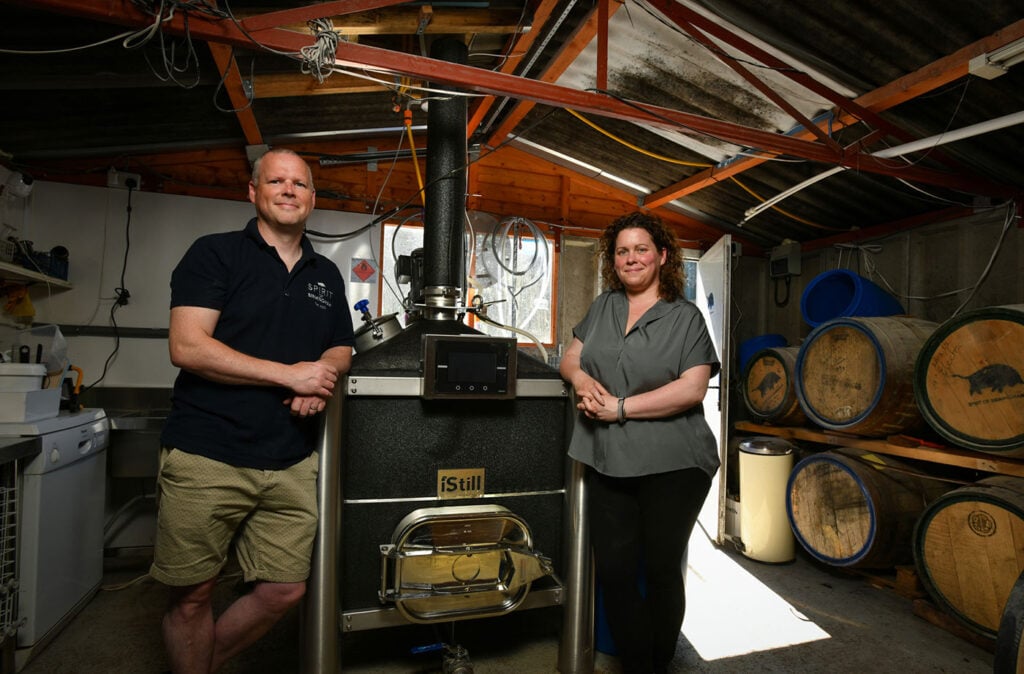
Meet Tony and Joanie from The Spirit of Birmingham
An English Whisky Guild
The English Whisky Guild came together in 2022, and its website states that the overarching vision of the EWG is for English whisky to be recognised globally as a respected choice for whisky drinkers. Great!
It goes on: “By combining the experience of our members, we aim to showcase the remarkable diversity and quality of our unique whiskies as well as to underscore the tireless pursuit of creativity, inclusivity and innovation.” Brilliant!
I have a problem with their next statement, informing me that they are working to clearly define the technical standards for what constitutes English Whisky and monitor adherence to those standards. They then add, “and we will propagate all agreed standards so that they are known, understood and accessible to all current and prospective producers and anyone with an interest in English whisky.”
The industry is not even 20 years old, and yet the EWG wants to define English Whisky without exploring what English Whisky could even be. I was saddened…
Scotch whisky made in England?
I downloaded their 2025 Annual Report, the opening introduction from Morag Garden, CEO of the English Whisky Guild, states, “English Whisky is no longer the industry’s best-kept secret. It is a thriving category defined by quality, provenance, and innovation. As we look ahead, our community of distillers will continue to push boundaries, ensuring English Whisky earns its rightful place amongst the world’s great spirits.”
This is a great inspirational statement, especially saying positive words, such as innovation and pushing boundaries. However, flip forward to page 53 for the outline of The English Whisky GI, and I’m disheartened to find that it more or less mirrors the SWA requirements, and still includes the permitted additive of E150 colouring.
To be labelled a Single Malt Whisky, it must be distilled in copper pot stills, no hybrid stills, no column stills (even the US new rules incorporate different stills for American single malt), it must be aged in wooden casks of a maximum size, blah blah, blah.
It’s the same as it ever was, with the exception that English grains and English water must be used. Where has that innovation gone? These regulations appear to read ‘Scotch Whisky made in England’ to me.
The debate around English whisky and its GI rumbles on
English Whisky’s Ancient History?
I’ve seen a lot of talk recently from certain voices about a long history of whisky-making in England, which also concerns me.
In Alfred Barnard’s epic The Whisky Distilleries of the United Kingdom, first published in 1887, he mentions that there were just ten distilleries, with most of them being ‘confined to the manufacture of Plain Spirit for rectifying and manufacturing purposes.’
There were just four listed that came ’within the scope of the present work.’ (The writing of The Whisky Distilleries of the United Kingdom). The majority of production from these four distilleries was stated as being Pure Grain Whisky, although both the Bristol Distillery and the Lea Valley Distillery, in London, were making malt whisky. Barnard clearly states that the production of whisky from the Bristol Distillery was sent to Scotland and Ireland for Blended Scotch and Irish Whisky.
English whisky production ceased for nearly a century after the circa 1905 closure of East London’s Lea Valley Distillery, the last operating English whisky distillery. The distillery was owned by Distillers Company Limited (now Diageo) at the time, and its demise followed the 1898 “Pattison Crash.”
The Rise of English Whisky
While 2006 can be considered as the start of English Whisky production, it wasn’t until 2010 that a second distiller came on board when Adnams started their whisky production. However, 2014 marks the beginning of the ‘boom’ of English whisky production, with several distilleries starting their stills that year.
The 2026 edition of Malt Whisky Yearbook lists 40 English distilleries making malt whisky, and Cooper King’s excellent Whisky Map, which is updated every English Whisky Week, shows 69 now, which is simply astonishing!
Anyway, I have digressed a long way off the subject, but it’s all relevant as we’ll explain below.
Getting into The Spirit of Birmingham
I’ve met Tony and Joanie from The Spirit of Birmingham at several whisky shows over recent years. They are always a joy to catch up with, as their passion comes across in spades, and their whisky (I’ll always call it whisky, even if it is less than the ‘magic’ three years) was always among the best tasted at the events.
From an idea at a kitchen table in 2017, less than 30 metres from that kitchen table, Spirit of Birmingham, Birmingham’s very own whiskey distillery, started production. They released their inaugural whisky in the summer of 2025.
I’ve wanted to catch up with them for a long time, but understandably, they were quite busy getting their first Single Malt release out. We’ve recently caught up online, and I had a detailed discussion with them about their journey so far, their current plans for the year, and their future ambitions for the distillery.

Welcome to The Spirit of Birmingham Distillery
The Spirit of Birmingham
Before I begin, let me introduce you to the brother and sister team, Tony and Joanie. I’ve known Tony on social media as ‘Tony Pancakes’ for ages; he regularly asks for playlists to listen to while he’s working in the distillery. I have great respect for anyone whose work is inspired by or involves music!
There are two more people to tip our hats at: Tony’s wife, Xanthe, who keeps everything together and moving forward: The glue that binds, the grease for the wheel, AKA “the Boss”, and an Aussie friend, Foxy, who is described as the master of mischief, brightening everyone’s day and encouraging them to do bold things, like open a distillery.
Joanie said that Foxy could be described as “the Enabler”, and I understand what she means. I’ve worked with several Aussies over the years, and they have a ‘can-do’ attitude to just about everything, getting behind every project with encouragement.
How did The Spirit of Birmingham come to be?
With 25 years as a chef, Tony has a deep appreciation for quality ingredients. His journey into fermentation began after a colleague introduced him to the process, leading him to experiment with home brewing. While his early brewing efforts weren’t always successful, they formed the crucial foundation for his current craft.
His perfect moment is relaxing on the decking with a cocktail as the still quietly operates. Joanie brings a varied background—including Irish dancing, travel agency work, and owning a bridal business—all unified by a commitment to excellence and a desire to support other small enterprises.
Driven by an innate sense of doing things properly, she rejects the easy or cheap route. She loves the creative process and seeing the delight people experience when they indulge in their products. Her happy place is a wild beach on the west coast of Ireland, sharing it with her cats, Uisce and Tighe.
Birmingham’s first grain-to-glass distiller
From a shared love of whisky and good times, coupled with a strong can-do attitude, the initial inspiration for Tony and Joanie to start the distillery was born. They chose to launch a distillery specifically because they were driven to actually make whisky, not simply to launch a brand. As per their members’ club welcome letter, the core mission is centred on community, friendship, integrity, and, of course, good times.
As craft producers, Tony and Joanie envision the distillery as a beacon for innovation, aiming to cement themselves as a high-quality whiskey producer within the broader English spirits landscape.
The distillery location is particularly special because Birmingham is their hometown, and their distillery is the first grain-to-glass distillery ever to be registered in the city. This provides a unique opportunity to build for the future while paying homage to Birmingham’s history of innovation and industrial heritage.

The Spirit of Birmingham Distillery’s inaugural pot still whiskey
Why an ‘e’ in Whiskey?
Spirit of Birmingham’s primary spirit is whiskey, and the distillery focuses on small batch and single-cask releases, meaning there is no year-round product, but their signature mixed mashbill will be a core annual batch release. I’ve noticed that Spirit of Birmingham are spelling whiskey with the ‘e’ and asked for the reason. Their answer was comprehensive:
With no history of distilling in Birmingham and very little in England, there were no whisky traditions to draw from. Their guide to whisky production was the EU regulations and technical file. It would have been easy to look at Scotch Whisky and copy production methods. However (within the regulations), the aim was to build a process from the ground up, creating a product that meant something and spoke of Birmingham, the home of the distillery.
There was never any intention of making Scotch south of the border (whilst so many are), and that was avoided. Their whiskey is inspired by the brewing heritage in the Midlands, innovating with its own production methods and equipment. The ‘e’ is a marker for a point of difference. This spirit is not like everyone else; it is different. It felt right and gave a nod to their Irish heritage, too.
It’s not all whiskey.
Of course, cash is a necessity for any new whiskey distillery, so both gin and vodka are produced on a more regular basis, alongside other liqueurs from time to time.
The brother and sister duo do everything from mashing, fermenting, and distillation, to label design, bottling, selling, social media and the administration! While they are hands-on with all of their grain-based products, they also import and independently bottle a specially selected Jamaican rum.
Sustainability plays a huge role in their production practices. Being a new distillery, they were not reliant on historic practices or old equipment. They endeavour to keep supply chains as short as possible. Spent grain goes to a local family-run dairy to give the ladies a treat between milking, and they reuse and recycle packaging. They were particularly proud of the couple of IBC’s collecting rainwater off the roof, which is used to cool the condenser – this simple act easily saves many litres of water annually.

This is floor malted Maris Otter barley
A unique mashbill
Tony’s unique multigrain mashbill, which I learned about early on at whisky shows, stems from his two decades of occasional homebrewing. He identified a missed opportunity in the distilling industry’s conservative choice of grains, contrasting sharply with the innovative, multi-grain approaches prevalent in Birmingham’s buoyant craft brewing scene. Brewers routinely use diverse grains—such as heritage, crystal, roasted, and Munich malts—while distillers often let high yield and low cost, rather than flavour, dictate their decisions. This led to their core hypothesis: A good beer (without hops) should logically produce a good whisky.
To test this, they embarked on an R&D project, producing a dozen different beer styles, ranging from a light rice beer to an imperial stout. Each batch was split: half was hopped and bottled as beer, and the remainder was distilled into spirit. A blind tasting with friends and family sought to identify the “most compelling spirit.”
The result was a unanimous preference for the darker spirits, falling somewhere between a ‘Newkie Brown’ and Guinness. Their R&D efforts then focused on this flavour profile, meticulously developing the signature mashbill:
- Maris Otter Heritage Barley: Floor malted at Warminster Maltings, comprising 80% of the mashbill.
- Unmalted Barley
- Malted Oats
- Chocolate Malt
- Malted Rye
Each of these components contributes a unique layer of flavour and a rich texture, adding significant depth to the final spirit.
Filling casks
When filling casks with their new make spirit, they use a lower ABV entry (58%) than most distilleries today. I’ve had discussions with US distillers who used this method too. Tony told me that it tempered the extraction from new wood, allowing full-term maturation without over-cooking it. American distillers are increasingly using lower barrel entry proofs (typically 100–115 proof, 50% abv – 57.5% ABV) to produce softer, richer, and more complex whiskey. From the discussions I’ve had, the consensus is that lower proofs allow for better water-soluble sugar extraction from the wood, favouring caramel and vanilla notes, rather than the sharp tannins and dry notes associated with the industry-standard 125 proof (62.5% ABV).
New Recipes
I asked about their recipe development and new product innovation, and Joanie told me that they come up with an idea and try it in tastings, and then sales using 20cl bottles at artisan markets. Recently, they added a vegan Coconut Liqueur to their permanent line-up due to overwhelming customer demand. They would love to explore more flavour profiles with heritage barley varieties, and for a bit of fun, locally foraged fruit liqueurs.

Vorlauf helps set the grain bed, creating a natural filter for a better clarity wort
Equipment and Raw Materials
The centrepiece of the operation is a 500-litre, 100% stainless steel Istill, which is electrically heated using entirely renewable energy. This choice of equipment reflects the distillery’s commitment to sustainability and energy efficiency, a key consideration from the project’s inception. Unlike copper stills, the stainless steel design offers a longer lifespan and prevents toxic copper compounds from contaminating the pot ale. By addressing potential issues “upstream,” the Istill technology helps the distillery avoid unnecessary processes and reduce embedded costs.
They bought the biggest still they could afford (couldn’t really afford!), which didn’t leave a lot for everything else, so they bootstrapped. The mash tuns are handmade using 220L HDPE blue drums, a perforated false bottom from a brewer’s kettle and some off-the-shelf pipework. Grain is scooped in by hand and stirred in with a kitchen whisk. Pumps are small, slow homebrew pumps, but cheap and replaceable. The Istill serves as a fermenter with temperature control, and the blue drums serve as receiving vessels when not used for mashing.
Primary raw materials are all locally sourced:
- Grain and Malt: So far, all of their grain is supplied by Warminster. They went on to say that they adore the team there, love their story, and they are certain of the social, economic and environmental benefits of using local suppliers.
- Yeast: A slightly guarded secret. They want a focused approach to flavour development, Tony expanded, “for us, that comes from the excellent grain. Yeast plays a role in flavour creation, but when we swapped out different yeasts during R&D and early production, we found no perceivable difference. The difference that heritage grain makes overpowers any subtle variances from yeast choice.
- Botanicals: Tony would love to grow them all himself. Half of the planting in the garden, which sits between the distillery and his home, is edible. However, there is a bay tree at the distillery door, planted when he first moved there. The bay and some orris root, which he digs out of the garden, are added to the recipe too. They source the bulk of their gin botanicals from small online spice businesses.
- Water: Birmingham’s finest, straight out of the tap. No babbling brooks or picturesque tributaries here, and no reverse osmosis either. They explained that when it comes to whisky, water sources are more of a source for romance than ingredients. Distilleries pumping out millions of litres of whisky a year point to a “wee burn” behind the visitors centre. It’s laughable. They use their crystal clear municipal supply, piped in from the Elan Valley in Wales, via Frankley. Of the few ingredients that make up whiskey, water makes the least difference, but it makes for easy marketing.
Let’s talk about wood.
In line with their commitment to use local suppliers, they always wanted to source their casks from Alastair Simms, who at the time was the last Master Cooper in England. Most of the casks they use are 200-litre new toasted Staffordshire oak and first-fill ex-bourbon. There are some other cask types that they would call ‘outliers.’ These will make up special releases in the future. Some examples given were new sweet chestnut and local English wine barrels. They believe Alastair, Jonathan and the team at Kingsborough Cooperage are a national treasure, adding, “They continue a craft that is thousands of years old, and we do our bit to secure its future.”
I picked up on their cask names and was told, “All of our casks are named rather than numbered. Alphabetically and connected to music we listen to. There’s usually a double meaning in any names that we choose – the names might be connected to a Birmingham band or may have a more personal connection to us.” The musical connection doesn’t stop there; each of their releases comes with a QR code on the bottle, which links to a playlist of music playing in the distillery while that whiskey was mashed in. Tony puts a shout-out on the ‘anti-socials’ for recommendations for #MashinMusic, adding, “The playlists are pretty eclectic, but then so is Birmingham, and the whisky community!”
If it were easy, everybody would be doing it!
When asked whether anything had gone wrong with the setting up of their distillery, Tony recounted just one disaster in five years of distilling. “Our initial fermentations and distillations were actually “on grain”. The Istill is designed to do this. However, one hot summer day, a fermentation in the Istill got going very fast. A vigorous bubbling of CO2 production pushed the grain to the liquid surface, sufficiently enough to block the column, which vents CO2 during fermentation. The still became pressurised. I found this out by opening a small tri-clamp cover, which immediately shot out of my hand, hit the ceiling, followed by a warm geyser of half-fermented wash and grain porridge. It was everywhere! Ceiling, floor, racking, casks, equipment, the lot! After frantically installing a blowoff pipe to corral the volcanic eruption, it took me a week to clean up. That was the last time we fermented on the grain. Joanie said at the time, I’d laugh about it one day… I’m still bitter.”

The Spirit of Birmingham makes a lot of different spirits
Spirit of Birmingham’s current Portfolio consists of:
Whiskey
- Their Inaugural Release Single Pot Still Whiskey sold out pretty quickly. From a mash bill of traditionally floor malted heritage grains: malted Maris Otter barley, unmalted flaked barley, malted oats, malted rye and chocolate malt, matured in four casks: two first-fill ex-Buffalo Trace bourbon, and two new Staffordshire oak.
- First Single Malt Whiskey – Dó: A single cask release using organic Plumage Archer barley (a heritage variety) grown just 43 miles from the distillery at a regenerative farm in the Cotswolds. The grain was traditionally floor-malted at Warminster Maltings, and the whiskey was matured for three years, two months, in a hand coopered new Staffordshire oak cask. This special wood grew less than 40 miles from the distillery, in a sustainably managed woodland.
Gin and Vodka
- Single Pot Still Vodka: An English vodka handmade, hand-proofed, hand-bottled and hand-labelled at the distillery from the same mash bill of five English heritage grains.
- Birmingham Dry Gin: Again, from the same mash bill of five English heritage grains, infused with a juniper-forward blend of botanicals, some growing just a few metres from the distillery.
Liqueurs
- Coconut Liqueur, A recent addition to the permanent lineup, a vegan, dairy-free alternative to cream liqueurs that’s been made from their single-origin Jamaican rum.
Rum
- Single Origin Jamaican Rum: While they aren’t currently making rum, they are importing and bottling it themselves.
What’s Happening in 2026?
Still in Cask have a cask of Spirit of Birmingham Pot Still Whiskey coming of age in June.
Spirit of Birmingham’s second batch of Single Pot Still Whiskey will be released in the autumn, and they have some very exciting things planned for 2027, which are all top secret. They could tell me, but would have to drown me in the mash tun afterwards!
The proposed Geographical Indication (GI) for “English Whisky,” currently under review by DEFRA, is a significant concern for Spirit of Birmingham’s Single Malt Whisky.
Tony, co-founder of Spirit of Birmingham, asserts that their production methods are deliberately unconventional, stating, “Our way is not different just to be awkward. It is different to offer customers more, a different experience within the whisky landscape and push the boundaries of what is possible, in a time of over-industrialisation and homogenisation.” Initially, the distillery planned to use an IStill for sustainability reasons, which Tony notes “made sense to us from a sustainability point of view” and was compliant with existing guidelines, as they “weren’t beholden to historic traditions or overregulation.”
Why a GI at all?
However, the GI application put forward by the English Whisky Guild (EWG) proposes new, restrictive rules tailored to suit its authors, most notably mandating the strict use of copper for the production of “English Single Malt.”
This directly conflicts with Spirit of Birmingham, which has produced a maturing English Single Malt with zero copper contact. This product is now on the market, epitomising English provenance: made in England, using English organic heritage barley grown by an English farmer, and fully matured in English oak, hand-coopered at the only English cooperage. Despite this deep commitment to English sourcing and production, the EWG deems it unworthy of the origin status they propose.
Tony and Joanie, the founders, highlight the EWG’s refusal to engage in proper consultation regarding their objections to the GI application. They believe the EWG has structured the GI to exclusively benefit its largest members, showing little regard for the broader English Whisky community. Evidence supporting this includes the fact that the original draft excluded some of the EWG’s own members, and others have since left the guild. While they don’t disagree that a GI might be necessary, they don’t think it should be prescriptive, just geographical. Personally, I’m not so sure it’s required just yet.
This ruling, if passed, will affect other English distilleries that want to make English Single Malt Whisky using anything other than copper pot stills, too; it’s not just a Spirit of Birmingham issue. It also allows very little in innovation with maturation, requiring wooden casks only, precluding real innovation like Circumstance Distillery’s spindle ageing process.

A launch party thrown for the first Spirit of Birmingham whisky
In the Market
Joanie told me that their target market was for spirit lovers with a passion for products steeped in integrity, alongside establishments that aren’t afraid to take a chance and offer their customers a better experience. Sales are handled by themselves with direct-to-consumer, independent retailers and independent bars.
Spirit of Birmingham is active on social media, although Tony said that it is often like screaming into a void! I tend to agree with them here. Social media used to be a lovely space years ago – I tend to call it anti-social media nowadays. Joanie told me that they’ve gone old school. Every weekend, they are personally present at Artisan Markets, Community Markets and whisky festivals.
Tony expands, “Meeting, chatting and listening to people can’t be beaten. Getting our story across is so important because it is so different to the usual multi-million-pound, investment-led distillery start-ups, with Joanie adding that their story is relatable, aspirational and real.
A self-appointed custodian
I asked about the challenges that they have faced in the market so far, especially with the current uncertain climate, and being continually undercut by wholesalers and large established brands was their immediate response, Tony adding, “it’s a race to the bottom.” The other challenge being innovation versus incumbency.
They explained that the English Whisky Guild is a self-appointed custodian of the future of English whisky. They have applied for a GI, which seeks to pull up the drawbridge and stifle innovation, contrary to the exciting things happening in English whisky, primarily from craft distillers like themselves. It’s something I very much agree with!
You can always find them at local artisan/craft/farmers markets around Birmingham, as well as the Cathedral Square market at selected weeks before Christmas. Whisky Festivals booked in for 2026 are: Brighton in June, The English Whisky Festival in November, and Kendal in December. You might also find them wandering around the Whisky Show in October with a dram in hand.
Future plans
Joanie shared the distillery’s three-year vision, which includes relocating to a new, modest premises. They are being careful and are in no hurry to select a site. A crucial aspect of this expansion will be the ability to host visitors, as they currently cannot, meaning a tasting room, tours, and educational sessions will be integrated into the new location. As well as looking for a new site, they have recently secured some warehousing just a few miles from the current distillery to store maturing stock.
When asked for advice for prospective English craft distillers, Tony stressed that finding a USP is essential, saying new products can get lost in a sea of mediocrity. While they are not actively seeking investment, and to date they have been entirely self-funded, they want to continue that way. They aren’t afraid to grow organically. Joanie emphasised that they have a passion for what they are doing, while investors have a passion for making a return, although they would take a cheeky five million tomorrow if someone offered!
Their first five-year plan was to have great whiskey on the market. For the next five-year plan, they hope to continue working with great ingredients, traditional crafts and other local businesses. They are actively looking for a small building to grow into…