How is whisky made?
Ever wondered what whisky is made from, and the production steps involved? We guide you through the entire process from grain to glass.
Jump to section
Authors:


Reading time: 10 minutes
Whisky in some ways is a simple product, made from a process you could define as grain + water + yeast + wood + time = whisky. There’s a world of nuance and personality in that process, however, which can differ across regions, countries, and categories, with each factor having a significant effect on flavour.
Whisky making is a science, with a good helping of art and a touch of mystery and magic thrown in like any good craft. If you had two distilleries next door to each other making whisky to the exact same method with the same equipment and materials, they would have perceptible differences. Why this happens will perhaps remain beyond our full comprehension, not that people haven’t attempted to explain it, much like the stock market or The Matrix.
But we can break down the methodology and explain what each step adds to the process. We’ll also take this opportunity to encourage you to go to a distillery and witness the process for yourself. The sights, the smells, and the atmosphere make it all very real and undoubtedly add to your appreciation of this fantastic spirit.
Grains (and water)
- Whisky is commonly made using barley, corn/maize, rye and wheat, although other grains can be used. Some styles of whisky call for specific types or combinations of grains, by law.
While the above grains are most common across the world, which one gets used is traditionally dictated by the kind of grain that is grown/easily imported in the area where the producer is based. These local traditions also feed into the laws that dictate certain whisky making in that location. Single malts are made with 100% malted barley, for example, while to make bourbon, the grain recipe, or ‘mash bill’, must have at least 51% corn, with rye and wheat used for flavour, as well as some malted barley. Whisky makers in some countries can also use unmalted barley, which is most common in Irish single pot still whiskey.
You also need water to make whisky. Good, clean water free of nitrates is required, but honestly beyond that it doesn’t make too much difference where it comes from or what style of water it is. The romantic notions of a local loch or ancient well having an effect on the final character of a whisky is at worst marketing bumf and at best a misty-eyed belief passed down over generations, but one that is largely discredited.

Barley is one of the most important whisky-making grains.
Malting (and kilning)
- Malting is an approach to releasing the starch stored within grains, mainly barley, as well as crucial enzymes. (Both will be needed for the next step, mashing.)
The first stages of whisky production are concerned with obtaining fermentable sugars from the grains. These simple sugars can be used to produce alcohol.
Barley is especially well suited to malting, whereas for the likes of corn, rye, and wheat you would typically cook them in hot water instead to make the starch available. In those other cases, some malted barley will still likely be added to provide necessary enzymes, and additional enzymes that are not derived from the grains (‘exogenous’ enzymes) may need to be added too.
Malting is a process that essentially tricks barley into growing. The barley seed is encouraged to grow by soaking or ‘steeping’ the grain with water and managing the temperature so that they germinate. This process is then halted with heat as the roots start to sprout. We’re not trying to grow a plant here, but for the structure of the barley to be modified to ensure that both the enzymes and starch needed are available.
Once a process that distilleries carried out themselves, malting of this kind has mostly made way for industrial facilities that malt grain in bulk and then supply it to whisky makers. Balvenie is an example of a distillery that still uses a traditional floor maltings, where barley was laid out across the floor to germinate. This would require regular turning by workers to regulate temperature and stop the roots growing into one another. It was phased out due to concerns over inefficiency and inconsistency, as well as the compromising effect it could have on workers health, with repetitive strain injuries like ‘monkey shoulder’ common. Whisky lovers are a romantic lot, however, and a desire to maintain the methods that served for decades means that a lot of nostalgia and reverence is reserved for floor malting.
The addition of heat to arrest further growth is conducted via a method called kilning. There are a few key heat sources used to dry the germinating barley, now called ‘green malt’. These include anthracite (a kind of smokeless coal with few impurities), oil and gas. Despite it not being the most commonly used, the most famous is peat. This partially decayed organic matter only forms in certain areas (Scottish isles and bogs across Ireland are historically full of it) and is harvested and cut into bricks. When burnt, it has a distinctive smoky, phenolic character, one that can even carry the essence of its location, be it more coastal elements, smoked floral heather notes, or woodfire and smoked cheese character. This profile carries through to the whisky and is prized by lovers of peated whisky, particularly those from Islay. Peatiness has become something measured in PPMs (phenolic parts per million), but this generally only states how peaty the barley is, not the final product once it's been mashed, fermented, distilled, and matured. Once kilning is complete, you have malted grain, often simply referred to as ‘malt’.

A traditional floor malting - the distillery worker is using a malt 'shiel' to move the barley.
Mashing (and milling)
- The purpose of mashing is to convert the starch in the grain, made available during the malting process, into the all-important fermentable sugars required to produce alcohol.
So, a distillery gets a big heap of malted grain delivered to it. What next? Well, it will need to mill it down into a coarse mixture called grist. This occurs in mills, funnily enough, the most famous of which are the Porteus and the Boby. A cruel irony, both companies were so successful at creating sublime machines requiring few repairs that they both went out of business once all the distilleries had one! The grist produced in these mills is made up of three parts: husk, grits, and flour, which are increasingly fine substances, the proportions of which are down to distiller preference (a mix of 20-70-10 is typical).
The grist is then fed into a vessel called the mash tun, where hot water is added to create a porridgey mixture called the mash. Two batches of increasingly hot water are typically added to each batch of grist, with a final third water retained to become the first water in the next run. What's happening here is that the water, aided by the heat, first makes the starch in the malt swell and then become soluble. The second crucial process is then that the naturally occuring enzymes from the grain and water break down the complex starch molecules into the simple sugar molecules distillers require. The temperature, initially around 63°C, is optimum for the enzymes (amylases) to work efficiently.
The larger bits of husk help when it comes to filtering the liquid out through the base of the mash tun, which is rich in sugars and is now called wort. The residual waste product is called draff. This remnant of the milled grist is protein-rich and can be sustainably used for bioenergy production, or simply as feed for livestock.
Mash tuns were originally vast cast-iron vessels that circulated the mash with huge mechanical rakes, or even by hand as it’s still done at Glenturret! Nowadays most distilleries have shiny stainless steel vats with lauter technology, a more efficient raking and filtering system.

Inside Glen Moray distillery's shiny full lauter mash tun.
Fermenting
- Fermentation is carried out by yeast, which are added to the sugary 'wort' liquid (created during the mashing process). Alcohol and flavour compounds such as esters are produced.
After mashing, the wort needs to be cooled so fermentation can take place in a new set of vats called washbacks. Traditionally made from wood such as larch or Oregon pine, these can also be made out of stainless steel. There’s some debate over the material used, with some feeling very strongly that the use of wood has a big impact on flavour (although the variety of wood was chosen due to its size historically), while steel is championed by those who believe it to be more hygienic and less faff to maintain.
Regardless of what is used, what happens in washbacks is fermentation, in which yeast is added to the wort to convert its sugars into alcohol. Commercially produced distiller’s and/or brewer’s yeast is the bedrock of this side of the industry, but increasingly producers are playing around with different strains to bring new flavour elements into their whisky. Natural yeast specific to the distillery may also play a part.
Yeast strains matter because a by-product of alcohol conversion are flavour congeners like esters, ketones, acids, and aldehydes. (Think of floral and fruit notes such as banana and pear in your glass.) As does the length of fermentation. After 48 hours, distillers essentially have all the yield of alcohol they require, so they can halt the process here. Leave it longer, 72, 96, even over 100 hours long, and more of the above flavour congeners can develop. It’s costly in that you could make several batches in that time period, but distilleries that prioritise flavour or a certain house style will make that sacrifice in cost and yield.
In bourbon production, distilleries will use bespoke yeast strains and are fiercely private over the exact quantities. American whiskey makers also have a choice of using sour or sweet mash fermentation. The former is the industry standard for bourbon, a method that involves adding a portion of a prior fermentation batch (known as backset or stillage) into the next run, much like you would to make sourdough bread. This ensures an acidity that helps prevent contamination from microorganisms and helps with consistency.

Simon Thompson adding yeast to the washback for fermentation at Dornoch distillery.
Distilling
- During distillation the fermented 'beer' is boiled in stills, with the vapour collected and condensed. This process concentrates the alcohol and other selected characteristics.
After fermentation, your wort has become ‘wash’, essentially a beer that clocks in around 8% ABV. It’s the process of distillation, however, that makes it a spirit, one that takes place in huge vessels called stills. There are pot stills and column stills and we’ll explain both, starting with the former.
Pot stills are typically heated by a steam coil, but the traditional method was direct fire from coal, oil, or gas which some distilleries maintain to this day. You can think of it like a giant kettle, only you want to collect the 'steam'. Inside the stills, the wash is boiled above 78.3 degrees celsius (the boiling point of ethanol) but below 100 degrees celsius (the boiling point of water), which produces vapours. This vapour is full of alcohol and flavour, and when it leaves the still it gets condensed to form a new liquid.
The size and shape of these have a big impact on the flavour of the final product. Every pot still is unique, with the shape and height having an impact on a process called reflux, where some of the vapour returns to the liquid instead of passing straight into the condenser.
A signature feature is the swan neck, which looks a bit like the neck of a swan (duh). The neck connects to what is called the ‘lyne arm’ in Scotland and some other countries. This is essentially a pipe linking the top of the still across to the condenser, which can either be a worm tub, or shell and tube condenser. The former was the traditional method and involved a long pipe (worm) running through a vat of cool water, but it’s been gradually replaced by the latter for its efficiency and increased copper contact. The signature, heavier spirit worms tubs create are still highly prized by some however.
Copper contact is a huge part of this process. Most whisky stills are made from copper because it’s an excellent natural purifier, stripping out sulphury elements from the liquid running through it and lightening the spirit.
Double distillation is most common, a two-stage batch process in copper pot stills which typically operate in pairs, one a wash still, the other a spirit still. After your first distillation, you have what is known as low wines, a liquid of about 20% ABV. During the second distillation, distillers make selections for the ‘middle cut’ or ‘heart’ of the spirit, which is what will be kept for maturation. Before the middle cut comes the ‘foreshots’, or ‘heads’, which contain the most volatile compounds including fractions like the poisonous methanol, which rise to the top in greater proportions first as they have the lowest boiling point. The ‘feints’, or ‘tails’, is the name given to the spirit that flows after the heart has been collected. These include fractions like fusel alcohols (propanol, iso-amly alcohol, butanol) which can be unpleasant in high concentration, but can add texture and weight in moderation, which is why a portion is often retained and added to the next run.
The distillation process also produces waste products, pot ale and spent lees, which can be repurposed as fertiliser, fuel, or animal feed when mixed with the draff from mashing.
Then there are column stills, for which there are various names including Coffey (named after the most significant contributor to the still’s design, Aeneas Coffey), continuous (that will become clear), or patent still. It’s a form of distillation that occurs not in batches but continuously (see?). The stills are columns, often a pair (a rectifier and analyser) through which vapours pass many copper plates that force the gases and liquids in the vapour to interact with each other, purifying the spirit. The advantage of a column still is that the design allows the creation of highly rectified spirits (as much as 96%) and they can run continuously, both wins for yield. What you potentially trade in flavour, however, is why pot stills are still favoured by many. Grain whisky is traditionally made using column stills, where pot stills are used for malt whisky in most cases.

The famously long-necked and tall stills in Glenmorangie's still house.
Maturing
- Maturation in wooden (usually oak) casks develops a whisky's colour and flavour over time through interactive processes between liquid, wood and air over months and years.
We now have a spirit. Is it whisky? Nope. (Or at least not in the UK and many other places.) Distillation creates what Americans call white dog, the Irish call poitín, and the Scottish call new make. It’s a flavourful, raw spirit that has a profile distinctive to the place it’s made, often referred to as 'distillery character'. It does, however, require some maturation. This happens by filling the spirit into a cask made of wood, with oak being by far the most common variety. American white oak and European oak dominate the scene, but Japanese mizunara is another example. Casks are created by the perennially underappreciated coopers, who create perfect vessels by softening wooden staves with steam, arching them then securing them with metal hoops. An ancient craft we haven’t bettered.
In the EU, a whisky can’t be called as such unless it has been matured for three years. For Scotch, this has to be in oak. In Ireland, the law states woods such as oak, leaving the door open for alternatives like chestnut and acacia, while bourbon must be aged in brand new (charred) oak barrels that haven’t been used for any other purpose previously. Because of this, a huge quantity of bourbon barrels are available and they form the bedrock of the cask market for almost every other category of whisky. In Tennessee whiskey, spirit from the still is filtered through maple charcoal before maturation, a method called the Lincoln County process.
The two things wood fundamentally bring to whisky are its colour, as well as a big chunk of flavour. It’s a process of interaction, one of subtractive and additive effects. These can be so pronounced that an often parroted line in whisky is that it contributes 60-70% of the final flavour. Although there's no way to objectively measure that and increasingly whisky makers are putting more effort and innovating on the processes that take place pre-maturation.
It’s not fully known who pioneered a deliberate use of wood as flavour enhancer and not simply a means to transport spirit. Certainly the old wine trade of the 19th century had a big impact, as casks filled with the likes of sherry and Port would be imported into the UK. It was noted that the long period of time the wine remained in the cask would have the effect of seasoning them and with little economic sense in simply sending empty casks back to Spain, they were sold on to the whisky industry for re-use. This soon became industry practice as the seasoned casks had a noticeable effect on the whisky.
The type of warehouse casks are stored in also has an impact. American traditional open-air rickhouses are wood-frame structures several stories high with corrugated metal sides and roofs and floors filled with wooden ricks, in which barrels are stacked three-high. The design encourages air to circulate around the barrels, which means they never need to be moved or rotated. In Scotland, there’s traditional dunnage warehouses, with characteristic earth floors and stone walls. Casks are stacked on their sides, no more than three barrels high in stows (rows), to ensure good air circulation and an even maturation.
The inside of casks are often burned with a flame before use, called charring. They can also be toasted, which are methods that add flavour, with the former also creating a layer of charcoal which removes impurities from the spirit, extracting more volatile, sulphury elements out of the spirit. The level of char can vary. Oak is most commonly used not just due to its structure which means it’s tight enough not to leak but porous enough to let the spirit breathe, but because of the compounds it releases, like tannins, lactions, hemicellulose, and vanillins (no prizes for guessing what that brings).
The smaller the cask, the greater the percentage of the spirits is in contact with the wood, the faster flavour and colour will be transferred into it. Casks are a bit like teabags in the way they impart flavour, in that the interaction is strongest in the first use, but it can be used again on a diminishing scale of effectiveness. The average cask can be filled up to four or five times with spirit, but first-fill or second-fill are prized for obvious reasons. Climate has a huge effect too. In warmer locations, subtractive and additive maturation is accelerated, imparting colour quickly and barrel character very swiftly.
A cask in India or the Caribbean aged for seven years could look the same as a Scotch matured for 21, for example, although it should be remembered that doesn’t mean it’s just as mature or developed, there’s a lot of nuance here. Every year in the barrel, a percentage of the whisky evaporates, which is known as the angels’ share. This is around 2% per year in Scotland, but in warmer countries that evaporation increases. Hence why a lot of warmer climates don’t age whisky for that long, it’s simply not feasible to lose that much spirit and money.
The other way you can impart flavour through wood is with finishing. This is the practice of taking whisky from one cask and transferring it to a different cask type. For example, a whisky that was aged in bourbon casks followed by a short period in cask that previously held oloroso sherry. That was the case in what is the whisky that really established this trend, the legendary Balvenie DoubleWood, which malt master David C. Stewart CBE pioneered in the early 1990s. The technique has now become a feature of the whisky industry, with new cask and unusual cask preferences giving brands an edge and a means to distinguish its single malt in a crowded market.
Some whiskies are bottled straight from a single cask. These are prized because once that cask is empty, that specific liquid can never be fully replicated. Single barrel or single cask whiskies have become increasingly popular and are usually released by independent bottlers, though some distilleries will do limited-edition bottlings too.
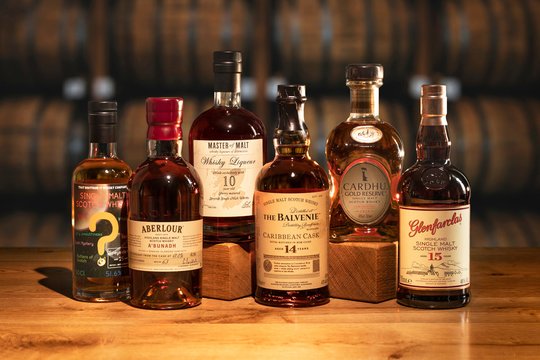
Whisky matured in interesting casks
These whiskies are all aged or finished in intriguing casks

Cask maturing in a traditional dunnage warehouse in Bowmore distillery on Islay.
Blending
Blending is, in principle, an easy enough process to understand. You have a choice as a whisky maker of what to do with the whisky you made. Do you bottle from a single cask, or marry malt whiskies from a single distillery as is the case for most single malts, or combine single malts from different distilleries (known as a blended malt). You can, of course, combine both grain whisky and malt whisky to create a classic blended whisky, or what is commonly known as a 'blend'. Unless a whisky is bottled from one barrel though, everything on the market is involves blending, and the process is an art.
Master blenders often take charge at whisky distilleries, deciding the fate of the stock they have access to and employing their expertise and experience to pull together competing, conflicting, and complementary elements alike to create a product that’s greater than the sum of its parts. While blended whiskies can be unfairly disparaged in comparison to single malt, they contain a world of complexity and, for many, are the first route into this wonderful world of whisky.
Filtering and colouring
Before you bottle a whisky, you’ll first need to filter it. Some of the char or toast on the inside of the barrel will naturally detach and float in the liquid, so when casks are emptied whisky will be passed through a sieve to remove larger wood fragments. A further filtration with smaller pore sizes may be necessary, or you may prefer to let gravity do its thing by placing the spirit in an inert vessel so the fragments sink and form a sediment at the bottom. Pretty much every whisky will go through one or more of the above. Filtration, however, can be a treated as a dirty word in whisky despite its necessity.
This is because of chill-filtration. This is a method of filtering whisky employed to avoid cloudiness appearing when the spirit drops below a certain temperature (usually following the addition of water or ice). It entails chilling the spirit to between -10 and 4°C and then passing it through a very fine filter. At such temperatures the fatty acids, proteins and some esters can compound as large clumps which are too large to pass through the filter. It’s only necessary below 46% ABV as long-chain ethyl esters (sometimes referred to as fatty acid esters) that occur naturally in whisky are soluble at higher strengths. It’s done because consumers may be put off by the appearance of any haze which could result in bottles being returned as ‘faulty.’ However, there is a belief this can compromise texture and flavour, so whiskies that are bottled without chill filtration usually make a point of saying it.
Adding colouring to whisky is common too, for purposes of consistent presentation. In Scotch and Irish whisk(e)y, only E150a caramel colourant is permitted, but laws differ across the world. Some people believe this affects the texture and flavour of the whisky so prefer bottles with natural colour.
Brilliant blends and un-filtered whiskies
Top blends and whiskies bottled without chill-filtration are right here

Dr. Nick Savage blending samples of Bladnoch single malt.
More whisky guides
Find out how whisky is made, about the different types of whisky available, and more...
Discover more whisky guides
Find out how whisky is made, about the different types of whisky available, and more...