

The Dalmore distillery tour has changed. Reopening its doors for the first time after COVID, the Highlanders are not presenting a shinier version of the same old distillery tour. We paid a visit to find out what that means last week.
What they’ve built isn’t a visitor centre in the usual sense. There’s no conveyor belt of wide-eyed groups being shuffled from mash tun to gift shop. It’s slower than that. Controlled. Private. More akin to what Brora offers.
You don’t book a slot, you arrange a visit. There’s a concierge involved. You decide what you want to see, what you want to taste, how long you want to stay. It sets the tone early. That decision runs through the whole experience. It won’t suit everyone. It’s not supposed to.
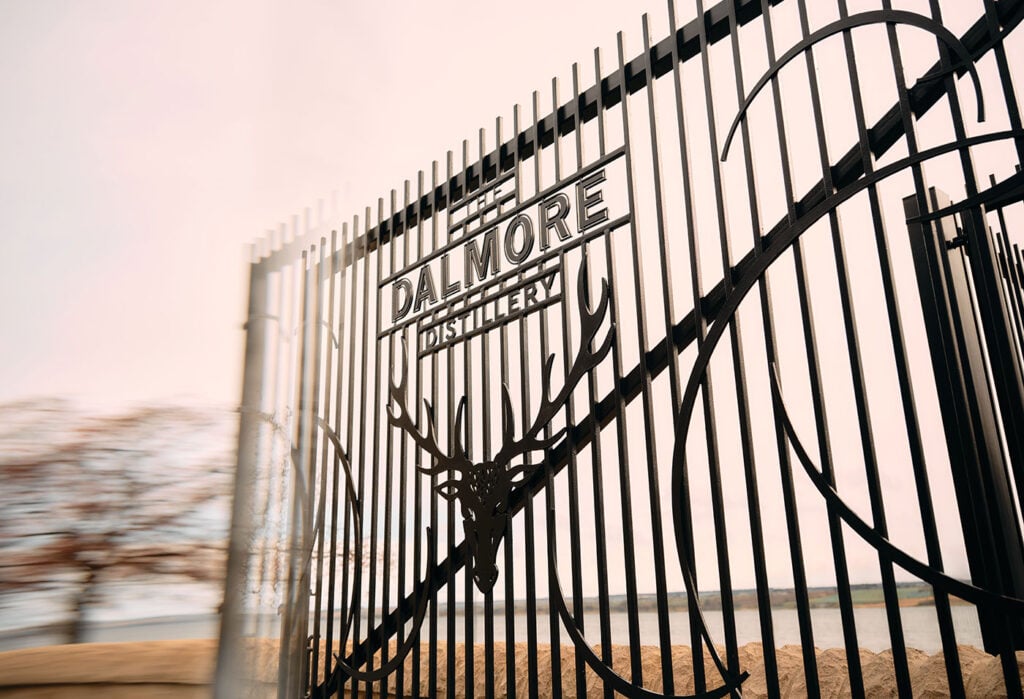
Welcome to The Dalmore
It’s your tour
The experience is tailored to you. If you’re a whisky enthusiast, you’ll get new make samples and ample washback access. If you’re a prestige chaser, you’ll get Instagrammable views and shiny premium bottles to ogle. We’re told about an upcoming booking where one guest doesn’t even like whisky. No problem. The Dalmore will run a Champagne tasting for them alongside the whisky.
That’s the headline: It’s your tour.
A host will take you through the production process as you would expect, but there’s not going to be a script. It flexes depending on who you are and what you’re interested in. There are tactile moments where you handle raw materials. You can spend time in spaces that usually feel rushed. Food can be built into the visit. Time can stretch. Conversations can drift. If you want to sit there for a couple of hours and drink cocktails, no one’s tapping their watch.
The tasting at the end isn’t fixed. Core range, distillery exclusives, the Principal Collection, sometimes something older if the moment calls for it. Tell them what you like, what you’ve had before, what you’re celebrating. If it’s your 40th birthday, don’t be surprised if a 40-year-old appears.
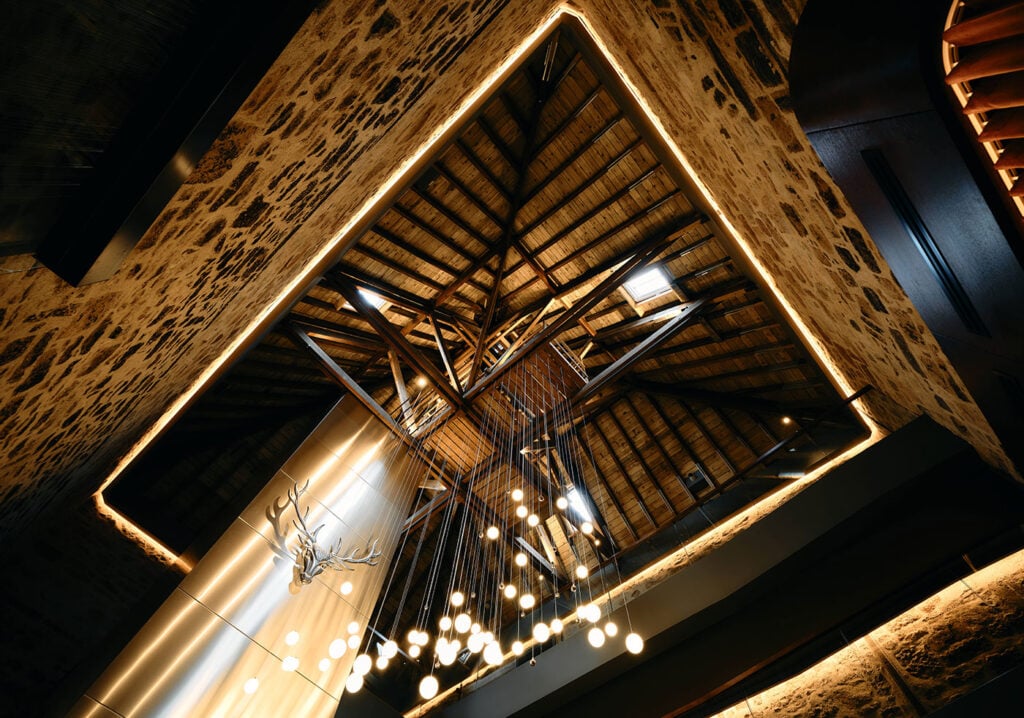
The old kiln leading up to the pagoda roof has been transformed, without losing the original charm
You don’t walk through it. It walks you.
The route itself follows the whisky, which sounds typical enough initially. We start in the old kiln, now repurposed as a introduction to where Dalmore lives. From a charming, cosy but still decidedly modern boutique you talk Cromarty Firth, water source, geography.
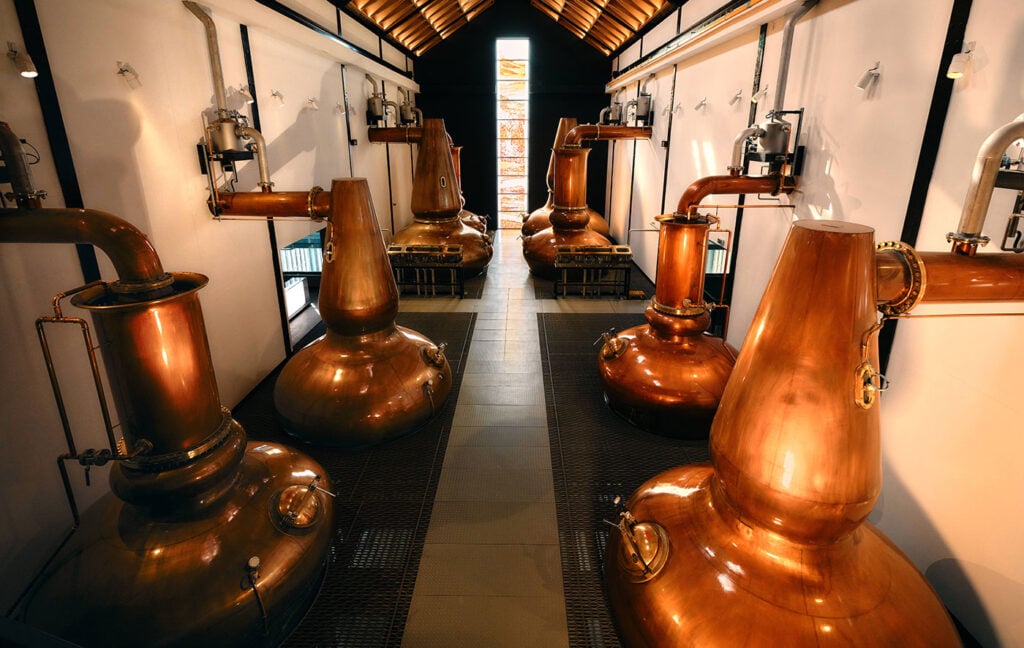
Next comes the mash house, tun room, still house, warehouses. The still house is the centrepice. This isn’t a recplacement of the old still house, it’s an additional four sets of stills built to exact specifications, except these sit in front of a spectacular ten-metre glass installation by glass artist John Kenneth Clark.
You see it first from a raised platform and the whole space opens out. You can take pictures (not always easy in a still house, as any seasoned distillery tourist knows). The installation charts the whole process, barley to angels’ share, in layers of fused glass that shift with the light coming in off the firth. You could spend an age digging into its details, or you could just admire the way it illumates the room.
Gaze upon it
The still house centrepiece
It’s spectacular. One of the most impressive stillhouses I’ve ever been in. But even more intriguing than the aesthestic were the distillation details we were told. The Dalmore is now communicating its pre-maturation process in greater depth than before. For years, the conversation around Dalmore has been dominated by casks. Sherry, Gonzalez Byass, the whole Paterson era vocabulary of Matusalem and Apostoles.
That’s still part of the story (no pun intended), but standing in this still house, you realise how much of the house style is locked in long before any of that. The Dalmore runs a split distillation regime using different still shapes and sizes to create multiple spirit styles before they ever see a cask. Some stills are taller, encouraging reflux and lighter, more elegant spirit. Others are shorter and broader, producing a heavier, oilier character. The distillery then blends these new make styles together before maturation.
The new stillhouse is the perfect place to learn all this. It frames the room without distracting from the job being done. Spirit is still being made. You don’t forget that. We’re talking about this and sipping on new make drawn from different stills to understand the nuances and that’s my kind of distillery tour. Which is why The Dalmore is doing it. They’ve read the room and pulled in a group of nerds (you know we are, guys) hook, line, and sinker.

The tour shows you the sights you expect to see, but at your pace, through the lens you choose
There’s more going on than copper and oak
Throughout, you can see that care has gone into this project to bring new life without ripping out the soul of The Dalmore. You will still recognise the place if you’re a local or frequent visitor. The architecture, handled by ThreeSixty, opens up the Old Victorian buildings without replacing them. Stone has been reused. New elements sit alongside the old without trying to fake heritage.
It feels like a distillery that’s been worked on, not wiped clean and rebuilt. Take the creation of new stills. Dalmore’s configuration isn’t standard, and changing it would have changed the spirit. So they didn’t. That’s not a small decision. It’s expensive, awkward, and entirely the right call. Material choices follow the same logic. Hard-wearing metals for the coastal air. Infrastructure upgrades that improve efficiency rather than tick boxes. You don’t get a lecture on sustainability, but you can see where thought has gone.
Then there’s the aesthetic touches. Design, craft, architecture. Sculptural pieces by Highland artist Iseabal Hendry. A curated book collection threaded through the buildings via a partnership with V&A Dundee. Archival material from the University of Glasgow. Old documents, labels, glimpses of the past, all building texture and adding context.

Will you take The Dalmore Distillery Tour?
The obvious catch
There are drawbacks to this approach, of course. There’s no pulling in off the motorway and popping in on a whim. Everything is private and pre-arranged. It’s not cheap, and it’s not casual. Bookings are open well into 2027 but there’s already a waiting list. At the time of writing, there’s basically nothing left pre-November. The new Dalmore is going to frustrate some people. Fair enough.
But Whyte & Mackay, Dalmore’s owners, aren’t daft. The loss of a more typical clientele has been factored in. The brand has decided who this is for and built it accordingly. And what you lose in accessibility, you gain in freedom. There’s no pressure to move you on, no need to keep numbers high, no dilution of the experience to make it fit a broader audience.
In return, The Dalmore gets people likely to spend, who stand a good chance of being actual fans of the distillery, and those who crave something different. There are 150-plus working Scotch distilleries across Scotland. Most offer tours. Many are excellent. Some are cheap. You should go to them. Distillery tours are still one of the best ways to understand whisky. In 2024, there were 2.7 million visits to Scotch whisky distilleries. That number could double and it still wouldn’t feel like enough people taking the chance to see how this stuff is made. This just isn’t that kind of experience.

The Dalmore Distillation Experience promises to be like no other
So what is The Dalmore distillery tour, really?
What I saw at The Dalmore Distillery isn’t the future of whisky tourism. It can’t be. It doesn’t scale, and it isn’t interested in trying. But it’s a brand trying to build a tour that reflects them. The Dalmore trades on a certain idea of luxury. Now it has a physical space to express that, while keeping the working distillery intact. Without compromising the slightly old-fashioned, fireside soul you want from a Highland site.
I’m a frequent distillery visitor. Too many are interchangeable. The same routes, the same talking points, the same rhythms. You learn the process, then you learn it again, just with a different accent and a new gift shop at the end. This isn’t a better version of the standard tour. It occupies a different space entirely.
Craig Swindell, global specialist and chief evangelist at The Dalmore, calls it “the last distillery tour”. Not because it replaces everything else. It doesn’t. You should still visit the smaller sites, the odd ones, the places figuring it out. But if you keep turning up, asking questions, chasing flavour and process and place, it all points towards something like this.
You don’t start here. You end here.
For further reading on whisky tourism, check out our blog: Whisky Tourism and How Place Became the Point.




