Trade
Trade

Big news just in! The Japan Spirits & Liqueurs Makers Association (JSLMA) has announced new, tighter Japanese whisky regulations.
That means some of our favourite Japanese whiskies will no longer be classed as ‘Japanese whisky.’
What is Japanese whisky?
It’s something of an open secret in the drinks business. There is whisky that is labelled Japanese that contains spirits from other countries, mainly Scotland and Canada.
At Scotch whisky distilleries, it’s common to see huge plastic containers full of whisky being exported to Japan. There, they are blended and then exported back as Japanese whisky.
As Japanese whisky as a category has boomed, bulk imports from Scotland have increased fourfold between 2013 and 2018, according to the SWA. Coincidence?
Japanese whisky must be distilled in Japan
There’s been a lot of rumours attached to which blends contained non-Japanese whisky. Now and not before time, the JSLMA has announced what can and can’t be defined as Japanese whisky. The rules don’t have legal powers. But they will apply to all the association’s members. That includes the country’s main producers such as Nikka and Suntory (full list here).
The crucial part of the rules* is: “Saccharification, fermentation, and distillation must be carried out at a distillery in Japan” to be labelled as ‘Japanese whisky.’ Furthermore, the resulting spirit should be no higher than 95% ABV. Rules that mirror Scotch include ageing for a minimum of three years in wooden casks no bigger than 700 litres. Plus bottling at a minimum ABV of 40%.
Brian Ashcraft, author of Japanese Whisky: The Ultimate Guide to the World’s Most Desirable Spirit, commented: “They’re a good step in the right direction. It’s important to have some rules of the road. The concern for me, though, is that there is still some wiggle room and that unscrupulous people are going to continue to be unscrupulous. It would be good if this were covered by laws, to be honest.” He went on to say: “For instance, the wiggle room I’m talking about is that they cannot prevent people from slapping a kanji character on a bottle or, if it’s sold in Japan, labelling the whole thing in Japanese”.
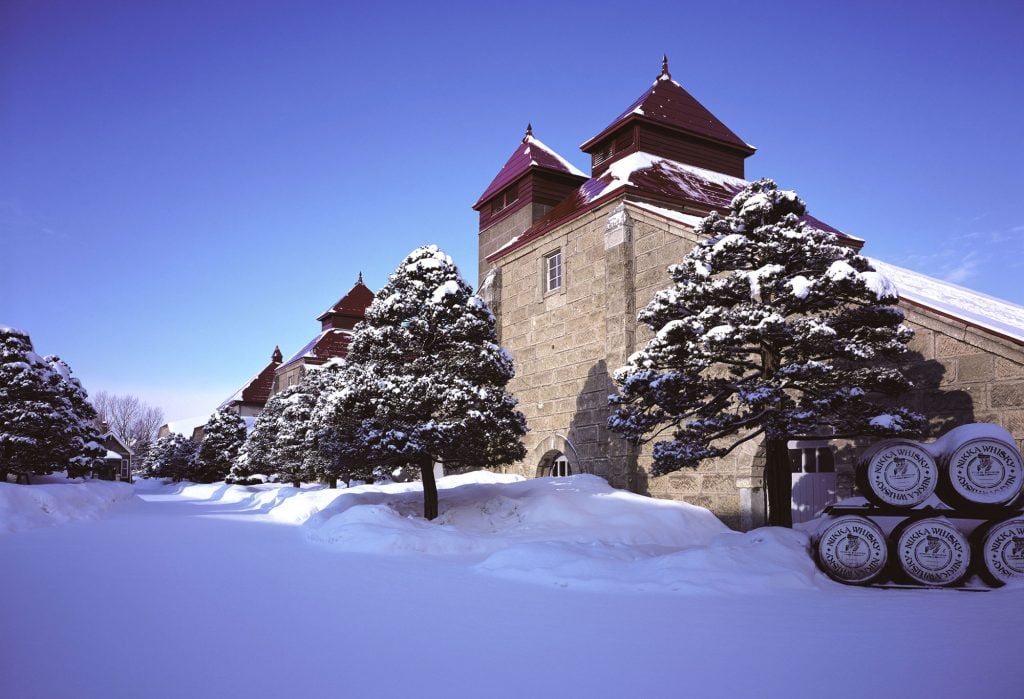
Yoichi distillery, real Japanese whisky is made here
Statement from Nikka
The deadline to follow the rules is 31 March 2024. At the moment, labels don’t reflect the new ruling. Nikka, however, has updated its site to make it clear which whiskies are now technically ‘Japanese whisky.’
In a statement, the company announced:
“We have decided to provide further information for individual products on our website to clearly distinguish between products in Nikka Whisky’s line-up, which contains both whiskies that are defined as ‘Japanese whisky’ according to the labelling standards, and those that do not meet all the criteria. We feel this is an important step towards ensuring customers’ clarity so that they can reasonably decide which products to buy, and information will be updated if the status changes.”
Looking at the Nikka website, you can see that Yoichi and Miyagikyo single malts, Coffey Grain and Taketsuru Pure Malt pass the new rules.
BUT popular blends like Nikka Days, the Nikka and the beloved Nikka from the Barrel have the following disclaimer: “This product does not meet all the criteria of ‘Japanese whisky ‘ defined by the Japan Spirits & Liqueur Makers Association.”
It doesn’t state where they stray from the rules. But we are sure that Master of Malt customers will be able to work it out.
*Read the full standards here,