Different types of whisky
From the difference between whisky and whiskey, to knowing your single malts from your blends, learn about whisky traditions and definitions from Scotland, America, Ireland, Japan, and around the world.
Explore by category
Authors:


Reading time: 5 minutes
What is whisky? For a relatively simple product, that question doesn’t have a very simple answer. Legislation is different across the world where traditionally different kinds of whisky are found, hence why we’re categorising whisky types by country. So, if you’ve found yourself searching ‘difference between whisky and bourbon’, ‘what is the difference between malt whisky and blended’, or even just ‘types of whisky’, the below should help.
The answer to ‘what does the word whisky mean?’ is easier to answer because we know the word comes from the Gaelic word uisge/uisce beatha, or 'usquebaugh', meaning 'water of life'. That, in turn, originated from the Latin aqua vitae, which means the same thing, but was applied more to spirits in general. Over time uisge beatha became uisge. If you sound that out phonetically you should be able to see how that has susquently become whisky, or indeed whiskey.
What's the difference between whisky and whiskey? The simple addition of an ‘e’ has long carried the notion that it’s a distinctive and meaningful way to separate categories, but truthfully, whether you label the spirit ‘whisky’ or ‘whiskey’ across the world is essentially down to the producer because the ‘e’ isn’t actually regulated. Its use is typically more of a style guide thing. Scotch is pretty much always labelled without the ‘e’, whereas in Ireland and America the ‘e’ is usually used. This doesn’t indicate a difference in quality or define the spirit made in those countries, however, and it’s all whisk(e)y in the end. The true differences lie in the laws that govern these spirits, which are often reflective of different production traditions.
Scotch whisky (inc. single malt and blended)
Scotch whisky means a whisky distilled in Scotland from water and grain, whether that’s malted barley, wheat, corn, rye, or oats. Mashing, fermentation, and distillation must take place on-site, which means no local brewers producing mash and shipping wort as is common in other parts of the world. There’s also only endogenous enzymes allowed, as in those produced naturally by the grain. You can’t add exogenous enzymes and only yeast is permitted in fermentation, no sugary or fermented liquid substitutes. The spirit must be distilled to less than 94.8% ABV and then aged in oak (and only oak) barrels of 700 litres or less for a minimum of three years. You can add only caramel colour and water after maturation – both of which are optional – and the spirit must be at least 40% ABV when bottled. When an age statement is used, it denotes the age of the youngest spirit in the bottle.
Scotch whisky was divided into five distinct categories by The Scotch Whisky Association (SWA) in 2005. There’s Scotch single malt whisky, which is made from malted barley and distilled in a batch process in pot stills in a single distillery. Scotch single grain whisky is made from a mixture of malted barley and corn/maize or wheat or rye or oats. These can be distilled in a continuous process in a Coffey or column still in a single distillery. Blended grains are a mixture of grain whiskies from more than one distillery.
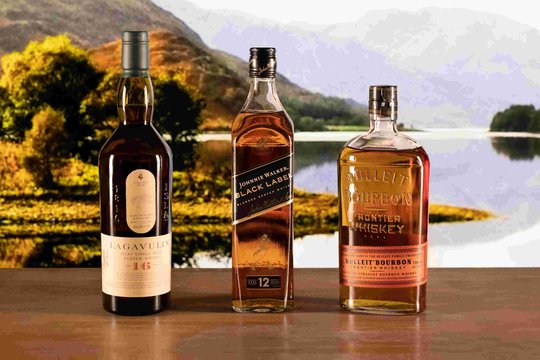
Then there’s blended malt, sometimes called vatted malt whisky, which is a marriage of only single malt whiskies. If you add grain to that mix, you get a blended whisky. Blended whisky changed the game for Scotch, helping it conquer the whisky world at the turn of the 20th century and ensuring an era of dominance that today accounts for over 90% of Scotch whisky sold, with names like Johnnie Walker, Ballantine’s, and Dewar's ubiquitous. The difference between single malt whisky and blended Scotch whisky comes down to the use of spirits of other grains and different distilleries in the latter, but that doesn’t make it a worse drink. Whisky is all about taste, which is subjective.
You can also label your single malt Scotch according to where it’s made, with five official whisky regions defined as Highland, Lowland, Campbeltown, Islay, and Speyside. There are flavour associations with each like peaty whisky from Islay, or floral and sweet whisky from the Lowlands, but with a huge number of distilleries making a variety of whiskies across Scotland there will always be outliers and exceptions.
Scotch whiskies
Classic single malts, blended malts and blended whiskies from Scotland.
Discover Scotch whiskies
With a rich tradition, established categories, and a variety of flavours, the whiskies of Scotland are globally recognised and celebrated.
Bourbon and American whiskey (rye, corn, wheated)
Another major type of whiskey is American whiskey. To be called a whiskey in America, the spirit must be made from a fermented mash of grain and distilled to less than 95% ABV, aged in oak barrels, and must be at least 40% ABV when bottled. In blended whiskey in the USA, you can add neutral spirit, but that would exclude it being labelled as a whisky in the EU.
Bourbon must be made from a mash bill of at least 51% corn, distilled to no more than 80% ABV and can’t go into the barrel above 62.5% ABV. The barrel must be made from new charred oak. Exogenous enzymes (enzymes not derived from grains) are allowed, there’s no ageing limit, and you can use as much corn as you like as long as it’s above 51%, though using rye, wheat, and barley in the mashbill is common. No bourbon can contain ‘harmless colouring, flavouring, or blending materials’ such as caramel and sugar, as defined by the Supplementary Federal guidelines.
The rules are the same as bourbon for rye, wheat, malt, and rye malt whiskies in America, except that the 51% mash bill rule applies to the star grain, so to call it a rye whiskey, for example, it must contain at least 51% rye. There’s also corn whiskey, separate to bourbon because the mash bill must be at least 80% corn and you don’t have to use oak. If oak is used, it must be either used or uncharred new oak. Tennessee whiskey is defined as a spirit that undergoes the same production process as bourbon, as well as an extra step called the the Lincoln County process, which entails taking spirit from the still and filtering it through maple charcoal before maturation. You also can only make it in Tennessee.
Much like Scotch, an age statement denotes the age of the youngest spirit used. If a bourbon, rye, wheat, malt, rye malt, or corn whiskey is described as a ‘straight’ whiskey, that means it’s at least two years old (which wouldn’t technically make it a whiskey by EU standards where the minimum age requirement is three years), while a whiskey labelled ‘bottled in bond’ must be from a single distillery and must come from the same distilling season (1 January-30 June or 1 June-31 December). It also must be mature in wood barrels for at least four years and bottled at 50% ABV. The terms small batch, craft, or single barrel have no regulation.
Bourbon & American style whiskeys
Kentucky classics to craft gems, solid sippers and cocktail staples.
Discover Bourbon & American style whiskeys
The States is home to its own diverse, world-famous styles and traditions, from Tennessee treats to spicy rye whiskeys.
Irish whiskey (incl. single pot still)
Irish whiskey can be made anywhere on the island (Northern Ireland or Republic of Ireland) from a mash of malted grains, unmalted grains, and other cereals. Triple distillation is common, but not a requirement. Like Scotch the spirit must be distilled to less than 94.8% ABV, but exogenous enzymes are permitted and maturation must take place in ‘woods such as oak’ for a minimum of three years in Ireland in vessels of 700-litres or less. The ‘such as oak’ terminology is loose and allows a huge potential of variation, with acacia, cherry wood, and chestnut all used in recent times. Only water and caramel colour can be added after distillation and Irish whiskey must be bottled to a strength of at least 40% ABV.
There are four styles of Irish whiskey, malt whiskey made from a mash of 100% malted barley distilled in pot stills, either twice or three times. Then grain whiskey, made from a mash containing unmalted grains and malted barley, the latter of which can’t exceed 30% of the recipe, and the grain whiskey must be distilled in column stills. Blended whiskey, meanwhile, simply is a blend of two or more different whiskey types.
This can include Ireland’s signature whiskey style: pot still Irish whiskey. This is whiskey made from mash that includes a minimum of 30% unpeated malted barley, a minimum of 30% unmalted barley, and other unmalted cereals. It must be distilled in pot stills, either twice or three times. Typically it features a blend of malted and unmalted barley, the latter used supposedly during the 19th century as a means to avoid British tax laws on malted barley. Its use has persisted due to the unique profile it brings Irish whiskey, defined by a rich, textural spiciness.
Irish whiskeys
Single pot still, single malts and famous blends.
Discover Irish whiskies
Like Scotland and America, Ireland is a traditional whiskey-making country with its own unique practices, and truly delicious spirits.
Japanese whisky
In Japan, whisky was pioneered by Masataka Taketsuru, a student of the University of Glasgow who toured Scotch whisky distilleries in the 1920s to learn the secrets of the trade. He helped establish the first wave of Japanese whisky with Suntory, before founding Nikka, the two companies that dominate to this day. The process mirrors Scotch considerably, but there is a key difference to the way the industry works in each country as Japan does not have the same culture of distilleries sharing and swapping whisky. Instead, Japanese whisky distilleries are typically set up to produce a variety of both malt and grain whiskies, with blends made in-house.
In 2021, The Japan Spirits & Liqueurs Makers Association has announced new tighter Japanese whisky regulations, addressing something of an open secret in the drinks business that much whisky that is labelled Japanese contains spirits from other countries, mainly Scotland and Canada. The rules don’t have legal powers but will apply to all the association’s members, including the country’s main producers such as Nikka and Suntory.
Whisky will only meet the new requirement if mashing, fermentation, and distillation are carried out at a distillery in Japan. Furthermore, the resulting spirit should be no higher than 95% ABV and must be aged for a minimum of three years in wooden casks no bigger than 700 litres and bottled with a minimum ABV of 40%.
Japanese whiskies
Celebrated blends, coveted single malts and more.
Discover Japanese whiskies
Using the same categories as Scotch whisky, Japan has nonetheless developed its own approaches to expert whisky-making over the last century.
World whisky (incl. English, Canadian)
Whisky is now made all over the world, from Taiwan to Norway, New Zealand and beyond. The geographic diversity of whisky production and the different approaches and flavours inherent in that is thrilling, but you will need to get your head around the fact that each country and region creates its own framework of legislation that suits its category.
English whisky, for example has followed a basic programme of legislation (minimum three years ageing, bottled above 40% ABV etc.) but proposals are in place by the English Whisky Guild to cement are more rigorous definition. This would class English whisky as a spirit made from UK cereal grain and water, distilled in England from wort created in England and matured in England in wooden casks, such as oak (but not limited to), of no more than 700 litres for a minimum of 3 years, for example. While this hasn’t been approved at the time of writing, it’s clear some kind of framework is inevitable.
Canadian whisky, by contrast, has some particularly distinctive traditional rules. It permits that any spirit or wine, domestic or imported, can be used to flavour the whisky. As long as the whisky is defined to still have the aroma, flavour, and characteristics of Canadian whisky, you can add as much as you like in the domestic market. If you want to export Canadian whisky, the limit is 9.09%. This could be young rye spirit or sherry.
World whiskies
Whisky is now a truly global spirit.
Discover world whiskies
Made on almost every continent (to be fair, Antarctica would be tricky...) distilleries can now be found around the world, and some of the whisky available to us from non-traditional countries and regions is truly fantastic.
More whisky guides
Find out how whisky is made, how to drink it, and more...