How is rum made?
Wondering exactly what rum is made from? And how? We guide you through the raw materials and processes involved in making this famous spirit.
POPULAR CATEGORIES
Authors:

Reading time: 5 minutes

‘What is rum?’ A surprisingly difficult question to answer. There are so many varieties of the spirit. There are all kinds of local histories and processes that are recognised in the country of origin that need to be understood. Individual countries may have very strict rules, or a larger body like the EU will have a standard. But there is no overarching legislation that dictates what the spirit is across the world.
So, naturally, we should give up. No, wait, there is a way! To learn how rum is made. The best way to uncover the secrets of the spirit is to understand how it is made into one in the first place. One consistent raw material kicks things off nice and simply for us.
What is rum made from?
- Rum is made from molasses, sugar cane juice, sugar cane syrup, or even cane sugar depending on where you are in the world.
This question is easier to answer. Because, in a word, it’s sugar. (Although there's slightly more to it than that...) To make the sugar you put in your cup of tea, the steps include crushing the sugar cane, extracting the juice, and then cooking it to give you those lovely little white flavour crystals. Let's take a slightly closer look at that journey...
For rum, the same process of crushing and milling sugar cane to extract the juice is followed. This juice itself, however, can be used as the raw material for the next stage of rum-making (fermentation). Most commonly, sugar cane juice is used to make 'rhum agricole'. This style originated in French Caribbean (hence the spelling, that’s not a typo) countries like Martinique and Guadeloupe. Another example is cachaça, the flavour of the Brazilian beach (olé, etc.).
You can also filter and evaporate the sugar cane juice to create sugar cane syrup/honey, which is another example of a rum raw material. Keep going in the sugar production process and the next step is to cook it, and then separate in a centrifuge raw sugar crystals from a thick, sticky, black residue akin to treacle. This by-product is called molasses, the raw material fermented and then distilled to create the majority of rum.
In fact, this process of separating sugar crystals and molasses usually takes place several times, creating different grades of both sugar and molasses. What's more, as the sugar industry becomes more efficient, it's placing pressure on the quality of molasses required for the rum industry.
Rum can also be made from brown sugar (or even further refined white sugar), although not all of these options are available to every producer depending on their location around the globe, not to mention the characteristics and style they wish to create.

Sugar cane is processed at Takamaka Distillery in the Seychelles.
Fermentation
Whether you’re making rum with sugar cane juice, syrup, or molasses, all of them will need to be converted into booze via fermentation. For this you need yeast. Rum distilleries will often have proprietary strains of yeast, mostly cultured yeasts, but natural yeast can be used too. Fermentation can run as short as 24 hours for lighter rums, to over a week for more complex creations. During these longer periods, natural or spontaneous fermentation is common and this is where rum producers will create an environment where natural yeast thrives like open-topped wooden fermenters. This encourages the development of more esters, volatile compounds such as ethyl butyrate, which smells of pineapple.
If a distiller wants to produce very estery rum, then additives like dunder and muck can be used. These are not the names of cartoon villains trying to pollute a lake in a Looney Tunes episode. Dunder is the ‘setback’ from distillation, which for those of us who are too cool for nerdy terms, is rich liquidy stuff left in the still after you’ve distilled off all the booze. It’s packed full of concentrated flavour because when you reuse it, deprived of the stabilising influence of alcohol, it undergoes bacterial as well as yeast-based fermentation taking place over many days with natural yeasts. This bubbling broiling mass of black gloop is a hotbed for esters to create lots of fruity, funky flavours. It can be used as fertiliser but in places like Jamaica, pits are filled with this magic muck to create what you could describe as a rum seasoning.
Muck is the decaying (composting) by-products of rum production made in either a big old pit either outside the distillery or more commonly inside in a vat. Ingredients can be fermentation residue, lees (residue from retort stills), dunder, or even remnants from sugar cane plants. The mixture is essentially a big tasty treat for bacteria, which create a highly acidic, pungent liquid thanks to all the fatty acids that develop. Distilleries that use muck include Hampden Estate and will use it sparingly

Fermentation at Long Pond distillery in Jamaica.
Distillation
Due to the variety of rum made all over the world, all kinds of stills will be used from pot, column, and hybrid, even wooden stills in Guyana. The Diamond Distillery, for example, has three wooden stills: a Port Mourant double wooden pot still, a Versailles single wooden pot still and an Enmore wooden Coffey still and these native woods interact with alcoholic sugars which, when combined with the immense reflux from the copper columns it has, creates a robust, highly flavourful, and aromatic distillate classic in Demerara rums.
Distillation methods also depend on what style of rum you’re creating and where you’re creating it. They’ll actually make several distillates, called marks or marques, which will vary from the lighter, which will typically have been made with short fermentation and column still distillation, to heavier created with longer fermentation times and potentially pot stills. Agricole rums are typically produced in multi-column stills, or a combination of pot and column in the French Caribbean islands. Bolder, funkier rums like the kind you find in Jamaica are typically made in traditional pot stills.
The majority of rum pot stills, however, use retorts. These are copper vessels that contain the leftover high and low wines from the previous distillation to create additional flavours, attain a high ABV, and ensure an efficient distillation from a single process, collecting as much 'good' alcohol as possible through the extra rectification the retort brings. The size of the retort and the volume of wines charged through the retort determins how much heat is lost from the system through radiant cooling and this in turn influences how much reflux is generated. A larger retort with a smaller charge will result in more cooling, which means more reflux. A smaller retort with a larger charge will result in less cooling, so less reflux.

A pot still at Foursquare distillery in Barbados, with retorts on a raised platform next to the main still.
Maturation
A lot of rum is bottled unaged, or just rested for a short time. This includes your back-bar mixers to more complex blanc agricoles. Rum can also be matured in casks that may previously have held other spirits or wines such as bourbon, sherry or Port. Much like in whisky or brandy, maturation involves interactions bwteen the liquid, wood and air that can change the colour, flavour, texture and strength of the spirit over time.
In the Caribbean, the tropical climate heightens extraction, oxidation, concentration, and filtration. A lot of rum is often transported to the cooler climates of North Europe, due to factors such as the cost of evaporation that occurs in the warmer climate, or because the producer wants to slow the ageing process down in order to achieve a specific flavour profile.
There’s rarely a minimum ageing requirement, but in Cuba for example, new make spirit (arguardiente in local terms) must be aged for a minimum of two years. It is then blended with a spirit distilled to a high strength and these blends are rebarreled and aged for a second period. This forms the building blocks of the final blend.
Solera aged rums are a feature of brands like Ron Zacapa. The Guatemalan brand age new make rum for a year and half, then blend it with rums more than six years old. This marriage is then aged for a further year and a half before being blended again with old reserved rums. That process is repeated four times until the initial new make rum is six-years-old. Some of the final blend is bottled, while the rest is used to replenish stock for future blends. This is the circle of life, I think. I fell asleep watching the Lion King but I’m pretty sure that’s the jist.
Blending
Blending is also a big part of the rum game, with many brands sourcing multiple casks of different rum from the same distillery and creating their own product with it. Distillers will produce their own brands but also supply non-producers with newly made or aged rums. Hence why distillers will make several marks which can meet various supplier needs. Blending these marks is vital in the trade.

Diplomático rum ageing near the Venezuelan Andes
Colouring & sweetness
Rum is often categorised by colour: white, gold, and dark. But caramel colour is often used in rum, meaning many darker rums present as being older or mature but don’t reflect how it was made or how long it’s spent in barrel. You shouldn’t confuse colour for flavour or fall into the trap of thinking a rum’s colour will reveal a lot about the spirit. Check how it’s made, if the colour you see is natural, then you can make an assessment.
Sugar is often added to rum. This simple process of adding flavour is one of the most controversial and contested subjects in the rum world. The common belief is that sugar is used to mask a bad product and hide faults. This is absolutely true in certain cases, but how to use sugar after distillation is very much a craft in and of itself. The addition doesn’t automatically create a bad rum.
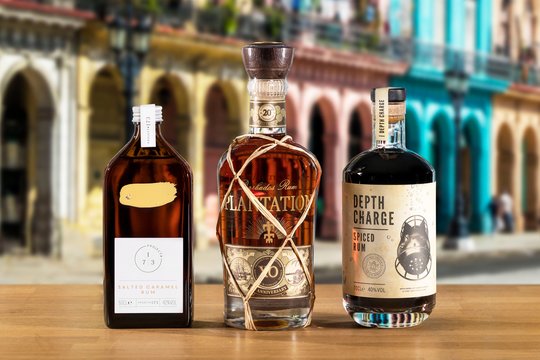
The most common way of flavouring rum is to create a spiced rum. One of the most popular gateways to the world of rum, spiced rums h are sweetened with sugar and seasoned, often with vanilla, citrus peel, and aromatic spices like cinnamon. They form part of a wider flavoured rum category that is increasingly including rums distilled with botanicals akin to the way gin is made. According to the EU, however, a rum cannot be flavoured. Hence while you’ll see a lot of ‘spiced rum’ bottlings actually not use the word rum on the label.
Rums are generally bottled above 40% ABV, but some legislation will allow lower bottling strengths. There’s also rum bottled in excess of 57% ABV which tends to be labelled as Overproof or Navy Strength, referring to the lowest strength a spirit can be mixed with gunpowder it still lights with a consistent flame. It’s basically an old sailor’s trick used to see who was stealing from the rum rations and topping it up with water.
Varying laws and/or producers decisions
Rum is difficult to define, as we stated at the beginning of this guide. There’s a perception then that there are no rules and that it’s the ‘wild west of spirits’. This is a bit reductive. Is there any spirit category governed by an international strict set of rules, not just country regulations? Whisky, for example, doesn't have one overarching world rule that defines it, the legislation that protects whisky is regional.
Still, there is a greater push for definition in rum all the same. A Geographical Indication, or GI, is being pushed for in Barbados in order to add clarity and protect the spirit worldwide. The theory is that a inferior, pretender rum can pass as Bajan too easily.
Jamaican rum has recently been successful in implementing a GI. It states, among rules that the rum mash must be made using naturally filtered limestone water from the region, with fermentation and distillation also requited to occur in the territory of those limestone Aquifer water basins. It also allows pot and column stills, but the pots must be made from copper, as must the rectifier portion of the column still. No colouing other than from oak wood aging or from cane sugar caramel is permitted too.
Martinique too has its Appellation d’Origine Contrôlée Martinique Rhum Agricole. It’s a tight guideline that ensures rules like rum can only be made from freshly-crushed sugar cane juice, natural yeast must be used, column stills only, and that Blanc can’t be rested for more than three months, for example.
There are wider laws too, like European regulation 2019/787, which defines rum as a “spirit drink produced exclusively by the distillation of the product obtained by the alcoholic fermentation of molasses or syrups produced during the manufacture of cane sugar or the alcoholic fermentation of the juice of the sugar cane itself”. It also requires the spirit to be distilled at less than 96% ABV in such a way that the distillate demonstrates “the specific organoleptic characteristics of rum” and it cannot be flavoured.
The US also has it’s own definition, one that states that rum must be made from the fermentation and distillation of molasses, cane syrup, sugar cane juice or any other sugar cane by-product. It must be distilled to a strength of less than 95% ABV and have a minimum bottling strength of at least 40% ABV.
Rums to try
Explore the world of rum with these top picks
More rum guides
Find out more about rum, a truly amazing spirit, such as how people have traditionally tried to categorise it (and the issues that presents)...