The Story of Aberargie Distillery and its First Whisky

Aberargie Distillery has been laying down casks since November 2017. If you haven’t heard of them until recently, you’re not alone.
The Lowland whisky maker was quietly tipping away on a quest called whisky on a barley farm just south of Perth with barely a press release for nearly nine years. There was the odd article. Then, last autumn, whisky show appearances began the tease, with some aplomb. Debuting with whisky around 8-years-old is a bit of a flex.
Then came the official news: Aberargie Inaugural Release would arrive in March 2026.
Well, it’s here. And it’s good. But who the Sam Heck are these more patient than saints whisky makers?
Meet Aberagie.
The mark of the Morrison family
If you know your Scotch history, the Morrison name carries weight. Stanley P. Morrison owned Bowmore Distillery in the 1960s. Morrison Bowmore eventually became part of Beam Suntory. The family has seen the boom years, the whisky loch years, and the slow rebuild. Aberargie is their return to distillation.
In 2005, the Morrison family, led by Brian Morrison and his son Jamie, took a majority stake in the Scottish Liqueur Centre in Bankfoot, Perth. There, they developed Bruadar and Columba Cream and steadily rebuilt their operational footprint. The business later became Morrison & Mackay, expanding into blending and bottling Scotch whisky under the Càrn Mòr range and relaunching Old Perth in 2014.
As Old Perth gathered momentum, the company needed more space. Conveniently, the Morrisons owned a 300-acre farm in the nearby village of Aberargie, where they had already been growing barley for maltsters.
In early 2014, plans to construct a new blending and bottling hall on the farm received approval. Alongside it sat a more ambitious proposal: a purpose-built distillery, separate but adjacent, owned and operated by the Morrison family under The Perth Distilling Company. With a majority stake in Morrison & Mackay, they pushed both projects forward at the same time, laying the foundations for what would become Aberargie Distillery.
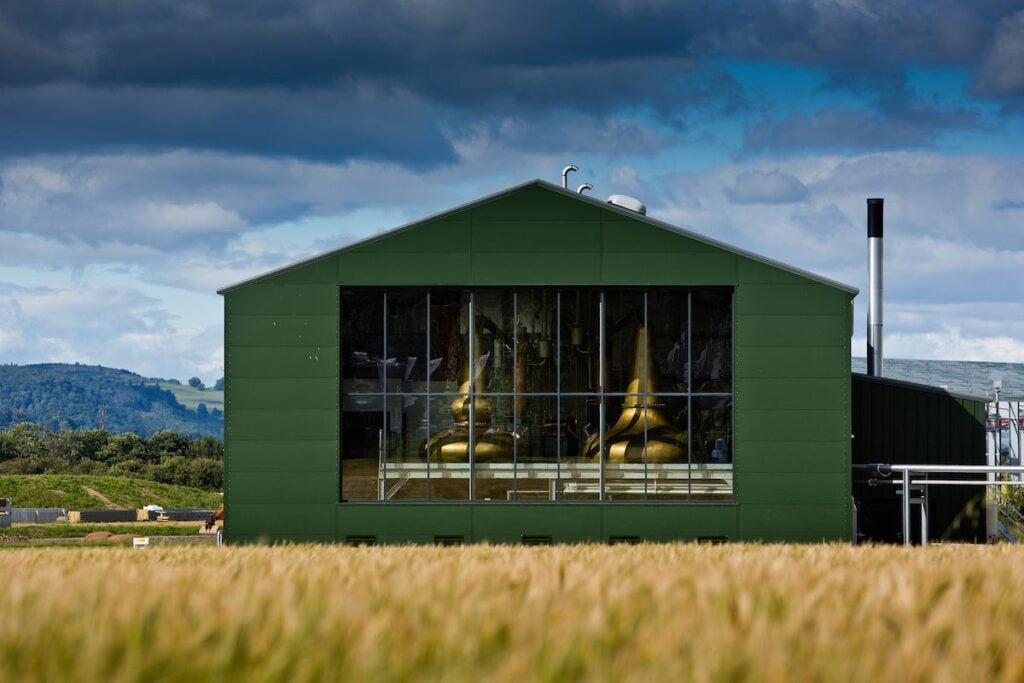
Welcome to Aberargie Distillery
From broker to builder
“When I spoke to Jamie, he told me he felt it was his duty, given his family background, to own and operate a single malt Scotch whisky distillery,” managing director Niel Hendriksz says. They set out to create Aberargie from scratch. It didn’t evolve from anything existing. They did not buy a mothballed site. They did not convert a warehouse.
“It was purpose-built with the ambition to establish a true single malt Scotch whisky distillery, to manage our liquid and inventory requirements, and, most importantly, to build a distinctive single malt Scotch whisky brand”.
Ground broke on the project in June 2016, and following distilling trials in October 2017, Aberargie distillery’s first cask was filled on 1 November that year.
The Morrison family is an important part of Aberagie, according to Hendriksz. From a day-to-day point of view, they’re involved particularly when it comes to inventory and managing the liquid, the heart of the business. But in terms of operations, they’ve entrusted a dedicated team to run the brand and manage the day-to-day running of the distillery. It’s a balance of oversight, experience and trust, Hendriksz says.
How Aberagie Distillery makes whisky
Production director Graeme Mackeddie also spoke with us, kindly outlining in great geeky detail the production process. Strap in.
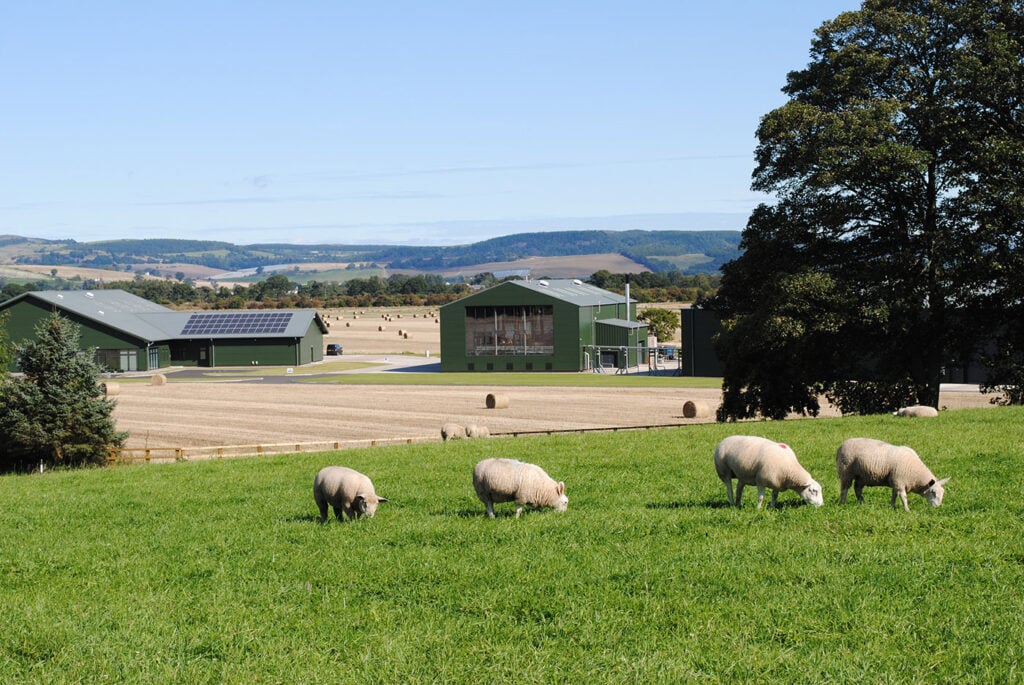
Aberargie is in the Lowlands region
Beginning with barley
Aberargie grows its own barley on the Morrison family farm. Every grain that meets the required standards is destined to be Aberargie Single Malt. That sounds romantic. It is also complicated.
“Growing your own barley and managing the logistics of your own malt is a mixed bag,” says Mackeddie. “It definitely adds a level of complexity to the operation, which can prove to be a challenge from time to time. The advantages, however, greatly outweigh the negatives. The level of control it gives us, as well as the provenance and authenticity it gives to the process and the finished product, makes it worthwhile.”
Control is the operative word. Aberargie runs two barley varieties: Laureate and Golden Promise. Laureate is a modern workhorse. It delivers strong yields in the field and produces a clean, vibrant, fruit-forward spirit in the still. Golden Promise is heritage stock. It yields less on the farm and less in distillation. It makes up for that in character.
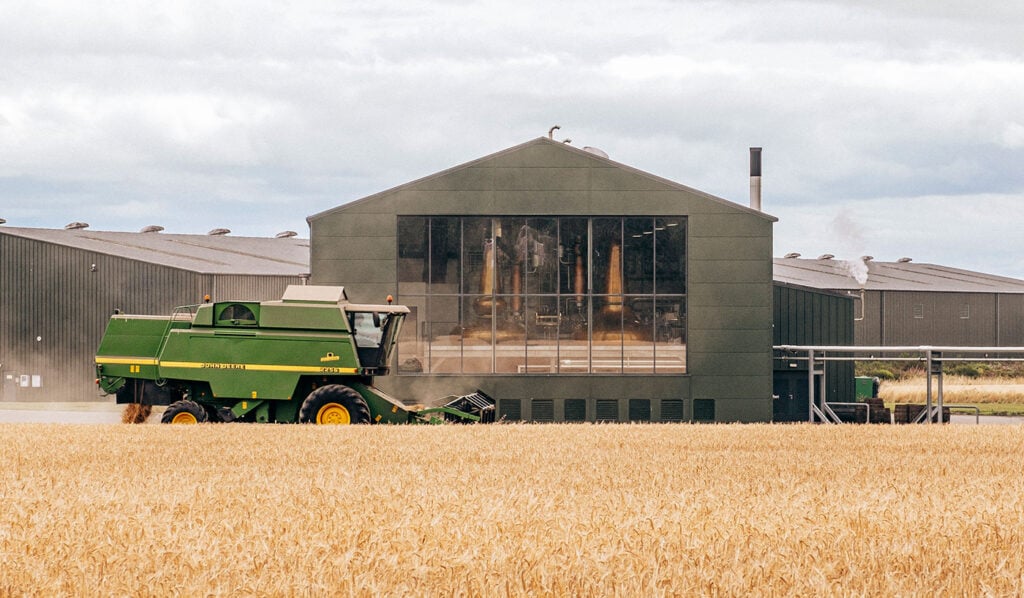
The barley farm at Aberargie Distillery
Promise is golden
Running two varieties gives them blending latitude before a cask ever enters the equation.
“Where Golden Promise excels,” Mackeddie explains, “is that it generates a uniquely rich and oily spirit, with a distinctive flavour profile — something richer and heavier in its style. Using two varieties of contrasting flavour profiles allows us to curate a finished product which showcases the best of both varieties — the fruit-forward nature of Laureate, with the depth, mouthfeel and structure of the rich, oily spirit of Golden Promise.”
As for experimentation, there is no restless tinkering for the sake of it. “We do grow other barley varieties across our farms, and there will be the opportunity to explore these different varieties as aged single malts in due course,” Mackeddie says. “But experimentation is not our raison d’être.”

There are distinctions between barley varieties and the flavours they create in whisky
Two varieties, two personalities
They segregate barley by variety and harvest year. They do not segregate by field.
“The work we have done hasn’t shown any significant difference in spirit from barley grown across different fields on the farm to warrant any additional complexity to our farm and malting operations,” Mackeddie says.
They nose every distillation. Within a given variety, flavour remains consistent across the year. Between varieties, the difference is marked. Vintage variation does show up, but subtly.
“We do see some interesting yet minor flavour variations if you compare one year’s single variety new make to another year’s,” Mackeddie says. “This is primarily a reflection on the farming year and weather throughout the year.”
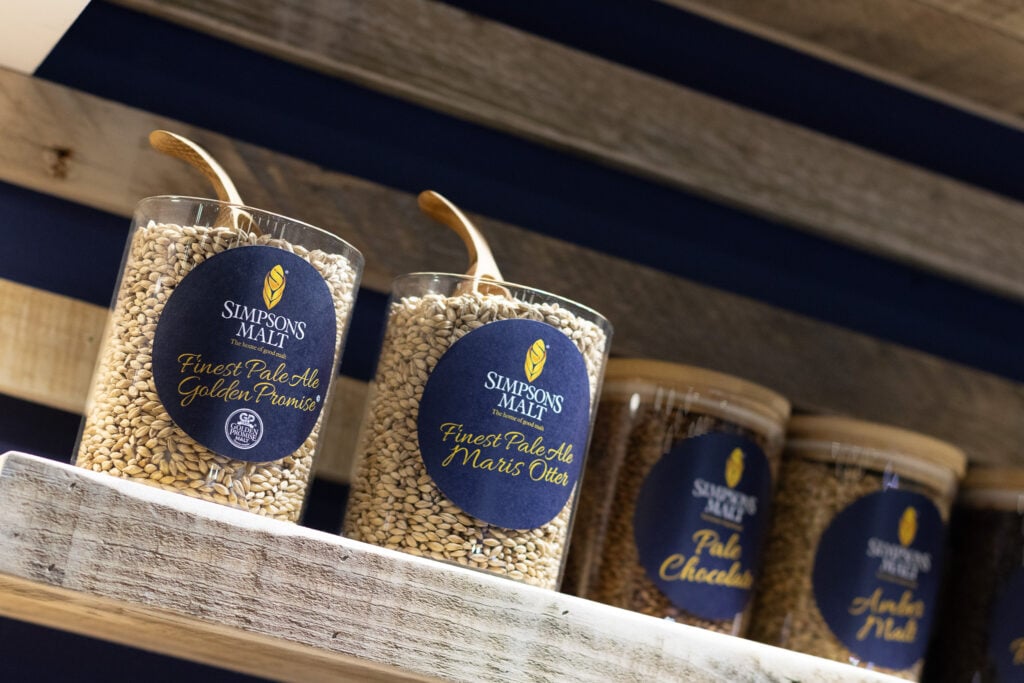
Simpsons Malt are an experienced partner to call on
Moving on to Malting
Aberargie does not malt on site. It works with Simpsons Malt, which supplies the seed barley in spring, manages transport at harvest, malts the barley, and handles ongoing logistics.
Floor malting is a romantic idea – but it’s not for Aberargie, Mackeddie admits. It’s an incredibly labour-intensive undertaking that a busy, small team don’t have the time for. It also poses limitations when it comes to scale. Some distilleries still run floor maltings, big ones too, but as Mackeddie says, typically floor malted barley makes up a tiny percentage of their annual production. “There are some notable exceptions, and good for them!” he adds.
The key is in the standards they set together with Simpsons Malt. “We stipulate that our barley has to be segregated through all parts of the malting process with full traceability, in addition to being segregated by year and variety,” Mackeddie says. “Our malt is not peated, and we request that it is malted to the same exacting standards Simpsons use for their own premium malted barley for each variety.”
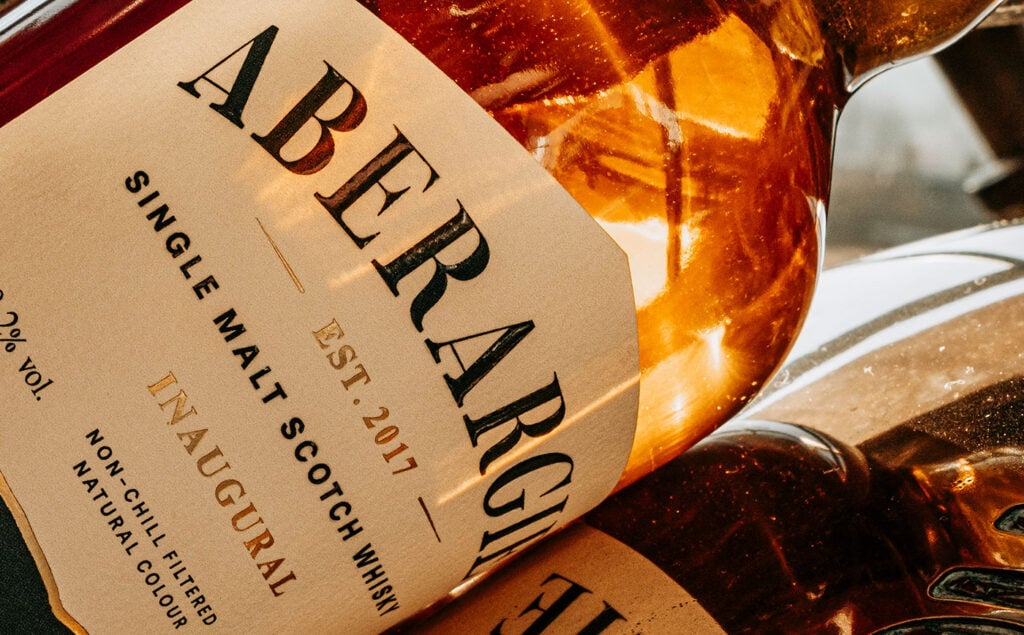
The first whisky from Aberargie is here
The mash
Aberargie runs a semi-lauter mash tun and processes both barley varieties in the same way from mash, through fermentation and distillation. Laureate generates a clear wort, and Golden Promise generates a slightly cloudy wort.
This sets our two varieties off on two diverging paths from the very start,” Mackeddie explains. “Laureate, with its clear wort is destined to become a clean, crisp and fruit-forward spirit, while Golden Promise is set to become a slightly richer, more robust spirit.”
Every stage of the process can build in flavour, something distilleries have well and truly embraced in the modern era. Aberargie is no different. Naturally, wort clarity is an important factor in finished spirit character. You could adjust the mash parameters to force Golden Promise clear. Or deliberately choose to keep it as is. “The differential here is barley variety, not process,” Mackeddie summarises.
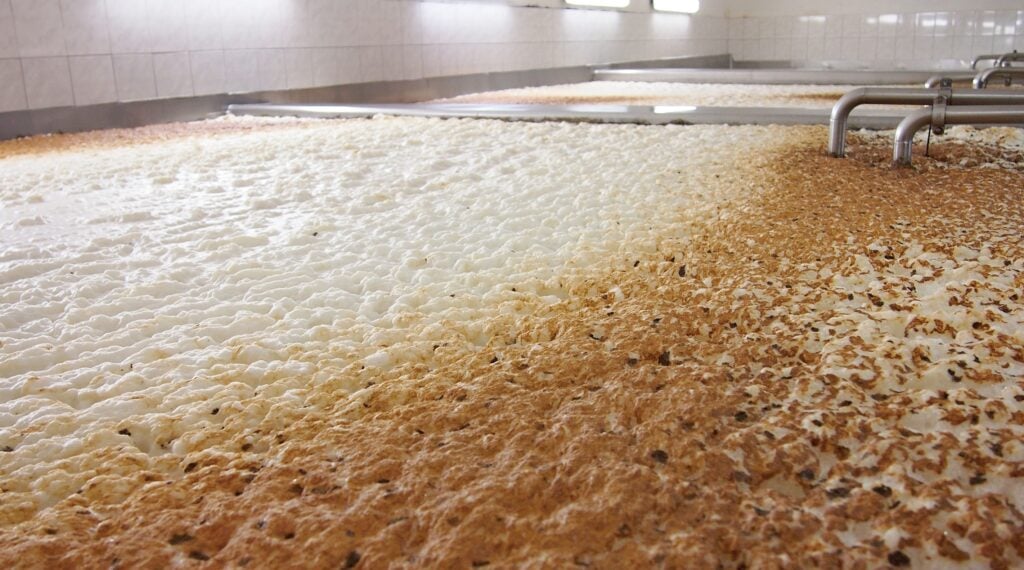
Magical yeast turning sugar into booze during fermentation
Fermentation
Aberargie has the comfort of not having great pressures on capacity, which means it can keep fermentation times on the long side to develop more esters and create a richer, fruitier spirit. There’s no fixed regimen as this is not a 24/7 distillery, the team works Monday to Thursday, with a half day Friday. There’s no mashing or distilling at weekends, and fermentation mirrors that rhythm.
“We have fermentations Monday, Tuesday and Wednesday, topping out at 144 hours,” Mackeddie says. “Later-week ferments land closer to 80. Longer fermentations are rich and estery – think over-ripe bananas, and you’re not a million miles off. Shorter fermentations are cleaner and crisper – still on the fruity side, but fresh fruits. Crisp green apples or pear drops if we’re running Laureate. Slightly tarter if we’re running Golden Promise, think Gooseberries, along with some herbaceous, almost leafy notes. ‘Green’ notes are the theme”.
The wash typically reaches 9% ABV, whether that is a short fermentation or a long fermentation. As for yeast trials? “Again, experimentation is not our raison d’être,” Mackeddie says. “We have found what works for us, and we tend to stick to our guns for the most part. However, we are aware of new strains and opportunities, so we keep ourselves informed and have looked at alternative options for the right reasons”.
Will we ever see Aberargie with interesting yeast variations? “Yes, absolutely, at some point.”
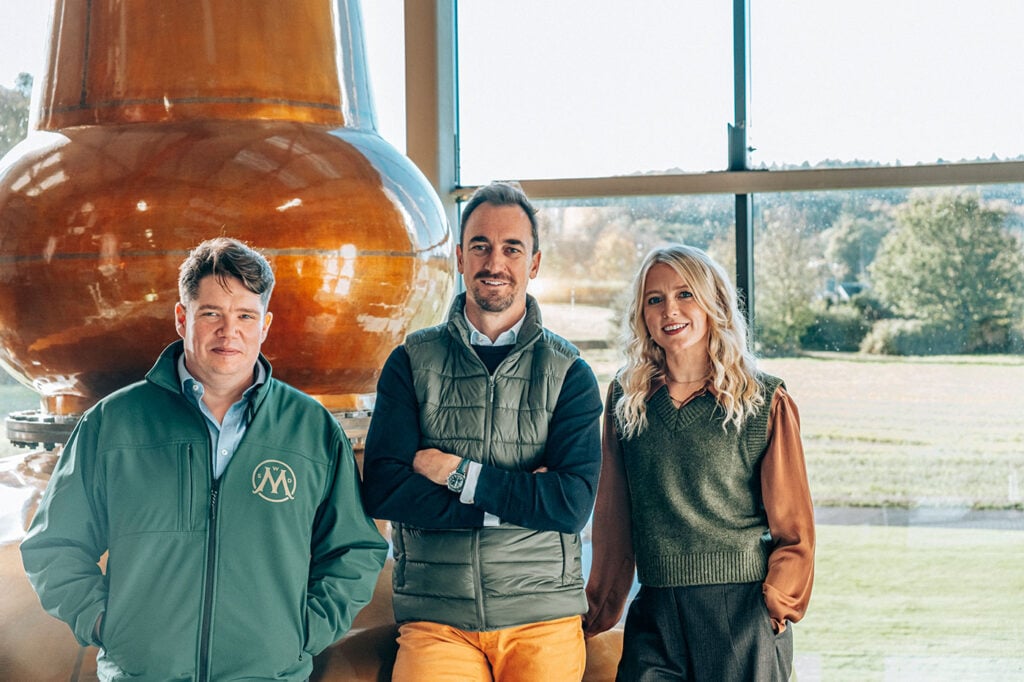
The stills at Aberargie and the distillery’s senior team
Distillation
The stills are not radical, nor exuberant in their design. Aberargie worked closely with Forsyths to land on a configuration that would deliver a specific profile. The wash still is classically shaped, charged with 11,000L of wash. The spirit still is onion-shaped with an added boil ball on the neck to encourage reflux. It takes 7,500 litres of low wines.
Both stills have slightly descending lyne arms and shell and tube condensers. “Worm tubs are great, and do a great job to hit a certain flavour profile, but that profile is perhaps a little too rich and at times too savoury for what we’re looking to achieve,” Mackeddie explains.
The cut point strategy chases fruit, weight, and texture. “Rich and fruity is the brief – but ‘rich’ isn’t a one-dimensional word, for us it covers nose, palate, mouth feel/texture and overall experience with a spirit,” Mackeddie says. “We are looking for a degree of ‘heft’ to our spirit, that is, a spirit that carries some weight, without being so robust it becomes challenging”.
“We run a wide cut, more classically seen for peated spirits, going ‘On Spirit’ at 74% and coming ‘Off Spirit’ at 60.5%,” Mackeddie explains. “The bonus with such a deep cut is texture, particularly with Golden Promise. The finished spirit is luxuriously viscous. Oily even”.
The new make falls into two styles, naturally reflecting the two strains of barley it’s made from:
Laureate – Clean, vibrant, and estery.
Golden Promise – Rich, oily, and herbaceous.
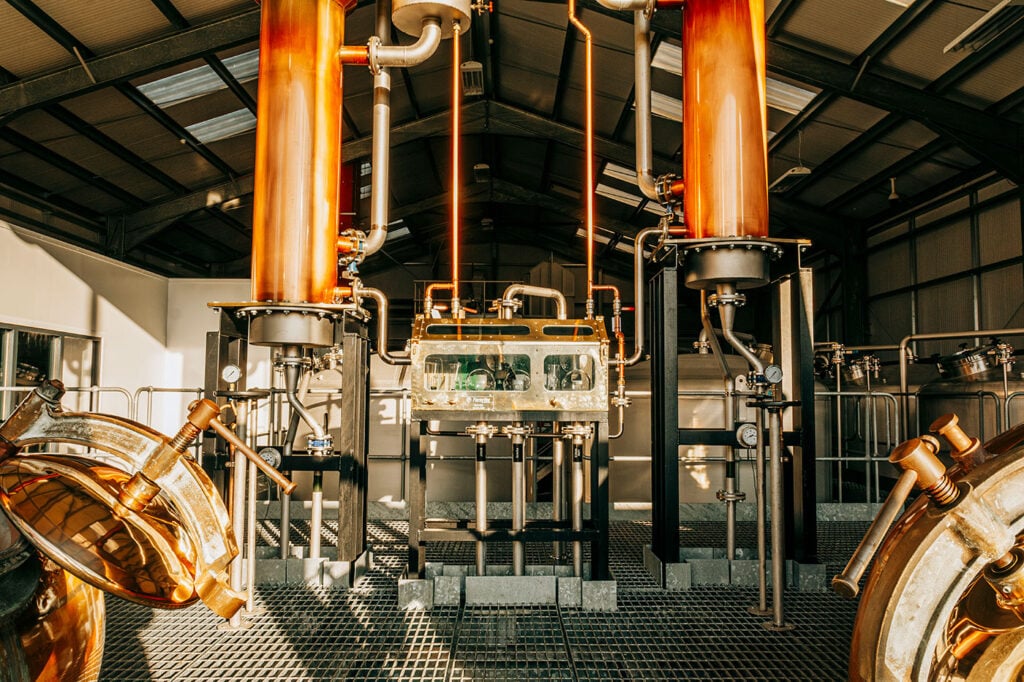
Rich and fruity spirit is the brief here
Maturation
Every single drop of Aberargie Single Malt is matured on site at Netherton Farm. The warehouses are racked. “Dunnage warehouses are lovely, but again labour-intensive and not always the most efficient use of space. Palletised warehouses serve a purpose but are not our thing. Racks offer a nice blend of space efficiency, accessibility, and they are kind to your casks, unlike palletised warehousing,” Mackeddie says.
The sherry casks are imported directly from José y Miguel Martinez, a combination of American oak and European oak, and a combination of both oloroso and Pedro Ximénez. The first-fill bourbons come direct from a variety of American distillers, which Mackeddie says offers some interesting variation in flavour. “Much like Scotch, every bourbon is different, different mash bills, different styles. Dealing directly where we can allows us to do things our way”.
From day one, Aberargie refused ‘rinsed’ or ‘steamed’ barrels. Rinsing or steaming is a common and legal practice in the US to yield every last drop of bourbon from the cask, including a degree of the ‘in drink’ within the oak that distillers like Mackeddie look for for flavour purposes. “While again it adds a level of complexity and expense to what we do, it means we control what we get and how fresh it is,” he explains.
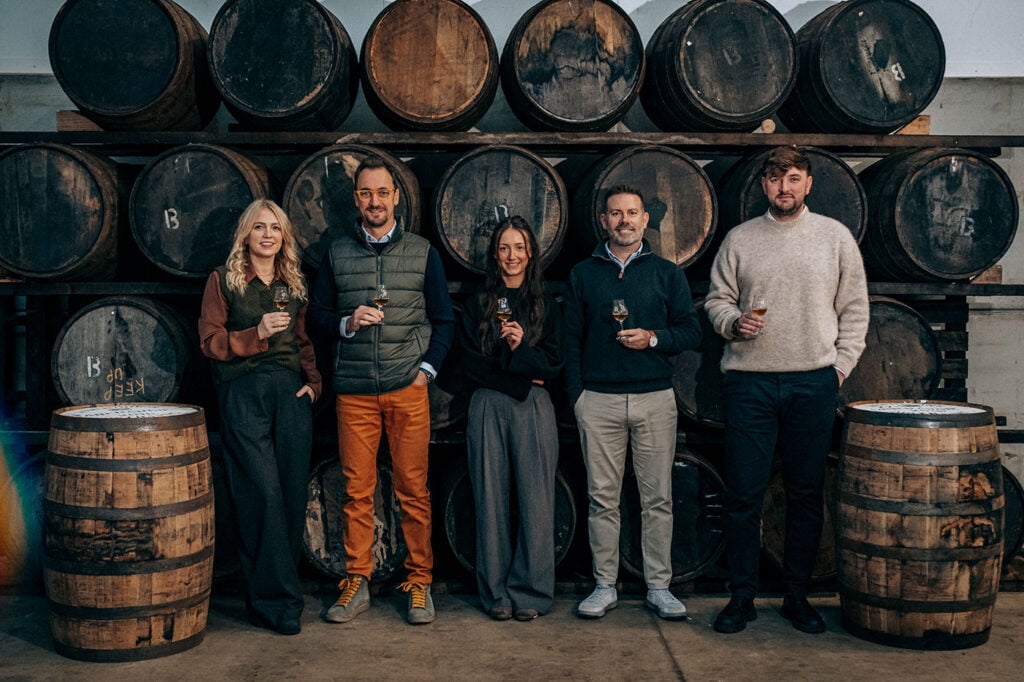
I would also be smiling like this if I were in the Aberargie warehouse
A Lowland highlight
Aberargie Distillery was built for a two-tonne mash with six washbacks, but in 2023, a further three additional washbacks were added to futureproof the operation without the need to sacrifice on fermentation times. It now operates a 2.7-tonne mash with nine washbacks. As it stands, there are no further plans to expand distillery capacity.
The very nature of a farm-to-bottle operation means that Aberargie doesn’t produce for ‘volume’ purposes. The ambition is to produce enough that will be able to keep core range products on the shelf. “Given the nature of what we do and how we do it, limited releases will be exactly that, and consumers may need to be snappy to ensure they get a bottle,” Mackeddie concedes.
This is not a stereotypically lighter “Lowland style” of spirit. A definition that means less every year. “Historically, regional styles were a way of guiding young whisky drinkers toward a specific flavour profile or style. But I think that’s largely disappeared over the years,” Hendriksz says.
“Today, you have Islay distilleries making unpeated single malt, Highland distilleries producing peated whisky, and some Lowland distilleries creating powerful, rich, oily spirits. We’ve moved beyond those regional stereotypes. The whisky we produce certainly doesn’t fit the traditional stereotype of a Lowland single malt”.

Aberargie Inaugural Release, now available at Master of Malt
Aberargie Inaugural Release
The Inaugural Release is the first whisky to leave Aberargie Distillery. It is described, accurately, as barley to bottle. The recipe is precise: 52% Golden Promise. 48% Laureate. The whisky matured in first-fill bourbon barrels and first-fill sherry butts, split 50:50.
The reason for that cask profile is simple: it worked. “Our early years of production were filled almost solely into first fill bourbon and first-fill sherry – the investment in wood from day one has been considered and sizeable,” Mackeddie says. “As a first release, it was always destined to be something rich and decadent, but through our innumerable prototype recipes, 50:50 hit the spot.”
The ambition was to show what the distillery actually tastes like. Home-grown barley, with varieties chosen for flavour profiles, matured in a combination of first-fill bourbon barrels and first-fill sherry butts, and making decisions based on flavour. “Autumn in a glass,” Hendriksz calls it.
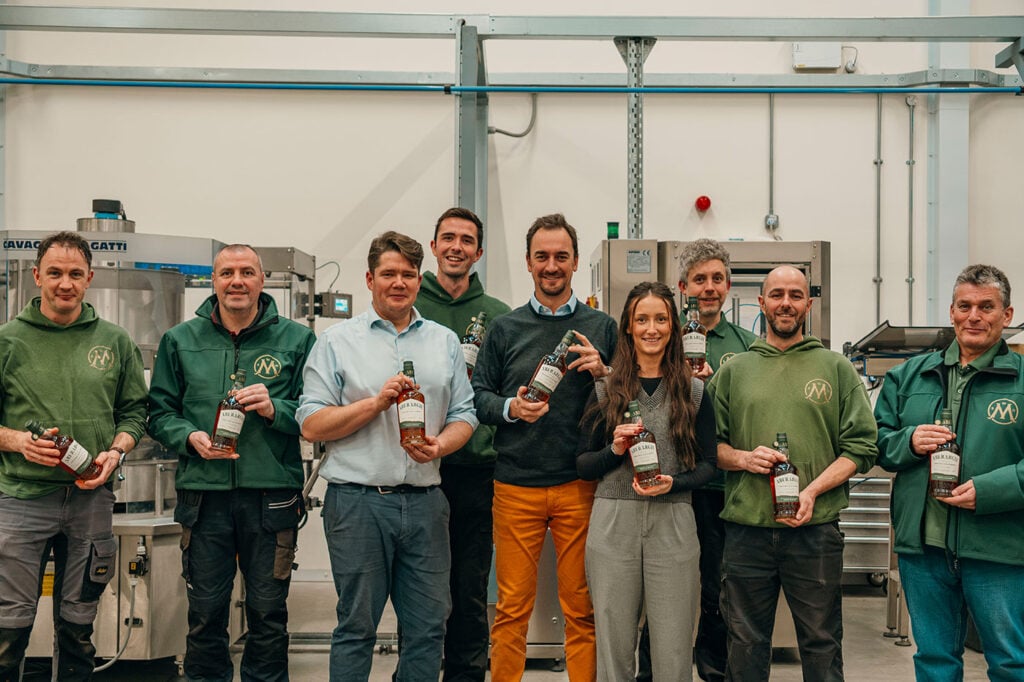
There is a community feeling at Aberargie
The virtue of patience
The reason we’ve waited this long to see any of it is that the brand never felt any pressure to release a young whisky.
“The Morrison family never pushed us commercially to bring something to market before we believed it was truly ready,” Hendriksz explains. He returns repeatedly to one word: patience. “They know whisky is a long-term game. They’ve seen the cycles, the highs and the lows, and that perspective gives us the confidence and flexibility to focus on doing things properly, without short-term pressure.”
Hendriksz explains that using first-fill wood allowed them to watch the whisky develop as intended. “Around 12 to 18 months ago, we reached a point where it was maturing in the way we wanted — the character, balance and depth were all coming together. That was when we felt completely comfortable putting it into a bottle, so we started the necessary steps to do that and bottled it in January 2026”.
Aberargie Distillery and its first whisky
As for what comes next, Hendriksz is clear. “We’ve released our inaugural bottling, which is a limited edition. Our ambition is to introduce a core release within the next 18 months. Until then, we’ll continue with a series of limited editions to help tell the story of who we are as a distillery.”
He frames the period ahead as foundational rather than commercial. “The next 18 months are really about storytelling — giving people insight into the foundations and building blocks that define us. He distinguishes commercial success and internal success.
“For me, workplace culture is incredibly important. We employ 20 people in a very small village, and I’d love for that still to be the case in 10 years’ time. I want this to remain a place where people feel comfortable coming to work, where they can learn and express their creativity. And of course, we hope to continue producing single malt Scotch whisky of the highest quality”.
A decade may not be a long time in Scotch whisky. But it is an eternity in modern brand building. It’s taken a while for us to meet this distillery, but that decision alone tells you what kind it is.
3 Comments





