Trade
TradeHow to drink whisky
When it comes to the question of how you should drink whisky, we're here to tell you there's no 'proper' way. Let's explore the delicious options.
Jump to section
Author:

Reading time: 5 minutes
There’s no single “best” way to drink Whisky. It depends on your mood, the dram, and your palate. Some nights demand neat, others call for a few drops of water to open up aromas, for adventurous souls, ice plays its part, and of course, whisky cocktails let you explore flavour combinations.
In fact, the same whisky can be enjoyed in various ways at different times and for different occasions. So when somebody asks us “What is the best way to drink whisky?”, the truth is it depends on the occasion! As Jack Beguedou, whiskey sommelier, says: “Start neat — meet the whisky as it is — then add water, or try over ice and in a cocktail; experience all its sides.”
The important thing is that we enjoy this fascinating and diverse spirit. You’ll find no snobbiness here – just the plain truth, which is that drinking whisky neat, with water, with ice, with mixers, in classic cocktails and serves, or even straight from the freezer, all have their place. Below, we’ll guide you through all approaches, with pros, cons, tips and even food pairings so you can drink like you mean it.
The best way to drink whisky neat
There’s no doubt that to get the most out of a well-aged whisky or whiskey, drinking it neat – meaning at room temperature with nothing added at all – can often be the best option. This can, quite naturally, be daunting if you’re new to whisky or not used to drinking spirits at this strength. This is also where ‘how to drink whisky’, and ‘how to taste whisky’, can mean different things. When whisky drinkers ‘taste’ a whisky, they usually mean they assess its character in detail. For this you’ll want a tapered, tulip-shaped tasting glass to help concentrate and direct the different aromas. The whiskies most associated with this type of tasting are perhaps single malts, but any whisky can be assessed and enjoyed this way if you want to really get under its skin and appreciate all the intricacies created during its production, ageing and blending.
To find out more check out our full how to taste whisky guide.
Whisky that's delicious neat
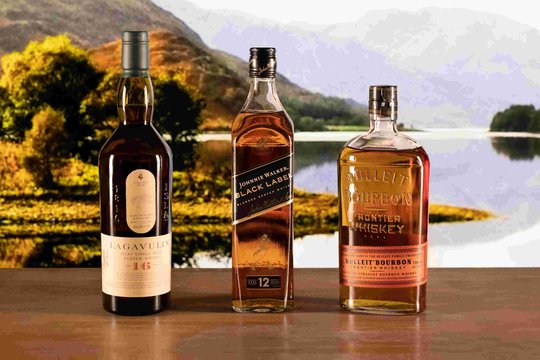
These whiskies are perfect if you like yours straight up.

Whisky served in a classic Glencairn tasting glass. Tulip-shaped tasting glasses help focus aromas.
The best way to drink whisky with water
Should you drink whisky with water? Yes! Or, rather, yes, you can. In fact, it can be vital to the kind of tasting described above. When you’re trying to get the measure of a whisky, whether it’s a malt, blend or bourbon, a few drops of water can help to open it up and release different notes. Just remember to go slowly - you can always add more water, but you can’t take it out!
We’re also often asked how to drink cask strength whisky, which can be 55-60% or even higher. Part of the answer is that a little water can really help. It can unlock the complexity within these intense bottlings where the high alcohol will likely otherwise numb some of your senses. (Although we’d still recommend tasting a little neat beforehand, and going slowly with the H2O.)
There are other ways of enjoying whisky and water too. A Mizuwari, or a Bourbon and Branch, for example, are refreshing serves – from Japan and America respectively – that call for whisky and spring water in different proportions, but we’ll get on to mixed drinks shortly.
The best way to drink whisky on the rocks
Enjoying a whisky with ice, or ‘on the rocks’ is a classic that shouldn’t be looked down upon. The key is knowing what you want from any drinking moment or experience. If we add ice, are we going to be able to identify as many notes, or appreciate the same levels of complexity as if we were drinking the same whisky neat? No, the flavours will inevitably be dulled. Is it still going to provide some tasty and refreshing sipping, perfect for a summer’s evening, or as you catch up with friends in a warm bar? Hell yeah, it’s probably going to be ideal for that! The glass called for here is appropriately often called a rocks glass, or more commonly in the UK simply a tumbler, or even an Old Fashioned glass (more on cocktails shortly). They’re all basically names for the same thing.
The whiskies we choose for these occasions may not always be the same ones, however. When people say ‘whisky on the rocks’, that’s an American expression (so 'whiskey on the rocks', really, given the more common spelling with an 'e' stateside) and would usually mean a bourbon poured over ice. Some actually say the term comes from a tradition of cold rocks being taken from Scottish streams and placed in drinks, but frankly that seems apocryphal. That doesn’t mean that a blended Scotch whisky, or even a single malt can’t be enjoyed with ice too though. Are you going to add ice to your fanciest and most expensive whiskies? Perhaps not, but hey – it’s your whisky! A complex malt with just one or two ice cubes added (or one slightly larger one) can be an absolute treat.
Whisky that shines with water or ice
These are big, bold whiskies that reveal more flavours when diluted or are perfect for a bit of summer sippin' with ice.

Bourbon from Kentucky served with a single pleasingly large ice cube. (Whiskey on the rock?) More on large ice in a moment...
What are whisky stones?
Occasionally called ‘whisky rocks’ (just to be confusing), whisky stones generally come in two different varieties: soapstone whisky stones, and steel whisky stones. The idea is that they cool your whisky without diluting it. They’re a novelty that have become perhaps the best known of all whisky accessories.
The problem is, a little dilution here can be good, and they’re not actually that great at chilling your whisky either – especially compared to ice! If you’re looking to limit how much your ice dilutes, what you actually want is larger ice. Use large solid cubes (say 1.5-2 inches wide), or an ice ball. Ice moulds for creating these are cheap and easy to use. You can always chuck your glasses in the freezer beforehand too, or even sling your whole whisky bottle in the freezer! No, really. This move can also provide some really satisfying texture or ‘mouthfeel’.
Whisky cocktails and mixers
There are countless ways to enjoy all sorts of whiskies within mixed drinks, starting with very simple but satisfying whisky and mixer serves. Much like whisky and ice (and you’ll want ice in most of these drinks too), there can be some snobbery around this, but don’t just take our word for it when we say you should look beyond any snobbery you encounter.
When top whisky writer Dave Broom released a book tantalisingly titled Whisky: The Manual back in 2014, rather than detailing how to evaluate the spirit neat and write tasting notes, he concentrated on just how well dozens of different whiskies – of all different styles, and from around the world – each mixed with water, soda, ginger ale, cola and green tea! Some serious myth busting, and we’re definitely here for it.
From Jack & Coke, to Jameson & Ginger, to whisky and soda Highballs made with heavily-peated single malt Scotch whisky from Islay, there’s a rich tapestry of refreshment to explore and enjoy. Never let anybody tell you whisky cannot be mixed! Increasingly, we can now expect our favourite bars (and even our home bars!) to be able to turn out high-quality whisky cocktails too.
The best whisky cocktails to try
Whisky-based cocktails have a long tradition, dating right back to the earliest drinks that would have been known as cocktails. These were made with spirit (bourbon, Scotch, Cognac, rum, or even ‘Holland gin’/genever), sugar, ice and bitters. The classic example, of course, is the bourbon whiskey-based Old Fashioned cocktail.
Today, the term ‘cocktail’ can refer to almost any mixed drink, and even back in the early 19th century it seems the definition was getting ever broader. Hence, why even back then, a drink sticking to the original formula could be considered ‘old-fashioned’.
The late 20th, and especially the early 21st century, saw a classic cocktail revival, with a steady resurgence of quality, popularity and availability of cocktails from by-gone ‘golden ages’, often served in era-appropriate speakeasy-style bars. Arguably, this hit the mainstream with Don Draper sipping an Old Fashioned, Manhattan or Whiskey Sour in Mad Men. Top bartenders have built on this renaissance with ‘modern classics’ such as the Penicillin with both blended Scotch and peated Islay single malt alongside ginger liqueur, honey and lemon.
The industry continues to build on this legacy in forward-looking, fun and creative ways. Whisky fans and home bar enthusiasts can also have an enormous amount of fun mixing up top cocktails in their own kitchens and living rooms with the veritable cornucopia of high-quality cocktail ingredients available today.
Whisky to mix
Top whiskies that are built for cocktails and creativity.

The Old Fashioned cocktail remains the most famous and celebrated whisky/whiskey cocktail.
Whisky and food pairings
Pairing whisky with food isn’t about showing off. It’s about unlocking flavours you’d never taste otherwise. A whisky’s complexity can amplify and contrast a dish’s texture, spice, and sweetness in ways wine or beer can’t. Fat softens alcohol burn, smoke meets salt, sweetness balances spice, and suddenly that sip you thought you knew shows another side of itself. The right pairing turns whisky from a solo act into a duet.
As whisky writer Dave Broom puts it, “Good pairing isn’t about force-fitting flavours — it’s about creating a conversation between glass and plate.” The balance is everything: you want the whisky to lift the dish, not bulldoze it. Chef Martine Nouet, often called The Whisky Chef, agrees — “When you find harmony, both the food and the whisky taste better than they would alone.” It’s not about rules but rhythm; contrast a smoky Islay with seafood, complement a sherried Speysider with chocolate, and always leave space for surprise.
Quick and easy food Pairings
- Aberlour A’Bunadh – Big, sherried and bold. Perfect with dark chocolate or blue cheese.
- Talisker 10 Year Old – Briny smoke meets seafood and oysters like they were separated at birth.
- Glenmorangie The Quinta Ruban 14 Year Old – Port cask sweetness flatters rich desserts and venison.
- Balvenie DoubleWood 12 Year Old – Honeyed and approachable; great with roast chicken or nutty cheeses.
- Nikka From The Barrel – Japanese precision and spice that shines with grilled meats or sushi.
- Red Spot 15 Year Old – Silky, fruity Irish charm that sings with spiced apple crumble or caramel pudding.
Whisky to pair with food
Need whisky suggestions for your next whisky and food pairing? Here's a few choice bottles.

The right foods can elevate a whisky
Try this, next time
- Try a dram neat for 5 minutes, then add one drop of water and re-taste.
- Sip the same whisky neat vs with water side by side, and note aromatic or flavour differences.
- Try a classic whisky cocktail (Old Fashioned, Penicillin) with a dram you already enjoy neat — see how it transforms.
- Pair your favourite dram with your favourite chocolate, see how the experience changes.
Neat vs Water vs Ice vs Cocktails
Neat
Pros: Purest expression of the spirit; nothing masked; ideal for terroir flavour.
Cons: Can be “harsh” on high-ABV drams; some flavours stay latent.
With water
Pros: Opens up aromatics and esters; can temper alcohol burn.
Cons: Too much water can kill character; dilute complexity.
On ice
Pros: Great for relaxed sipping; gradual dilution over time.
Cons: Ice cools and suppresses flavour; melt dilutes too much over time.
Cocktails/mixed
Pros: Versatile; introduces complementary flavours; easier for newcomers.
Cons: Masks subtle character in delicate whiskies; may lean too far from the dram.
Frequently asked questions
How big is a measure of whisky?
A traditional single measure in the UK is 25ml, but in many bars you’ll now find 35ml.
How many units in a bottle of whisky?
There are 28 units of alcohol in a 70cl bottle of whisky at 40% abv. That’s 1 unit per classic 25ml single measure, or 1.4 units for a 35ml single measure. Of course, some whiskies can be stronger than 40%, and it’s good to be aware of how much we’re drinking. Remember, sip, don’t gulp folks!
[strength (ABV) x volume (ml) ÷ 1,000 = units]
How to store whisky?
Whisky bottles can be stored upright, but should be kept out of direct sunlight.
How many calories in whisky?
There are approximately 1,500 calories in a 70cl bottle of whisky at 40% abv. That’s around 50 calories per classic 25ml single measure, or 75 calories for a 35ml single measure. This increases for stronger whiskies, and any mixers or other cocktail ingredients would need to be considered separately.
What temperature does whisky freeze?
The freezing point of pure ethanol is -114°C, with whisky and other spirits at around 40% abv having a freezing point of about -27°C. That’s still well below the temperature of home freezers, so you don’t have to worry about your spirits freezing.
Discover more whisky guides
Find out how whisky is made, about the different types of whisky available, and more...
More whisky guides
Find out how whisky is made, about the different types of whisky available, and more...