Scotch Whisky Association – guardian or bully?

Caledonian Distillery
Ian Buxton
Ian Buxton
Share:

We reported a few weeks ago on the legal action the Scotch Whisky Association is taking against a Canadian whisky producer in Vancouver Island, Saanich for violating Scotch whisky’s geographical indication. Now here’s Ian Buxton with the full story.

What is the Scotch Whisky Association (SWA) up to?

The more grey-haired of my readers may recall that in June 2009, after a nine-year legal battle, the SWA retired somewhat bloodied from its battle with Canada’s Glenora Distillery and its Glen Breton Canadian single malt. Their long-running attempt to stop the use of the tiny operation using the term ‘Glen’ ended with ignominious defeat in Canada’s Supreme Court and the award of some costs to the company.  You can buy Glen Breton to this day and Scotch whisky doesn’t seem to be suffering too badly.

SWA vs Macaloney

But despite this rebuff, they’re at it again and, earlier last month, in a joint action with Whyte & MacKay, filed a civil suit against MacMhaol‐onfhaidh (Macaloney) Brewers & Distillers, the owner of Macaloney’s Caledonian Distillery & Twa Dogs Brewery in British Columbia, Canada. 

Objecting to the use of the words ‘Caledonian’, ‘Macaloney’, ‘Island whisky’, ‘Glenloy’, and ‘Invermallie’ on the distiller’s products, the SWA claims that Macaloney is violating Scotch whisky’s geographical indication (GI) by using words that are associated with the country on its Canadian whiskies.
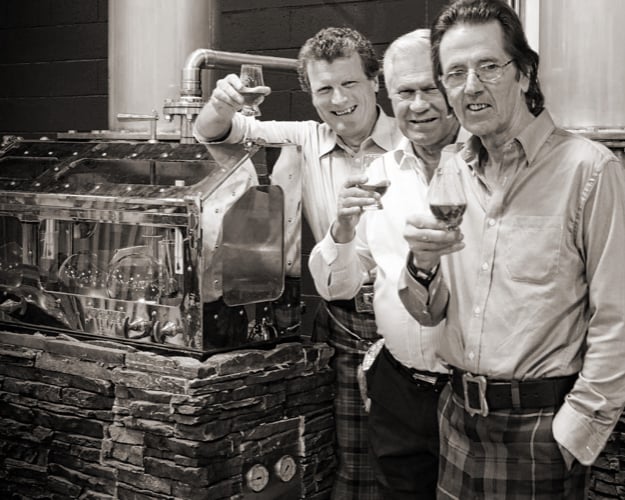
Caledonian Distillery Canada

Scottish not Scotch, from left Graeme Macaloney, the late Jim Swan and Mike Nicolson

Let’s put to one side the curious but undeniable fact that Macaloney Brewers & Distillers is in fact largely owned by its founder, president & whisky maker Dr. Graeme Macaloney who, not unreasonably you might think, wants to put his name to his products. These, as it happens, include whisky, which is distilled and bottled at the distillery’s Victoria Island home – ‘island whisky’ perhaps, in acknowledgement of the fact that, along with another twenty or so small distillers, it’s actually produced on a piece of land completely surrounded by water. So proud of this fact is Macaloney that a map of Vancouver Island appears on the cartons and both front and back labels of the bottles proclaim them to be Canadian.

Scottish not Scotch

Macaloney is both hurt and confused by the SWA’s actions, claiming to have “reached out to them five years ago to ensure our indie-bottled Macaloney’s Twa Cask vatted Scotches were fully compliant, from which they were aware I was using my name Macaloney and also the local regional name Caledonian”.  Further, he says, they have “responded to SWA’s request in late 2019 to describe our master distiller [ex-Diageo Scot Mike Nicolson] not as a ‘Scotch master distiller’ but as a ‘Scottish master distiller’. We also agreed to prominently display ‘Canadian’ on our whiskies. Our labelling and packaging identify our products as Canadian, and our distillery [location] in Victoria, British Columbia.”

For their part, a SWA spokesperson issued a statement confirming the action, saying: “The SWA consistently takes action in our global markets to prevent the use of Scottish indications of origin on whisky which is not Scotch whisky. This is vital to protecting both Scotland’s national drink and to ensuring that consumers across the world are clear about whether or not they are buying whisky that is produced in Scotland.  It’s critical to us to ensure that spirits producers in other countries do not take advantage of the quality reputation of Scotch whisky that our industry has built up over decades. It is important that anyone who wants to purchase a bottle of Scotch whisky can do so with the confidence that what they are buying is authentic, and that products which aren’t Scotch whisky are clearly differentiated.”
On The Nightcap: 26 March edition we learn not to mess with the SWA

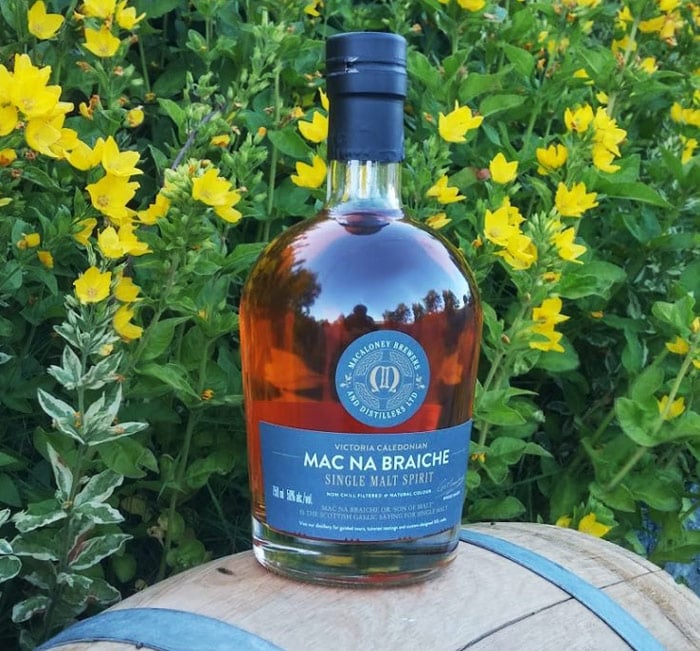
A bottle of Mac Na Braiche single malt from the Caledonian Distillery (in Canada)

Is there room for compromise?

And that seems reasonable enough if Macaloney were claiming to produce Scotch whisky. However, while clearly proud of his Scottish heritage and links to Scotland, including a Scottish distilling team and equipment sourced from Scotland, he maintains his company, brand and whisky are 100% Canadian. “We do not, and never have used the geographic indicator ‘Scotch whisky’ on our Canadian products”, he says “and strongly disagree with the SWA lawsuit’s assertion that our use of ‘Caledonian’, ‘Macaloney’, and other terms including ‘Glen’ ‘Inver’ and ‘island whisky’ are alternatives synonymous with Scotch whisky.”

The lawsuit is already attracting unfavourable publicity in Canada but it’s clear neither party is ready to back down. But, with the legal precedence already set in the Glenora case and with his army of loyal small investors behind him it’s hard to see why Macaloney wouldn’t fight this.

Well, as 19th-century French philosopher Pierre-Joseph Proudhon once wrote “Laws: We know what they are, and what they are worth! They are spider webs for the rich and mighty, steel chains for the poor and weak, fishing nets in the hands of government.” The SWA seems to have got rather tangled up this time.

20 Comments

Ian Buxton
Ian BuxtonApril 29, 2021
I’d just like to thank everyone who has made the effort to comment. The strength of feeling is quite apparent, which is something I understand and share. I’d suggest that you should also make these points directly to the SWA, or via social media (@ScotchWhiskySWA is their Twitter handle) though sadly, I don’t think the SWA will back down until defeated in court by which time much ill-will will have been caused; lawyers enriched and reputations damaged. Good luck and best wishes.
Ed Patrick
Ed PatrickApril 29, 2021
Bravo, Ian Buxton, for hitting the nail on the head, and all of the Comments writers for their thoughtful and accurate reading of the situation. Since it has all been said and said so well, I’ll confine myself to only two points: 1. The SWA will not drop its ludicrous case, and 2. The SWA will lose the case in court, as they did with Glen Breton. Just to show the SWA how they have alienated so many people in Canada, I will stop buying bottles of Scotch Whisky until this case is thrown out of court, and I invite everyone else to do the same. There’s lots of good Canadian whiskies available. Cheers!
Chris Thomas
Chris ThomasApril 28, 2021
The lawsuit is absurd. The SWA lost this argument in the Supreme Court of Canada already. I grew up on Vancouver Island and even with all the broom and gorse I certainly never was mistaken that I was in Scotland LOL. I have visited Scotland quite a few times and they love Canadians! To the SWA – grow up! The product is clearly labeled Canadian single malt whisky with a Vancouver Island outline on the marketing, labels and boxes. See you in the Supreme Court and this time costs and damages!!
Colin McKenzie
Colin McKenzieApril 28, 2021
Thank you Ian for a well written and articulate summation of SWA ridiculous lawsuit. I am President of the South Okanagan Whiskey Tasting Society, one of the largest whiskey tasting Society’s in the Interior of Southern British Columbia Canada and we are all appalled with SWA’s decision to attack an upcoming young distillery. This is definately a David vs Goliath scenario hoping that they can scare and bankrupt this fledgling Distillery. Dr Macaloney confirms that he has been in touch with SWA since he started this venture over five years ago and complied with any advice, however, now that Macaloney’s Caledonian Distillery has won prestigious awards i.e. Best Canadian Single Malt, that SWA are now persuing this lawsuit. To us it brings back memories of the Glen Breton debacle which SWA were slammed for not just in Canadian courts but also by Malt Maniac whisky writers at the time: http://www.maltmaniacs.net/e-pistles/e-pistle-200901-swa-the-scotch-wankers-association/ We agree with the comments above, I am a proud ex-pat, love Scotch and find no confusion or ambiguity with how to see if it is Made in Scotland or Made in Canada. If I put McKenzie on a bottle would anyone be stupid enough to think it is Scotch. SWA give your heads a shake and drop this lawsuit.
Graham H.
Graham H.April 28, 2021
Fine article, Mr Buxton. As a Scotsman, having lived on ‘The Island’ (Vancouver Island) for many years, I have become very aware of how proud and supportive Vancouver ‘Islanders’ are of their local ‘Island’ products, including their craft beer, wines and local spirits, food etc. Macaloney’s ‘Island’ whisky appeals directly to that local passion. I am also well aware of the strong and inextricable historical links between Scotland and Canada. Canada is steeped in Scotland, from the early fur trade and exploration to banking, universities, politics, the military (there are more Scottish Highland Regiments in the Canadian army than the British army!) and much more, including the railway that united Canada, led by three Scots from Speyside. See the plaque to George Stephen on the clock tower in Dufftown, Scotland, visit Donald Smith’s (Lord Strathcona’s) retirement home in Glencoe, Scotland, then there is Sir John A. Macdonald, Canada’s first prime minister. The last spike of the aforementioned railway was driven in at Craigellachie, British Columbia. Robert Dunsmuir, the Scottish coal barron, played a large part in the development of Vancouver Island, celebrating the opening of the local E&N Railway by sharing a bottle of Scotch whisky with Sir John A., down a mineshaft (out of sight of their wives!!!). It goes on and on. Look at a street map of Victoria, BC and you will find it littered with Scottish place names. The connections run deep and are everywhere. Indeed, when I return to Scotland, almost every Scot that I speak to, has friends or relatives in Canada. My own family connections in British Columbia go back over 100 years. What all this does is strengthen the bonds between Canada and Scotland and this greatly supports the Scottish tourist industry and the Scotch whisky industry. Why on earth would the SWA want to jeopardise that good will and support? They are giving the Scotch whisky industry a bad name, as a bunch of big business bullies. Canadians will defend their own turf and it can only hurt the Scotch whisky industry, especially the ‘big boys’ as more and more whisky enthusiasts turn their allegiance to small craft distillers and independent bottlers. Besides, if anyone is confused between a bottle of Scotch whisky and a bottle of craft Canadian single malt whisky, they either need to drink less, or pay a visit to Specsavers!!!
Mo Roberts
Mo RobertsApril 28, 2021
Very disappointing at this news, !! I am Scottish, from Loch Lomond, my Education/ degree in Edinburgh , I now live in Vancouver B.C. Canada. I am a very proud Scot .. a passionate and very knowledgeable lover of Whiskies. I come from a great place and I live in a great place …..this story made my blood boil.! SWA I am deeply disappointed with this action! really ? you come across as very insecure to think that someone was out there trying to be better than you…….. The Macaloney Distillery is on an Island and has every right to be called “Island Whisky” also B.C. Canada has more Scottish names (and people) due to Scottish settlers and immigrants than anywhere on the globe. I know Dr Macaloney as a professional, I remember his endless days and nights, struggles, trip to Scotland and hard work over years to get this business to where it is today , he spent endless hours with other professionals both in Scotland and in B.C to make sure he was creating his business with the highest of standards, correct wording …he was doing everything correct ……not at anytime has anyone to date expressed the idea that any of the names of his Whiskies are being copied or that Vancouver Island could be confused with the Islands in Scotland … and nobody can take Dr Graeme Macaloney surname away from him, he didn’t make that up …it is his given name for goodness sake. I would like to put a positive spin on this article….due to the Macaloney distillery to which I visit with large groups of Canadians and Americans on a regular basis since the opening ….Scotland is very lucky especially the SWA to welcome the hundreds +++ of visitors in recent years to whom after a visit to his Whisky Visitors Centre have this urgency to visit Scotland and its enhanced your business and the Scottish tourist industry to great heights in the last 5 years, so if anything I would be thanking Dr Macaloney for his contribution to your tourism and especially your Distilleries in Scotland. There is an ongoing huge demand for visiting Scotland in the past few years and a waiting list 10 miles long waiting for Covid to be over to visit as people get entrenched in the passionate history and a taste of whisky, I myself and many like us continue to promote with great pride your fine Scotch’s, Islands, Tourism and even locally the sales in our B.C. liquor stores have escalated over the last 5 years selling Single Malts and whiskies thanks to people like myself and Dr Macaloney , so please don’t come over as hurting…. this is a disgrace and very offensive to people who are actually promoting your wealthy industry. Regards …..a very embarrassed fellow Scot
James Deitch
James DeitchApril 28, 2021
I think the others have said it all! The article is well-written notwithstanding the error in the title. It is absolutely astounding, as someone who practised law for 35 years, that an action like this would be launched claiming that someone with the name Macaloney cannot use his own name to market his whisky. It clearly appears to be the case of a large organization trying to bully a smaller one for purely monetary reasons. The suggestion that the names on the packaging could confuse a whisky buyer into thinking that Macaloney’s whisky is Scotch is ludicrous. It is a fine Canadian single malt from Vancouver Island! Which is exactly how it describes itself!
Atholl Malcolm
Atholl MalcolmApril 27, 2021
Maybe it’s time for the rest of the whisky making world to collaborate in a legal action against the SWA for implementing frivolous lawsuits. Imagine the outcry if Robertson’s tried to limit the use of the term “marmalade” because they make scotch marmalade, or the Quaker Oat Company the term “porridge” to protect their brand of “scotch porridge oats”, or Mars, the term “butterscotch”, or Scottish haggis makers, the term ”haggis”, etc., etc., etc. The only word that comes to mind to describe the SWA’s action is “preposterous”. It reminds me of the great John Cleese’s Beggar Kicking Contest from his Upper-Class Twit of the Year Sketch! The SWA would be better off encouraging the use of the names mentioned in their suit because small distillers are spreading the gospel of single malt and increasing sales generally; which is good for all, including the SWA members. Offer John an honorary directorship, Graeme. Slàinte, Atholl Malcolm
David Cox
David CoxApril 27, 2021
Just to be clear Ian and take this in the good spirits intended but our famed distillery is not in Vancouver but on Vancouver Island in Saanich which is adjacent to Victoria, the capital of the Province of British Columbia Columbia. Okay, the wee geography lesson is over (spoken with a thick brogue). I resent the SWA implication that only the supremely intelligent Scotsman living in Scotland thinks that “scotch” means distillation and maturation in Scotland. Tell that to the Crown Royal or Canadian Club rye whisky drinkers or bourbon boys in the .S deep south. Clearly, the SWA’ers have never travelled beyond the borders of that wee country nor learned that much larger countries with real independence from Mother London have learned about and implemented the concept of legal labelling, in two languages indeed, neither of which is a form of Gaelic or spoken with a brogue in our fair land except by a minuscule few relative to population whole. We have a proud culture here and like all of our crafts – whiskey and whisky and beer and art – so go practice your Goliath bullying on the likes of Diageo before wee David resurfaces and demonstrates his prowess once again.
Ian Buxton
Ian BuxtonApril 27, 2021
Thanks – but you’ll have to complain to the Editor!! I don’t write the headline. But thanks for your kind other comments; much appreciated.
Donald McIntosh
Donald McIntoshApril 27, 2021
Great article Ian! If I can eat cheese and chocolate from around the world and wear a nice watch but accept that only cheese from north Somerset can be called ‘Cheddar’, that Belgian chocolate and swiss timepieces set the tone of refinement and quality then yes; perhaps I can appreciate that ‘Scotch’ whisky deserves its own protection. That seems to be the argument. However, Scotland did not invent distillation and there are now 2,000 new craft distillers in the US with 70-80% doing whisky, and Canada has just under 250 I believe. The malt whisky yearbook says Australia and NZ have added 60 single malt whisky distilleries in the last ten years. So similar to the thousands of factories and small independent craft businesses making chocolate and clocks around the world there are thousands of craft distilleries making whiskey and whisky. What we do have on Vancouver Island, the 43th largest island in the world, is a population one sixth that of Scotland, with a strong and vibrant Scottish cultural heritage. Pipe Bands and Double decker buses travel down the main street in the capital city, Victoria, named after a lass that built a braw house in the highlands of Scotland. Someone already mentioned in the comments the large number of British Columbians who identify as Canadian-Scottish. Many would say modern Canada was built by the scots. We still have kilted army battalions, 16 in fact, including a storied regiment here on the Island whose soldiers fought in kilts in the first world war and won 4 Victoria crosses. We hae history! But to be very clear, we have a young distillery that is Canadian, markets itself as Canadian and wins world awards as a Canadian Whisky. It has a beautiful etching of the Island on the carton showing the location of the distillery, and notes on the finest Canadian Barley used. Yes, we can read about the Scots and Irish roots of the whiskymaker on the box but that does not make the contents Scotch! The SWA does not even represent the UK industry, with many names such as Tullibardine, Edradour and Clydeside not under their banner. And look at the actual ownership of the brands under the SWA! Big business beating up on the upstart new boy on the block. Methinks, that with all those thousands of distilleries out in the wide, wide world, the results of this great team at Macaloney, with awards flowing in, is perhaps causing the SWA to run a wee bit scared and “the lady doth protest too much”.
Bruce
BruceApril 27, 2021
Thank you Ian, it does seem like the world has better things to do at the moment than sue small business owners for trying to celebrate the cultural heritage of their ancestors. I have always seen our local Victoria Caledonian distillery proudly announcing its Canadian-ness. I believe they even managed to find a source of Canadian peat so they could smoke their Canadian barley. I was born in Canada and I didn’t even know we had peat here! In school I was taught that Canada is a multicultural society and the Scots have been a part of it the whole time. The university started by James McGill just celebrated it’s 200th anniversary recently. That makes it 47 years older than our country! I hope no one wants them to change their name… I grew up knowing my ancestors were part highland and part lowland (with a few other cultures welcomed in here and there to spice things up). My highland ancestors came to Canada in a boat from Islay in the mid-19th century. My 3rd cousin Bob (not to be confused with my first cousin Rob, or my uncle Bob) told me he remembers his Grandma’s generation whispering friendly secrets in Gaelic on the farmstead in Manitoba so the kids wouldn’t know what they were saying. Sadly our strand of the Gaelic language is long gone now, washed away in the “normal” schools of the 19th and 20th centuries. Similar to what happened in Scotland it seems, https://www.bbc.com/worklife/article/20180731-can-27m-a-year-bring-a-language-back-from-near-death Even though they shared a Scottish culture, the branches of my family tree didn’t always agree on the interpretation of their history. I recall someone telling me once the Bruces weren’t really Scottish because they only arrived in the UK from France in the 1000s. I’m not certain that would be a popular opinion around the world… I am certain no one dared say that around my Grandad Bruce unless they wanted to endure an “Uncle Colm” length lecture on the contribution of the Bruces to Scottish history! Despite these fierce differences they all unanimously agreed on getting an education, doing the right thing, freedom, and respecting their heritage. As my family liked to say “Here’s tae us, wha’s like us, damn few an’ they’re a’ deid.”. I do hope the SWA finds a way to do the right thing. I think we should celebrate award winning whisky made by people who love Scottish heritage. Goodness knows that with only 5 million or so people living in Scotland, and only 30,000 fluent Gaelic speakers, we need to promote every little bit of our contentious culture!
Douglas Macphee
Douglas MacpheeApril 27, 2021
Good Grief. I came across this article while looking up Ian Buxton who wrote book “101 Whiskies”. Why in the world would the SWA think scotch whisky drinkers couldn’t read a label? We’re not illiterate. The label clearly says “Canadian”. As a third generation Scot living in the same city as this distillery, I pass Craigdarroch castle on the way to work and return on McLure street. Everyone here refers to the “Island”. Can’t use your last name because it’s Macaloney? Who are Diageo, Whyte & MacKay and the rest of the SWA to ban Scottish family names on a label? I followed Caledonia since they opened. They are a superb Canadian craft distillery sourcing local ingredients. If you appreciate local whiskey, you don’t need a global giant trying to shut them down. Myself and many others who enjoy our drams of single malts scotch are finding an astringent off flavour in this SWA cask. Madness.
John Thomas
John ThomasApril 27, 2021
Great Article Ian. As a grandson of a Scottish Immigrant, an Anderson, these bully tactics leave me almost speechless. Almost. My father taught me to appreciate a fine single malt over a blend, and i have supped many a malt in my life. I spent a long holiday in Scotland visiting the distilleries, and playing a little golf, and never in the small towns and distilleries did this idea that Canadian malts were taking away business, or confusing buyers, ever come up. I live in British Columbia, which was once know as New Caledonia. I live on an Island. Vancouver Island. This ludicrous idea that place names would confuse a buyer, when the labels scream made in Canada, is nothing but cheap bullying by the rich. If the SWA thinks that we will lay down and lick their shoes on this they will get yet another bloody nose in the courts. I love when the legal precedent is already set as it makes our defence all the easier.
James Jamieson
James JamiesonApril 27, 2021
Great Article Ian. I am a proud Scot, and many of my family members are here in Canada from Scotland and we too are not confused in this matter. North Americans are not confused either knowing that a scotch whisky is distilled and produced in Scotland, they all read the bottle label before buying their tipple. The SWA loves publicity and I am sure that they have tested our spirits and found that they are indeed classed as a fine whisky so they can only challenge the name on the label! If Graham Macaloney wishes to keep his name on the bottle and the Caledonian Distillery is a registered Canadian Distillery and the bottles declare ” Produced In Canada”, then the SWA does not have any chance of of success in their lawsuit on Geographical Identification. There are no scottish distilleries distilling “Glenloy” or “Invermallie” whisky and these words are not a registered trade mark in Scotland or elswhere. The BC Supreme Court will uphold the Trade Marks Act in Canada. When the lawsuit is chucked out, our whisky label should include: “A superior whisky made by traditional scottish methods in scottish stills mashed by a scotsman dedicated to producing the finest world class whisky at the envy of the Scotland’s Whisky Association.” Just tae rub it in!
Kirk Doherty
Kirk DohertyApril 27, 2021
Great article Ian! Reading it, I was struck first by the sheer idiocy of the SWA objecting to the use of “island whisky” as Macaloney’s whisky is indeed whisky made on a big fecking Island. What would the SWA be satisfied with? Perhaps “land surrounded on all sides by water whisky”? Or maybe “land not attached to other land whisky”? Maybe “dry spot in the ocean whisky”? If the SWA’s attack on the use of Glen Breton on a Canadian whisky generated negative publicity for the SWA, I can only imagine how this lunacy is going to fly… And what’s with their objection to Scottish words like “Glen” and “Inver” and “Caledonian.” After all, you really can’t throw a rock in British Columbia (the northern portion of which was even called New Caledonia from 1805-1858) without it landing on a Scottish sounding name – or hitting someone with a Scottish accent for that matter – and it seems there’s a Highland games or pipe band playing somewhere in BC most days of the year… But the thing that is really sticking in my craw is the SWA’s objection to Macaloney using his own bloody name! As a descendant of Irish farmers who left Ireland for Canada during the Great Migration, I’m keenly aware of the way that many too-Gaelic names were reduced to more manageable versions by census-takers, customs officials and the like. It seems to me there’s something decidedly colonial about an institution such as the SWA trying to prevent a proud Scot from using his own name.
Arthur McKenzie
Arthur McKenzieApril 27, 2021
Once again we have the SWA bullying a Canadian distillery with strong Scottish roots from using terms that are common to both of our beloved countries. The SWA should concentrate on protecting and promoting the Scotch industry through reducing trade barriers, pursuing counterfeit whisky and supporting the global growth of scotch and not on putting up barriers for valid whisky makers. I run a local whisky club and am heavily involved in the Canadian whisky community. Public perception and support are solidly behind Macaloney with the view that the SWA is using a misguided lawsuit to abuse a small craft distillery winning top international gold medals for their single malts. I wish Graeme and his hard working staff the best of luck in defeating this foolish lawsuit.
Martyn Ward
Martyn WardApril 27, 2021
Good analysis, Ian. Here’s a typical example of a well-funded organisation using bully-boy tactics against a small, independent business. Sadly, it’s a tactic that often works – the bully assumes that the victim won’t be able to afford an expensive legal battle and will simply roll over. However, we should remember that bullies are cowards and that the most effective defence is to fight back. In this instance, the Canadian company is so obviously in the right that we have to wonder what the SWA has been drinking. Didn’t they learn their lesson with Glenora? It’s past time that the courts started awarding punitive damages in addition to costs for this kind of blatant intimidation and unfounded persecution.
Gareth Withers
Gareth WithersApril 27, 2021
The SWA’s lessons in Canada from the Glen Breton / Glenora debacle appear to have gone entirely unlearnt. With 15% of Canadians identifying as Scottish-Canadian and Scottish place names stretching from Nova Scotia to New Caledonia (historical name given to part of BC) the SWA will not be winning many friends with their strong arm tactics against Canadian craft distillers. However, to object to use of the owner’s own name (Macaloney) really takes the biscuit for me. Keen Scottish historians might recall the MacGregors suffering a similar fate. History may not look to kindly on the SWA’s actions here either.
Douglas Neil Campbell Adams
Douglas Neil Campbell AdamsApril 27, 2021
What do Scotch whisky distilleries: Ardmore, Aberfeldy, Ardbeg, Craigellachie, Dunmore, Loch Lomond, Jura, Mortlach and Oban have in common with Canada? Well they’re all Canadian places settled by Scottish people just like Dr. Macaloney did. I did a quick Wikipedia search and came up with 409 Scottish place names in Canada. Places like Islay; Pitlochrie; St Andrews; Aberdeen; Orkney; Elgin, Iona. Can’t get any more Scottish than naming your town after a Scottish place. So are the SWA saying that Canadians can’t use Scottish words like Glen and Inver because people might get confused? Try searching for any country that doesn’t have a Scottish place name. I was born in Edinburgh, educated in Glasgow and now I’m a Canadian. I’m not confused.

Leave a Comment
