One of the world’s greatest dark spirits, Scotch whisky is the delicious product of cereal grains, distilled in Scotland and aged in oak casks for a minimum of 3 years and a day. The result is one of the most complex, flavoursome spirits to be found anywhere!
Scotch comes in a variety of styles, though all are made up of malt whisky, grain whisky, or a mix thereof. Malt whisky is distilled from just three ingredients: delicious malted barley, yeast, and water. By law, it must be distilled in a copper pot still before maturation in oak casks. It must be bottled at least 40%, and be left completely unchanged other than dilution with water, chill-filtration (to reduce cloudiness when chilled), or a little flavourless caramel colouring for aesthetic appeal! The term ‘single malt’ refers to malt whisky produced at a single distillery, whereas blended malt whisky refers to malt whisky produced at multiple distilleries. Scotch malt whisky tends to be distilled just twice, though in the Lowlands and occasionally elsewhere, triple-distilled variants can be found.
Grain whisky is made in much the same way, though it can be distilled from a variety of cereal grains as well as malted barley (wheat, corn and rye are all popular choices), and it is distilled in continuous column stills. This renders grain whisky a much cheaper, more efficiently produced spirit, though it often lacks some of the complexity of malt whisky. Grain whisky is bottled as either single grain whisky (grain whisky produced at a single distillery), or blended grain whisky (grain whisky distilled at more than one distillery).
Blended whisky, on the other hand is a mix of both malt and grain whisky. The reason for blending the two together is to mix the cheap, efficient virtues of grain whisky, with the rich, characterful flavour of malt whisky. Blends account for the vast majority of whisky sale, massively eclipsing those of single malt whisky.
In Scotland, one of the biggest influences on whisky flavour is the ‘terroir’ – literally the effects of the location the whisky was produced in. For this reason, Scotch single malt whisky is often sold by region, with each region displaying markedly different flavours and characteristics. Speyside houses the majority of Scottish malt distilleries, and the region is known for its ‘honeyed’, malty whiskies. Balvenie, Glenfiddich and Glenfarclas are stellar examples.
The Highlands is the largest region geographically, and because of this styles are varied. Overall, however, Highland whiskies tend to be malty, full-bodied and often slightly peaty. Think Dalmore, Aberfeldy, Oban and Dalwhinnie.
Technically a part of the Highlands, the Islands account for some of Scotland’s most diverse malts. Included in the region are Skye (home to the peppery, robust Talisker); Orkney (Highland Park and Scapa); Mull (Tobermory); and Arran, where the whisky of the same name is distilled.
Campbeltown was once Scotland’s most prolific region, but after the American Depression, Prohibition, as well as localised recessions, today the area holds just a handful of distilleries. These often exude an oily, salty flavour, with a hint of smoke.
A fabulous though often underrated region is the Lowlands. Whiskies in the Lowlands are often triple-distilled (much like most Irish whiskey) and are unpeated, and accordingly are named the “Lowland Ladies” – a reference to their floral, gentle character.
And finally, perhaps Scotland’s most prestigious, if not its most infamous region, Islay… Here is to be found an entire gamut of whisky styles, though Islay is mostly known for being the home of Scotland’s peatiest whiskies. Think Ardbeg, Laphroaig, Lagavulin and the now-legendary (and sadly defunct) Port Ellen.
Show More
We love Christmas and we love the excitement of advent calendars, but we've always longed for something a little more interesting than a small piece of cheap milk chocolate on the other side of each door… Well folks, we've got the perfect solution - the Whisky Advent Calendar from Drinks by the Dram.Behind each of the 24 doors is a different 3cl sample of delicious whisky! We'll keep the contents a surprise, but we can tell you that behind one of the doors is a sample of 50 year old Scotch whisky, the full-sized bottle of which is worth £350!Merry Christmas!
Prefer gin? Check out our Ginvent Calendar!
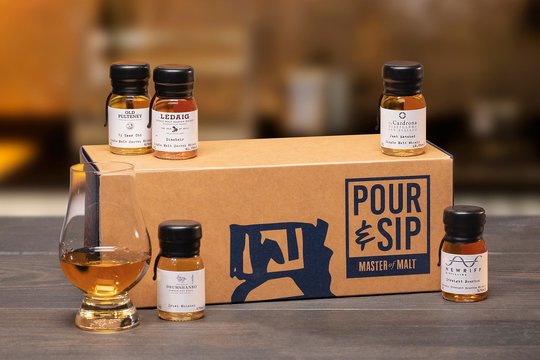
It's incredible just what a huge range of different styles of whisky that are produced all over Scotland. We came up with this tasting set of five 3cl samples to showcase the Regions of Scotland, from the peaty, smoky Islay, to the fruity Highland, the floral Lowlands, the malty, honeyed Speyside malts and more!Contents of the set are subject to change. However, rest assured that whichever dram set you order will include 5 superb drams which will either match or exceed the value of what is listed.Regions of Scotland Whisky Tasting Set- Auchentoshan Three Wood- Glenfarclas 40 Year Old- Caol Ila 12 Year Old- Dalwhinnie 15 Year Old- Springbank 15 Year Old
If you’ve ever wanted to try your hand at blending your own whisky, you’ll love this. We’ve created a whisky blending kit, which contains everything you’ll need to go about making your own whisky. Once you’ve perfected your blend using the whiskies provided, visit our Blend Your Own Whisky page, and input the exact quantities of each whisky you used. You’ll then be able to name your whisky, and even buy a bottle of it! To make a bottle, click here: The whisky blending kit includes the following:- 2x 3cl drams of Single Grain “base whisky”- 2x 3cl drams of Single Malt “base whisky” - 3cl Speyside single malt (sherry matured) - 3cl Highland single malt- 3cl Islay single malt- 3cl Lowland single malt- 3cl Old Highland single malt (sherry finished) - 3cl Old Speyside single malt- 3cl Very, very old Grain whisky- 3cl Very old Islay single maltIt also includes the following equipment to help create your blend: - 3ml pipette- 1ml pipette- 10ml Measuring cylinder- 25ml Measuring cylinder- 100ml Conical Flask- Crystal Tasting GlassWe’re also included a detailed explanatory letter to introduce the art of blending, and how to use the various whiskies and apparatus in the kit!

Speyside is Scotland's most prolific whisky regions, with the vast majority of the country's distilleries. Think honey and malt - that's the style that Speyside is best known for. This set includes five 3cl samples of some of the best whiskies you'll find in Speyside.Contents of the set are subject to change. However, rest assured that whichever dram set you order will include 5 superb drams which will either match or exceed the value of what is listed.Speyside Whisky Tasting Set Contents- Balvenie 17 Year Old Double Wood- Aberlour 18 Year Old- Glenfarclas 21 Year Old- Glendronach Revival 15 Year Old- Tomintoul 21 Year Old
Despite only arriving on the whisky playing field comparatively recently, Japan has some of the very greatest malts in the world. This set of five 3cl samples demonstrates how utterly astonishing some of these whiskies are. Contents of the set are subject to change. However, rest assured that whichever dram set you order will include 5 superb drams which will either match or exceed the value of what is listed.Japanese Whisky Tasting Set Contents- Nikka Taketsuru 17 Year Old- Yamazaki 12 Year Old- Hibiki 17 Year Old- Yoichi 20 Year Old- Hakushu Bourbon Barrel
This is a wonderfully quirky bottling of Invergordon single grain whisky from That Boutique-y Whisky Company. It boasts an illustration of a Coffey still - one of the features of the distillery - though it takes the pronunciation of the name perhaps a little too literally!‘That Boutique-y Whisky Company’ bottles single malts, blended malts and blends from a variety of renowned distilleries. These whiskies are adorned with cultish comic book-style labels.
This is Batch 1, with a release of 252 numbered bottles.
A much sought-after single malt with the massive peat-smoke that's typical of southern Islay - but also offering a dryness that turns it into a truly interesting dram. The 16 year old has become a benchmark Islay dram from the Lagavulin distillery.
What’s all this then? Well my friends – this is possibly the replacement for sliced bread in the ‘Best thing’ stakes.
In this kit, you’ll find a 1 litre (well – one and a bit litres) freshly toasted Kentucky Oak barrel of Medium to heavy char, and 2 x 500ml bottles of new-make spirit (made entirely from Malted Barley).
Directions: Put the new-make into the barrel (using the dinky little stainless steel funnel provided), wait for anywhere between a few days and a few months, and enjoy.
A few pointers:
First – you’ll need to give the tap a good old whack to ‘seat’ it in the barrel. Don’t go nuts and break the barrel, but ‘pushing it in’ isn’t enough.
Second – if the hoops around the barrel feel a bit loose, or there’s a bit of seepage from the cask ends when you fill it, you might want to bung a bit of hot water in before you fill it to help the wood expand and become watertight (liquor-tight?). Barrels are constructed without the use of any glue, and rely on the tension/compression of the staves against the other staves/hoops to keep them watertight.
Third – The fact that these barrels are made from Fresh Oak means that the first fill will be incredibly powerful in terms of Oak influence. You’ll be able to re-use the barrel at least two more times before the oak influence wanes.
Finally – The rate of evaporation from these puppies is quite large. The reason for this is two-fold. Firstly, the surface area to volume ratio of the barrel is very high, and secondly, you’re probably not going to keep it at as low a temperature as you’d find in a warehouse in Scotland. You can probably expect to lose between 3% and 5% per month if you’re keeping them at room temperature.
If you ever find yourself in need of some more new-make, you can simply buy more here.

Johnnie Walker Platinum sits between gold and blue in Walker's extensive range of blends. It carries an 18 year old age statement and comes in a very smart box.
From our Secret Bottlings Series
A smooth, refined blended whisky. Toffee on the nose, and rich brown sugar on the finish.